



Dickimaw Books Blog 
Coming Soon: Alternative History Crime Thriller The Fourth Protectorate 🔗
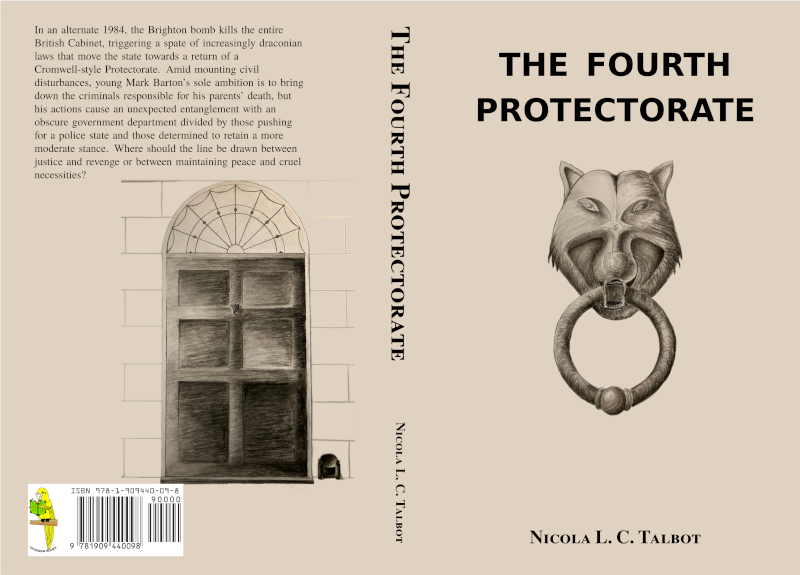
The cover blurb is as follows:
In an alternate 1984, the Brighton bomb kills the entire British Cabinet, triggering a spate of increasingly draconian laws that move the state towards a return of a Cromwell-style Protectorate. Amid mounting civil disturbances, young Mark Barton’s sole ambition is to bring down the criminals responsible for his parents’ death, but his actions cause an unexpected entanglement with an obscure government department divided by those pushing for a police state and those determined to retain a more moderate stance. Where should the line be drawn between justice and revenge or between maintaining peace and cruel necessities?
This novel has been a long time in development and if you have followed any previous posts or announcements that I made on the subject, you may have noticed that the blurb has changed and also the working cover image. I first posted about The Fourth Protectorate on Goodreads in 2016 (reprinted on the Dickimaw Books blog in 2019) and then on Goodreads in 2018 (reprinted on the Dickimaw Books blog in 2019).
Previously the blurb was:
In this alternate history, the 1984 Brighton bomb kills the entire British Cabinet, triggering a spate of increasingly draconian laws that lead to a return of a Cromwell-style Protectorate. Amid mounting civil disturbances, Mark Barton’s sole ambition is to bring down London crime lord Mr Ray and his organisation following the murder of Mark’s parents by Mr Ray’s protection racket. Mark’s actions unwittingly allow the newly emerging Protectorate to firmly establish itself as a police state. Can he undo the damage done and restore democracy?
It was a bit of an epic, charting the rise and fall of a police state with the story spanning from 15th September 1984 to 21st November 1995. As I have mentioned previously, real world events were putting me off working on the novel, but also I had feedback from some friends who said that although they found it enjoyable it was too long to reach the ending. Such friends are invaluable to a writer because if friends find it a slog then there’s definitely a problem.
Anyone who has studied creative writing has probably come across the phrase ‘kill your darlings’. It has been attributed to various authors but Sir Arthur Thomas Quiller-Couch used the phrase ‘murder your darlings’ in his lecture on style in 1914 (On the Art of Writing, Lecture XII): ‘Whenever you feel an impulse to perpetrate a piece of exceptionally fine writing, obey it — whole-heartedly — and delete it before sending your manuscript to press. Murder your darlings.’ It can be hard to prune out paragraphs, scenes or whole chapters that have taken so much effort to write, but sometimes it’s necessary for the good of the story to remove the slow parts that drag.
So last year I decided to do what needed to be done. I cut the story at July 1987 and jettisoned the second half. This meant it needed a new ending, and I set my target of a maximum of two (in-universe) months to provide a resolution. So the novel now spans from September 1984 to September 1987. This should have produced a smaller word count, but that turned out not to be the case. However the action in the new chapters is at a much faster pace, so hopefully it’s no longer a slog. The original cover image was of a white brick wall with ‘Be vigilant report sedition’ stencilled on it but, as that’s related to the deleted part, I’ve replaced it. The Georgian town house is Mr Ray’s house and the headquarters of the Ridlington Street mob, where most of the story is centred. The wolf’s head door knocker is on the front door to that house.
For a while, I thought of this new version as an alternative alternative history with the point of departure from the original version occurring on 21st July 1987, and I considered having echoes of the original alternative timeline but my brother Stephen advised against it. So now I think of this as an alternative history that has a defining moment which avoids the worst parts of what could have happened.
Although the story is set in a different timestream, it closely follows the real world. Many of the news headlines mentioned in the story (apart from those that relate to the fictional characters) are real-world headlines. There were indeed five states of emergency in the UK in the 1970s (due to strikes that threatened food shortages) which resulted in the Three Day Week in 1974 where electricity for commercial users was rationed to three days a week. UK MPs really did vote on whether or not to restore capital punishment in 1987 (although a few months earlier in real life than in the book). There were riots, strikes, hooliganism and acts of terrorism. The story just notches things up a bit.
I was studying for my A Levels from 1986 to 1988. The subjects I chose were an unusual mixture for someone in my generation (as we were expected to fit into exactly one of Sciences, Humanities or Arts): Mathematics, Geography, and Economic and Public Affairs.¹ So I was not only studying maths (which led to the start of my career path) but also politics. Researching that era for the book brought back a lot of memories (although I wouldn’t go so far as to call them nostalgic).
The technology in the alternative timeline is also quite close to the technology of our real 1980s, with one egregious exception. (At least, I certainly hope that particular piece of technology has never been developed.) Acorn enthusiasts might be pleased to discover that the BBC Micro and Acorn Archimedes exist in the alternative timeline. However, one caveat is that I never used the Arthur operating system that came before RISC OS, so if the Archimedes in the story sounds rather like it has RISC OS not Arthur on it, let’s just suppose that some change in the alternative timeline has resulted in a slightly different rate of development.
For those of you who are interested in typesetting, the PDF for the interior of the paperback was created with LuaLaTeX (memoir, lettrine, microtype, fontspec, glossaries-extra). The PDF was then converted into print-ready PDF/X with jmakepdfx (which I now need to finish off and upload the new version to CTAN once the TeX Java Parser Library and TeX Java Help System are sorted). The epub file for the ebook was created with an experimental and currently undocumented feature of one of the command line applications supplied with the TeX Java Help System, which provided a useful way of testing it. (If you’re interested in typesetting a novel, you might want to have a look at the novel class, which is available in both TeX Live and MiKTeX, or the e-book topic on CTAN. I’m not going to recommend my experimental tools.)
If you have been eagerly awaiting the publication of The Fourth Protectorate, I hope you feel it was worth the wait.
Sensitivity warning: The Fourth Protectorate contains strong language, substance abuse, offensive attitudes, homicide, and violence. (Needless to say, I’m not endorsing the behaviour of the antagonists.) Given the book blurb, it’s probably not much of a spoiler to say that violent deaths occur in the first chapter.
I didn’t use AI to create any part of the story — in spite of my liking for em-dashes. (How can a writer develop their ‘voice’ if they don’t themselves chose the words? I’ve seen ads that claim that AI can replicate your own writing style, but you would surely need a substantial amount of your own work to train the model to learn your particular style, in which case you have sufficient experience to not need it.) I did, however, take photos of the sketches for the front and back cover because my A3 sketchbook doesn’t fit on my A4 scanner and, if I understand correctly, smartphones use AI in their camera functions. I don’t know what difference that’s made. (I used GIMP to post-process the images and TikZ to arrange them on the template.)
¹As it happens, there was another student in my year who also studied those same subjects, so I wasn’t a total outlier. Incidentally, my list of A Levels is a good example of a situation where the Oxford Comma provides clarity.
Previous Post
 The third edition of The Private Enemy will be available as from 31st August 2026. A crime/speculative fiction novel set in a technologically regressed future where the Anti-Technology League collide with demands to restore former levels of technology, rival gangsters battle for dominance, and government agencies are determined to reinforce their message that the world is united in peace and prosperity — by any means necessary. Into this mix comes the last of the Coulgranes of Wynherne, hell-bent on revenge.
Recent Posts
 New alternative history crime thriller novel The Fourth Protectorate is due out on 14th November 2026, and will be available as paperback or ebook. In an alternate 1984, the Brighton bomb kills the entire British Cabinet, triggering a spate of increasingly draconian laws that move the state towards a return of a Cromwell-style Protectorate. A small government department, caught in a drive towards a police state, becomes entangled with a London crime mob and a young lad seeking justice.The third edition of The Private Enemy will be available as from 31st August 2026. A crime/speculative fiction novel set in a technologically regressed future where the Anti-Technology League collide with demands to restore former levels of technology, rival gangsters battle for dominance, and government agencies are determined to reinforce their message that the world is united in peace and prosperity — by any means necessary. Into this mix comes the last of the Coulgranes of Wynherne, hell-bent on revenge.
 Within FlowframTk, it’s possible to assign descriptions and tags to objects to make them easier to select and find in a complicated image. This post provides an example.
 The evolution of a vector graphics application inspired by Acorn's !Draw application designed for integration with LaTeX documents, either exporting images as pgf code or exporting document classes or packages that use the flowfram package. The application was originally named JpgfDraw but was then renamed FlowframTk.
 There are a growing number of digital historians who are interested in documenting old computing systems from the twentieth century, but much of the information has been lost and coincident names can make it hard to search. This article is about the RISC OS ARMTeX distribution, which provided TeX and LaTeX for the ARM-powered Acorn computers in the 1990s.
Search Blog
📂 Categories
- Autism
- Books
- Children’s Illustrated Fiction
- Illustrated fiction for young children: The Foolish Hedgehog and Quack, Quack, Quack. Give My Hat Back!
- Creative Writing
- The art of writing fiction, inspiration and themes.
- Crime Fiction
- The crime fiction category covers the crime novels The Private Enemy and The Fourth Protectorate and also the crime short stories I’ve Heard the Mermaid Sing and I’ve Heard the Mermaid Sing.
- Fiction
- Fiction books and other stories.
- Language
- Natural languages including regional dialects.
- (La)TeX
- The TeX typesetting system in general or the LaTeX format in particular.
- Music
- Norfolk
- This category is about the county of Norfolk in East Anglia (the eastern bulgy bit of England). It’s where The Private Enemy is set and is also where the author lives.
- RISC OS
- An operating system created by Acorn Computers in the late 1980s and 1990s.
- Security
- Site
- Information about the Dickimaw Books site.
- Software
- Open source software written by Nicola Talbot, which usually has some connection to (La)TeX.
- Speculative Fiction
- The speculative fiction category includes the novel The Private Enemy (set in the future), the alternative history novel The Fourth Protectorate, and the fantasy novel Muirgealia.
🔖 Tags
- Account
- Alternative History
- Sub-genre of speculative fiction, alternative history is “what if?” fiction.
- book samples
- Bots
- Conservation of Detail
- A part of the creative writing process, conservation of detail essentially means that only significant information should be added to a work of fiction.
- Cookies
- Information about the site cookies.
- Dialect
- Regional dialects, in particular the Norfolk dialect.
- Docker
- Education
- The education system.
- Ex-Cathedra
- A Norfolk-based writing group.
- Fantasy
- Sub-genre of speculative fiction involving magical elements.
- File formats
- FlowframTk
- A vector graphics application written in Java that can export to pgf picture drawing code but can also be used to construct frames for use with the flowfram package. Home page: dickimaw-books.com/software/flowframtk. (FlowframTk was originally called JpgfDraw.)
- Hippochette
- A pochette (pocket violin) with a hippo headpiece.
- History
- I’ve Heard the Mermaid Sing
- A crime fiction short story (available as an ebook) set in the late 1920s on the RMS Aquitania. See the story’s main page for further details.
- Inspirations
- The little things that inspired the author’s stories.
- Linux
- Migration
- Posts about the website migration.
- Muirgealia
- A fantasy novel. See the book’s main page for further details.
- News
- Notifications
- Online Store
- Posts about the Dickimaw Books store.
- Quack, Quack, Quack. Give My Hat Back!
- Information about the illustrated children’s book. See the book’s main page for further details.
- Re-published
- Articles that were previously published elsewhere and reproduced on this blog in order to collect them all together in one place.
- Sale
- Posts about sales that are running or are pending at the time of the post.
- Site settings
- Information about the site settings.
- Smile for the Camera
- A cybercrime short story about CCTV operator monitoring a store’s self-service tills who sees too much information.
- Story creation
- The process of creating stories.
- TeX Live
- The Briefcase
- A crime fiction short story (available as an ebook). See the story’s main page for further details.
- The Foolish Hedgehog
- Information about the illustrated children’s book. See the book’s main page for further details.
- The Fourth Protectorate
- Alternative history novel set in 1980s London. See the book’s main page for further details.
- The Private Enemy
- A crime/speculative fiction novel set in a future Norfolk run by gangsters. See the book’s main page for further details.
- Unsocial Media
- A cybercrime fiction short story (available as an ebook). See the story’s main page for further details.
- World Book Day
- World Book Day (UK and Ireland) is an annual charity event held in the United Kingdom and the Republic of Ireland on the first Thursday in March. It’s a local version of the global UNESCO World Book Day.
- World Homeless Day
- World Homeless Day is marked every year on 10 October to draw attention to the needs of people experiencing homelessness.