



Gallery: glossaries performance
Documents that use the glossaries package can take a long time to build. This page compares the performance of the various methods that can be used with just the base glossaries package and with the extension package glossaries-extra.
If you’re wondering what kind of document would require over 1,000 entries, the bib2gls user manual has over 4,500 entries. The user manual for glossaries-extra v1.49 has over 2,600 entries. Each command and option described in those documents is a glossary entry. If you click on a command it will take you to the relevant place in the document where that command is defined (a “standalone” definition), but you can also look up the command’s summary and syntax in the list in the back matter for a quick reminder or look up the location list in the index (glossaries). Similarly for the options.
The tests described here were compiled with glossaries.sty v4.49, glossaries-extra.sty v1.48 and bib2gls v3.0 (pending at the time of writing). Some of the examples may not work with earlier versions.
The test files were generated using Perl scripts. The first,
mkentries, writes n instances of
\newglossaryentry{entryidx}{name={word,description={sample
idx}}}
to STDOUT, where idx is an
integer (0 to n−1) and word is a randomly
generated word.
#!/usr/bin/perl -w

use strict;
use warnings;
use Data::Random::WordList;
use List::Util qw/shuffle/;

if ($#ARGV != 0)
{
   die "Syntax: $0 <number>\n";
}

my $count = $ARGV[0];

my $wl = new Data::Random::WordList( wordlist => '/usr/share/dict/words');

my @rand_words = shuffle($wl->get_words($count));

$wl->close();

for (my $idx = 0; $idx < $count; $idx++)
{
   my $word = $rand_words[$idx];

   $word=~s/([\\\&#%_\{\}\$])/\\$1/g;

   $word=~s/\^/\\textasciicircum /g;
   $word=~s/\^/\\textasciitilde /g;

   print "\\newglossaryentry{entry$idx}{name={$word},description={sample $idx}}\n";
}

1;
The test file entries-1000.tex was generated using:
mkentries 1000 > entries-1000.tex
The first five lines are:
\newglossaryentry{entry0}{name={silverback},description={sample 0}}
\newglossaryentry{entry1}{name={urbaneness},description={sample 1}}
\newglossaryentry{entry2}{name={twice-taken},description={sample 2}}
\newglossaryentry{entry3}{name={exoskeletal},description={sample 3}}
\newglossaryentry{entry4}{name={Dorsy},description={sample 4}}
There are three entries that start with a hyphen (which can be
found with grep 'name={-' entries-1000.tex):
\newglossaryentry{entry447}{name={-hippus},description={sample 447}}
\newglossaryentry{entry606}{name={-el},description={sample 606}}
\newglossaryentry{entry730}{name={-fuge},description={sample 730}}
The file only contains ASCII characters. This was converted to .bib format for the bib2gls tests using:
convertgls2bib entries-1000.tex entries-1000.bib
The file entries-1000.bib starts with:
% Encoding: UTF-8
@entry{entry0,
  name = {silverback},
  description = {sample 0}
}

@entry{entry1,
  name = {urbaneness},
  description = {sample 1}
}

@entry{entry2,
  name = {twice-taken},
  description = {sample 2}
}

@entry{entry3,
  name = {exoskeletal},
  description = {sample 3}
}

@entry{entry4,
  name = {Dorsy},
  description = {sample 4}
}
The encoding line identifies the file as UTF-8, although it only contains ASCII characters. (This isn’t a problem as ASCII is a subset of Unicode.)
There’s a similar Perl script, mkabbreviations, to create random abbreviations:
#!/usr/bin/perl -w

use strict;
use warnings;
use Data::Random::WordList;
use List::Util qw/shuffle/;

if ($#ARGV != 0)
{
   die "Syntax: $0 <number>\n";
}

my $count = $ARGV[0];

my $wl = new Data::Random::WordList( wordlist => '/usr/share/dict/words');

my @rand_words = shuffle($wl->get_words(3*$count));

$wl->close();

my $wordidx = 0;

for (my $idx = 0; $idx < $count; $idx++)
{
   my $word1 = $rand_words[$wordidx++];
   my $word2 = $rand_words[$wordidx++];
   my $word3 = $rand_words[$wordidx++];

   my $word = "$word1 $word2 $word3";

   my $abbreviation = uc(substr $word1, 0, 1).uc(substr $word2, 0, 1).uc(substr $word3, 0, 1);

   $word=~s/([\\\&#%_\{\}\$])/\\$1/g;
   $abbreviation=~s/([\\\&#%_\{\}\$])/\\$1/g;

   $word=~s/\^/\\textasciicircum /g;
   $abbreviation=~s/\^/\\textasciicircum /g;
   $word=~s/\^/\\textasciitilde /g;
   $abbreviation=~s/\^/\\textasciitilde /g;

   print "\\newacronym{abbrv$idx}{$abbreviation}{$word}\n";
}

1;
The file acronyms-1000.tex was created using:
./mkabbreviations 1000 > acronyms-1000.tex
The file starts:
\newacronym{abbrv0}{CMO}{Cuyab mercurialism oversaturates}
\newacronym{abbrv1}{BAJ}{bemoaningly aburban jackassism}
\newacronym{abbrv2}{RHS}{rend horsts stormward}
\newacronym{abbrv3}{IFS}{intercommon foliocellosis scription}
\newacronym{abbrv4}{OCP}{otter Celanese powderize}
The file abbreviations-1000.tex is a copy of
acronyms-1000.tex with \newacronym replaced
with \newabbreviation. The file starts:
\newabbreviation{abbrv0}{CMO}{Cuyab mercurialism oversaturates}
\newabbreviation{abbrv1}{BAJ}{bemoaningly aburban jackassism}
\newabbreviation{abbrv2}{RHS}{rend horsts stormward}
\newabbreviation{abbrv3}{IFS}{intercommon foliocellosis scription}
\newabbreviation{abbrv4}{OCP}{otter Celanese powderize}
The file abbreviations-1000.tex was converted to abbreviations-1000.bib using:
convertgls2bib abbreviations-1000.tex abbreviations-1000.bib
The first few entries are:
% Encoding: UTF-8
@abbreviation{abbrv0,
  short = {CMO},
  long = {Cuyab mercurialism oversaturates}
}

@abbreviation{abbrv1,
  short = {BAJ},
  long = {bemoaningly aburban jackassism}
}

@abbreviation{abbrv2,
  short = {RHS},
  long = {rend horsts stormward}
}

@abbreviation{abbrv3,
  short = {IFS},
  long = {intercommon foliocellosis scription}
}

@abbreviation{abbrv4,
  short = {OCP},
  long = {otter Celanese powderize}
}
To test UTF-8 support, entries-1000.tex was copied and the first few entries were changed to words starting with UTF-8 characters. This file was saved as entries-utf8-1000.tex. The first few lines are:
\newglossaryentry{entry0}{name={Øresund},description={sample 0}}
\newglossaryentry{entry1}{name={Þríhyrningsvatn},description={sample 1}}
\newglossaryentry{entry2}{name={Ängelholm},description={sample 2}}
\newglossaryentry{entry3}{name={ætherial},description={sample 3}}
\newglossaryentry{entry4}{name={œsophagus},description={sample 4}}
\newglossaryentry{entry5}{name={Łobez},description={sample 5}}
\newglossaryentry{entry6}{name={Ćmielów},description={sample 6}}
\newglossaryentry{entry7}{name={Żelechów},description={sample 7}}
\newglossaryentry{entry8}{name={Ångström},description={sample 8}}
The remaining lines are unchanged. This file was converted to entries-utf8-1000.bib using:
convertgls2bib entries-utf8-1000.tex entries-utf8-1000.bib
For the symbol examples, the file
greek.tex contains
Greek symbols defined (indirectly) with \newglossaryentry.
The first few lines provide some commands definitions:
\providecommand{\Beta}{B}
\providecommand{\Digamma}{F}
\providecommand{\Eta}{H}
\providecommand{\omicron}{o}
\providecommand{\Omicron}{O}
\providecommand{\Kappa}{K}
\providecommand{\mtx}[1]{\mathbf{#1}}
This provides math-greek commands missing from the LaTeX kernel
(\Beta, \Omicron, etc) and also a semantic
command to format symbols representing matrices (\mtx).
You may prefer different definitions for these commands, such as
\providecommand{\Kappa}{\mathrm{K}}
\providecommand{\mtx}[1]{\pmb{#1}}
Such minor font modifications are irrelevant to the tests performed
here (as long as the changes are within these custom commands and
aren’t added to the name field). The
glossaries-extra-bib2gls package (provided with
glossaries-extra v1.27+ and automatically loaded by the
record option) provides the missing math-greek commands
using \providecommand, so those definitions can be used
instead if that package has been loaded.
There’s also a convenient command
\newsymbol{label}{symbol}{description}{topic}
used to define each symbol.
\providecommand{\newsymbol}[4]{%
 \newglossaryentry{#1}{name={#2},description={#3},user1={#4}}%
}
For example:
\newsymbol{alpha}{\ensuremath{\alpha}}{angular acceleration}{physics}

\newsymbol{beta}{\ensuremath{\beta}}{thermodynamic beta}{statistical mechanics}

\newsymbol{Beta}{\ensuremath{\Beta(x,y)}}{Euler beta function}{functions}
The \sortart command, defined as
\providecommand{\sortart}[2]{#1 #2}
is used in descriptions that start with an article (‘the’, ‘a’, ‘an’). For example:
\newsymbol{lambda}{\ensuremath{\lambda}}{\sortart{an}{eigenvalue}}{linear algebra}
The equivalent bib2gls file can be obtained using:
convertgls2bib greek.tex greek.bib
This creates the file greek.bib containing
@entry definitions (convertgls2bib is able to
parse the provided definition of \newsymbol). This just
needs to have the custom commands added in @preamble, but I
made some extra modifications for convenience:
the user1 field was converted to a custom
topic field using a global search and replace
(s/user1/topic), and all instances of @entry
were replaced with @symbol (s/@entry/@symbol).
After these edits, the file greek.bib starts with:
% Encoding: UTF-8

@preamble{"\providecommand{\Beta}{B}
\providecommand{\Digamma}{F}
\providecommand{\Eta}{H}
\providecommand{\omicron}{o}
\providecommand{\Omicron}{O}
\providecommand{\mtx}[1]{\mathbf{#1}}
\providecommand{\sortart}[2]{#1 #2}"}

@symbol{alpha,
  topic = {physics},
  name = {\ensuremath{\alpha}},
  description = {angular acceleration}
}

@symbol{beta,
  topic = {statistical mechanics},
  name = {\ensuremath{\beta}},
  description = {thermodynamic beta}
}

@symbol{Beta,
  topic = {functions},
  name = {\ensuremath{\Beta(x,y)}},
  description = {Euler beta function}
}
The custom topic field will be ignored by
bib2gls unless defined or aliased. The math-greek commands
may be omitted from @preamble when the document is
compiled with glossaries-extra v1.27+ as they’re
provided by glossaries-extra-bib2gls. Since
\providecommand is used, these definitions will be
ignored if the example documents here are built with
glossaries-extra v1.27+.
The cross-reference examples use the file xrentries.tex which was created by a slightly modified Perl script (mkxrentries) adapted from mkentries:
#!/usr/bin/perl -w

use strict;
use warnings;
use Data::Random::WordList;
use List::Util qw/shuffle/;

if ($#ARGV != 0)
{
   die "Syntax: $0 <number>\n";
}

my $count = $ARGV[0];

my $wl = new Data::Random::WordList( wordlist => '/usr/share/dict/words');

my @rand_words = shuffle($wl->get_words($count));

$wl->close();

for (my $idx = 0; $idx < $count; $idx++)
{
   my $word = $rand_words[$idx];

   $word=~s/([\\\&#%_\{\}\$])/\\$1/g;

   $word=~s/\^/\\textasciicircum /g;
   $word=~s/\^/\\textasciitilde /g;

   my $desc = "sample $idx";

   if ($idx%4 == 3)
   {
      my $rand_idx = int(rand($idx));

      $desc .= " ref \\gls{xrentry$rand_idx}";
   }

   print "\\newglossaryentry{xrentry$idx}{name={$word},description={$desc}}\n";
}

1;
This adds a cross-reference in the description field every fourth
entry. The file xrentries.tex
was then created with:
mkxrentries 6000 > xrentries.texNote that I haven’t used the
see field, as this would
automatically trigger indexing and is therefore inappropriate for
large files that contain entries that may not be required (unless
you are using bib2gls, which has a
different way of dealing with the cross-reference fields).
The bib2gls cross-reference examples require the corresponding file xrentries.bib which was created with:
convertgls2bib xrentries.tex xrentries.bib
Each document (that can be fully compiled) has an associated bash
script (called builddoc1 etc) to perform the complete build
so that the process can be timed using the GNU time
command.
For example, the script builddoc1a contains:
#!/usr/bin/bash

pdflatex -jobname test-doc1a test-doc1
makeglossaries-lite test-doc1a
pdflatex -jobname test-doc1a test-doc1
(The documents that can’t compile without error aren’t timed.)
For simplicity, the build processes listed in each test below omits
-jobname and the hash bang line.
The bash script that times all the test documents is simply:
#!/usr/bin/bash

function build
{
  filename=$1

  /usr/bin/time -f "$filename:\t%e\t%E" --append --output=$logfile $filename  || exit $?
}

logfile='runtest.log'

rm -f $logfile
touch $logfile

bib2gls --version || exit $?
xindy --version || exit $?

rm -f test-*.{pdf,aux,log,ist,xdy,gls,glo,glg,acr,acn,alg,gls-abr,glo-abr,glg-abr,glstex}

for file in builddoc*; do
 [ -e "$file" ] || continue
 build $file
done
This creates a file called runtest.log that contains all the build times shown in this page. (The tests were run on a 64 bit Linux machine with TeX Live 2021.) The temporary files are all removed (if present) before running the tests, so the build times listed here are for the first complete build. If a document is modified, the subsequent build time may change as information from the temporary files created by the previous build is now available on the first LaTeX call of the new build.
The initial bib2gls --version call ensures that
bib2gls and Java are correctly installed before running the
tests. Additionally, the first instance of a Java application always
takes slightly longer than subsequent calls, which would cause
unpredictable results for the first bib2gls test depending
on whether the tests were run before or after any other document
builds performed since logging in.
Similarly the The first set of tests order the entries alphabetically.
All entries are selected (using
The glossaries-extra extension package increases the build
time fractionally, but it’s so small that it can be outweighed by
minor fluctuations in processing times if the tests are rerun.
The fastest method is with makeindex. For the
makeindex methods (using makeglossaries), the document build time is approximately
3 seconds for regular
entries (entries-1000.tex;
Test 1.1,
0:02.91),
3.5 seconds for regular
entries with glossaries-extra (entries-1000.tex;
Test 1.9, 0:03.55),
4 seconds–5 seconds for acronyms
(acronyms-1000.tex; Test 1.13,
0:04.91, and Test 1.14,
0:04.21), and
7 seconds for
acronyms with glossaries-extra (acronyms-1000.tex;
Test 1.19, 0:07.30) and
6.5 seconds for abbreviations with
glossaries-extra (abbreviations-1000.tex;
Test 1.20, 0:06.62).
The second fastest method is with bib2gls (which requires
glossaries-extra.sty) taking approximately
4 seconds for the regular entries
(entries-1000.bib;
Test 1.12,
0:03.79) and approximately 5 seconds for
the abbreviations (abbreviations-1000.bib;
Test 1.23, 0:05.24).
The third fastest method is using xindy
taking approximately
4 seconds for the regular entries
(entries-1000.tex; Test 1.5,
0:04.33),
5 seconds for regular entries with
glossaries-extra (entries-1000.tex;
Test 1.10, 0:05.04),
5.5 seconds for acronyms
(acronyms-1000.tex;
Test 1.16,
0:05.53), and
8 seconds for abbreviations with
glossaries-extra (abbreviations-1000.tex;
Test 1.21, 0:07.81).
There isn’t a great deal of difference in the build times for
makeindex, xindy and bib2gls (just a
matter of seconds). The slowest method by far is using TeX to sort
and collate (
Note that with just the base glossaries.sty package, it’s
marginally faster to use the newer acronym implementation triggered with
This example uses the test file entries-1000.tex. The
document code is:
The document build (builddoc1) is:
The total build time was 0:02.91
(PDF).
This example uses the same document as in
Test 1.1
but the build process uses the makeglossaries-lite Lua
script instead of the makeglossaries Perl script: The total build time was 0:02.85
(PDF).
This example uses the
The document build is just
The total build time was 0:02.93
(PDF).
This example uses the same document as in
Test 1.1
but the build process calls makeindex directly:
The total build time was 0:02.83
(PDF).
This example uses xindy instead. There’s just a minor
modification to the document code (the package option
The build process uses the makeglossaries Perl script to
call xindy:
The total build time was 0:04.33
(PDF).
This example uses the same document as in
Test 1.5
but the build process uses the makeglossaries-lite Lua
script instead of the makeglossaries Perl script: The total build time was 0:04.34
(PDF).
This example uses the same document as in
Test 1.5
but the build process calls xindy directly:
The total build time was 0:04.36
(PDF).
This example uses TeX to sort and collate. The document code is now:
The build process does require any external tools:
The total build time was 11:04.64
(PDF).
This example is like Test 1.1 but loads the
extension package glossaries-extra. The extra build time
comes from the additional code provided by the extension package.
(Remember that glossaries-extra automatically loads
glossaries, so there’s the load time from
glossaries plus the load time from
glossaries-extra and the additional time to process the
extra hooks etc.)
The document code only needs a minor modification
(the required package):
The document build uses makeglossaries:
The total build time was 0:03.55
(PDF).
Compared with the build time of 0:02.91
from Test 1.1,
the extra resources from loading
glossaries-extra.sty add less than a second to the
total document build time.
This example uses xindy instead. There’s just a minor
modification to the document code (the package option
The build process uses the makeglossaries Perl script to
call xindy:
The total build time was 0:05.04
(PDF).
This example uses TeX to sort and collate. The document code is now:
The build process does require any external tools:
The total build time was 11:04.58
(PDF).
This example uses bib2gls, which can only be used with the
extension package glossaries-extra. The document is
slightly different:
The document build is:
The total build time was 0:03.79
(PDF).
Unlike the previous examples, the list has no locations as there are
no records. With the other methods,
This example uses the test file acronyms-1000.tex. The
document code is:
The document build is:
The total build time was 0:04.91
(PDF).
This is a minor modification to the previous test that sets
the The document build is:
The total build time was 0:04.21
(PDF).
This example is like Test 1.13 but uses
xindy instead of makeindex:
The document build is:
The total build time was 0:06.23
(PDF).
This example is like Test 1.14 but uses
xindy instead of makeindex:
The document build is:
The total build time was 0:05.53
(PDF).
This example is like Test 1.13 but uses
TeX to sort and collate:
The document build is:
The total build time was 10:45.19
(PDF).
This example is like Test 1.17 but uses
The document build is:
The total build time was 10:45.80
(PDF).
This uses glossaries-extra and acronyms-1000.tex.
Since the abbreviations are defined using The document build is:
The total build time was 0:07.30
(PDF).
This uses glossaries-extra and
abbreviations-1000.tex. Since the terms are now
defined using The document build is:
The total build time was 0:06.62
(PDF).
This is fractionally shorter than the previous test (0:07.30), which used
This example is like Test 1.20 but uses
xindy instead of makeindex:
The document build is:
The total build time was 0:07.81
(PDF).
This example is like Test 1.20 but uses
TeX to sort and collate:
The document build is:
The total build time was 10:49.93
(PDF).
This example is like Test 1.20 but uses
bib2gls and abbreviations-1000.bib:
The document build is:
The total build time was 0:05.24
(PDF).
These tests are much like the above but they compare the build time
associated with group formation in the glossary. To simplify the
comparisons, only the regular entries (ASCII entries-1000.tex or
entries-1000.bib and UTF-8 entries-utf8-1000.tex
or entries-utf8-1000.bib) are compared with the The Note that makeindex isn’t designed for UTF-8 and the
document in Test 2.5 fails to compile as a result.
For the ASCII tests, makeindex is still the fastest with a
build time of approximately 3 seconds.
The second fastest method is bib2gls with a build time
of approximately 4 seconds.
The third fastest method is xindy with a build
time of approximately 4 seconds.
The slowest method is again using TeX to sort
( Overall, the difference in build time introduced by adding the
group skips and group headings is insignificant compared to the
total build.
This test is like Test 1.1 but it sets the
The document build is:
The total build time was 0:02.81
(PDF).
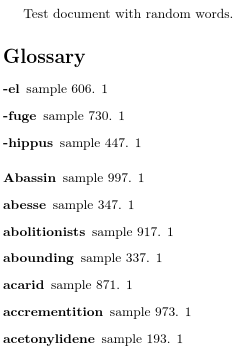
The entries starting with a hyphen are listed first followed
immediately by the ‘A’ group:
There are no gaps between the letter groups.
This test is like Test 2.1 but it doesn’t use
The document build is:
The total build time was 0:02.79
(PDF).
The entries starting with a hyphen are listed first followed by a
vertical gap separating them from the ‘A’ letter group:
Abassin sample 997. 1
This test is like Test 2.2 but it uses the
The document build is:
The total build time was 0:02.84
(PDF).
The entries starting with a hyphen have the group title ‘Symbols’.
The remaining letter groups all have the corresponding upper case letter as the
title.
This test is like Test 2.2 but it uses the
UTF-8 test file entries-utf8-1000.tex:
Note that the document requires UTF-8 support.
The document build is:
The total build time was 0:02.83
(PDF).
As with the previous two tests, the words starting with a hyphen are
listed at the start.
The words starting with extended characters are in three groups after ‘Z’:
Ćmielów sample 6. 1
Łobez sample 5. 1 This is due to makeindex not supporting UTF-8. The
sorting is performed according to the character octets. Ä (0xC3
0x84), Å (0xC3 0x85), Ø (0xC3 0x98), Þ (0xC3 0x9E) and æ (0xC3 0xA6)
all start with the octet 0xC3, which makeindex treats as
the letter group. Similarly Ć (0xC4 0x86) is treated as belonging to the 0xC4
letter group, and Ł (0xC5 0x81), œ (0xC5 0x93) and Ż (0xC5 0xBB) are
treated as belonging to the 0xC5 letter group.
makeindex is only appropriate for ASCII sort keys.
While it may be able to handle Latin-1, it doesn’t recognise
alphabets (which vary according to language).
This test is like Test 2.4 but it uses the
The document build in theory is:
The build fails on the second This is due to makeindex treating a single UTF-8
character as two octets. The first octet is written to the group
heading command, which LaTeX can’t parse as it’s invalid. (The
inputenc package makes this octet active as part of its
UTF-8 support. It expects the second octet, which is used as an
argument.) Even if the document was modified to use
fontspec and XeLaTeX or LuaLaTeX the build will still fail
as the code created by makeindex is corrupt. (It’s still
corrupt in the previous test, but it’s not noticed by the
non-Unicode LaTeX engine.)
This test is like Test 2.1 but it uses
xindy:
The build process is:
The total build time was 0:04.31
(PDF).
The sort method ignores hyphens, so ‘-el’ is listed between
‘efs’ and ‘Elaeis’, ‘-fuge’ is listed between ‘frutage’ and
‘full-roed’, and ‘-hippus’ is listed between
‘hinderers’ and ‘hirst’.
This test is like Test 2.2 but it uses
xindy:
The build process is:
The total build time was 0:04.30
(PDF).
The ordering is the same as the previous test but there are vertical
gaps between the letter groups.
This test is like Test 2.7 but it uses the
The build process is:
The total build time was 0:04.28.
(PDF).
Again the hyphens are ignored during the sorting. There are only
alphabetical letter groups (no symbol group), with each group headed
by the corresponding upper case letter.
This test is like Test 2.7 but it uses the
UTF-8 file entries-utf8-1000.tex:
The build process is:
The total build time was 0:04.33
(PDF).
This performs much better than makeindex. The document
doesn’t use any language packages, so makeglossaries calls
xindy using the options:
This doesn’t recognise the characters Ć, Ł and Ż as letters,
according to xindy’s English rule, so the words starting
with these characters are placed at the start, before the ‘A’ letter
group:
The thorn (Þ) letter group is placed after ‘Z’ on the last page.
The entries starting with Ä and Å are placed in the ‘O’ letter
group:
These characters typically don’t occur in English words, but proper
names like Ängelholm and Ångström would normally be placed in the
‘A’ letter group for documents written in English. A different ordering
is obtained with different language modules. For example:
This test is like Test 2.9 but it uses the
The build process is:
The total build time was 0:04.32
(PDF).
The unrecognised characters Ć, Ł and Ż are in the group headed
‘default’, but the thorn (Þ) letter group is correctly headed.
This test is like Test 2.1 but it uses
TeX to perform the sorting:
The build process is:
The total build time was 11:04.81
(PDF).
The glossary starts with the entries that have an initial hyphen
followed by the ‘A’ letter group (with no gap):
This test is like Test 2.2 but it uses
TeX to perform the sorting:
The build process is:
The total build time was 11:01.93
(PDF).
The glossary starts with the entries that have an initial hyphen
followed by a vertical gap separating them from the ‘A’ letter
group:
Abassin sample 997. 1
This test is like Test 2.12 but it uses
the The build process is:
The total build time was 11:02.35
(PDF).
The entries with the initial hyphen have the group label ‘Symbols’.
This test is like Test 2.12 but it uses
the UTF-8 test file entries-utf8-1000.tex:
The build process is:
The total build time was 11:10.91
(PDF).
The accented characters were sorted according to the unaccented
version, so ‘Ängelholm’ is listed between ‘anesthetizing’ and
‘angelologic’. The æ ligature is treated as ‘ae’ and the
œ ligature is treated as ‘oe’, so
‘ætherial’ is listed between ‘aeropulse’ and ‘aftercrop’,
and ‘œsophagus’ is listed between ‘ochidore’ and ‘of-fact’.
This method is not language-sensitive.
This test is like Test 2.14 but it uses
the The build process is:
The total build time was 11:07.92
(PDF).
The letter group headings are as for
Test 2.13.
This example is like Test 2.2 but it uses
bib2gls, which means that glossaries-extra.sty is
required. The document suppresses the loading of all style packages
with The build process is:
The total build time was 0:03.60
(PDF).
Unlike the earlier tests with As with xindy the hyphens are ignored when sorting, so
again ‘-el’ is listed between ‘efs’ and ‘Elaeis’, ‘-fuge’ is listed
between ‘frutage’ and ‘full-roed’, and ‘-hippus’ is listed between
‘hinderers’ and ‘hirst’.
This uses the same document as
Test 2.16 but
calls bib2gls with The total build time was 0:03.75
(PDF).
The document now has a vertical gap (but no title) between letter groups.
This is like Test 2.17 but it uses the
The document build is:
The total build time was 0:03.77
(PDF).
Each group is now headed with the corresponding upper case letter.
This is like Test 2.17 but it uses the UTF-8
test file entries-utf8-1000.bib:
The document build is:
The total build time was 0:03.89
(PDF).
Since no Different ordering can be obtained using different
locales, for example:
Alternatively, you can provide a custom rule or use a different
sort method.
This is like Test 2.19 but it uses the
The document build is:
The total build time was 0:03.80
(PDF).
The ordering is the same as for Test 2.19. The
miscellaneous group at the end is assigned a title taken from the
first entry in that group. The other groups are all headed with the
corresponding upper case letter.
The example documents in this section test the indexing
capabilities. Only a sub-set of the 1000 entries are used in the
document. The first 20 entries are referenced twice on page 1, the
first 10 are referenced on page 2, the first 5 are
referenced on page 3, the first 3 are referenced on page 4,
the first 2 are referenced on page 5, and finally the first 20 are
again referenced on page 6. Similarly for the acronyms/abbreviations.
This tests the indexing method’s ability to collate locations, and
compares the efficiency of maintaining a large file containing many
accumulated terms that may not be required.
A second set of tests omit the location list for comparison.
This is done through the For convenience, a test command is defined in all the example
documents:
This does The document build times are summarised in Table 3. The fastest method is now with
bib2gls, where the build time is under
2.5 seconds.
The next fastest methods, both with build times of around
5.5 seconds, are using TeX
( The slowest method is with xindy, where the build time
is approximately 7.5 seconds.
The reason for the significant improvement with bib2gls,
overtaking makeindex, is due to bib2gls only
writing the definitions of the entries that are actually required in
the document (20 instances of So, in these examples, the second LaTeX call is performing only 20
instances of Therefore, although bib2gls has to parse all 1000
instances of
This example uses makeindex (via makeglossaries).
The The document build is:
The total build time was 0:05.84
(PDF).
This example is like Test 3.1 but uses
xindy instead.
The document build is:
The total build time was 0:07.65
(PDF).
This example is like Test 3.1 but uses
TeX to sort and collate.
The document build is:
The total build time was 0:05.64
(PDF).
This example is like Test 3.1 but uses
bib2gls, which means using glossaries-extra.sty
and the test files entries-1000.bib and
abbreviations-1000.bib. The glossaries-extra
package defaults to the The document build is:
The total build time was 0:02.57
(PDF).
This example is like Test 3.1 but the location
list is suppressed with The document build is:
The total build time was 0:05.89
(PDF).
This example is like Test 3.2 but the location
list is suppressed with The document build is:
The total build time was 0:07.64
(PDF).
This example is like Test 3.3
but the location list is suppressed with The document build is:
The total build time was 0:05.63
(PDF).
This example is like Test 3.4 but the location
list is suppressed with The document build is:
The total build time was 0:02.57
(PDF).
This example is like Test 3.8
but the locations are omitted with The document build is:
The total build time was 0:02.62
(PDF).
The example documents in this section all test the build time for
all entries sorted according to definition. In this case, the presence of
UTF-8 characters is irrelevant as they don’t contribute to the sort
order, so the tests here are only with the regular ASCII entries
(entries-1000.tex or entries-1000.bib).
With is equivalent to:
If you explicitly use the
For ease of comparison, the closest matching results from
Table 1 are reproduced at the end of
Table 4. There’s no equivalent to
Test 4.4 in the earlier sections, as that
method can only be used when all defined entries need to be listed
in order of definition (regardless of whether or not the entries
have been used in the document).
The fastest (around 2 seconds) is
Test 4.4, which also benefits
from having the simplest document build (only one LaTeX call is
required). The other methods are all faster than the corresponding
alphabetical sort method. The most significant is
Test 4.3 (
This example is like Test 1.1
but it uses the The document build is:
The total build time was 0:02.91
(PDF).
(Compared with the build time of 0:02.91 for
Test 1.1.)
This example is like Test 1.5 but it uses the
The document build is:
The total build time was 0:04.36
(PDF).
(Compared with the build time of 0:04.33 for
Test 1.5.)
This example is like Test 1.8 but it uses the
The document build is:
The total build time was 0:03.58
(PDF).
(Compared with the build time of 11:04.64 for
Test 1.8.)
There’s no direct equivalent to this test in Section 1.
This method uses glossaries-extra.sty with the package
option The The total build time was 0:01.93
(PDF).
This example is like Test 1.12 but it uses the
The document build is:
The total build time was 0:03.45
(PDF).
(Compared with the build time of 0:03.79 for
Test 1.12.)
The For comparison purposes, these tests are modifications of the
documents from Section 3, which only index
20 entries and 20 abbreviations. The closest matching results from
Table 3 are reproduced at the end of
Table 5. The loop used in the test command is
reversed so that the entries aren’t indexed in the order of
definition:
As with ordering by definition, both As in Section 3 (and for similar reasons),
the fastest method is bib2gls with a build time of around
2.5 seconds. The second fastest is using TeX
(
This example is like Test 3.1 except that it
uses the The document build is:
The total build time was 0:05.64
(PDF).
(Compared with the build time of 0:05.84 for
Test 3.1.)
This example is like Test 3.2 except that it
uses the The document build is:
The total build time was 0:06.27
(PDF).
(Compared with the build time of 0:07.65 for
Test 3.2.)
This example is like Test 3.3
except that it uses the The document build is:
The total build time was 0:05.41
(PDF).
(Compared with the build time of 0:05.64 for
Test 3.3.)
This example is like Test 3.4 except that it
uses the The document build is:
Note that there’s no concept of a letter group with
While minimizing the overall document build time is desirable, a sensible
ordering of entries is also important. However symbols can be problematic for
some of the sorting methods. The examples in this section use either greek.tex or greek.bib. Each entry is referenced in
the document (with This file can then simply be included in the document using:
Each indexing method is tested in its ability to sort the
entries according to the For comparison, each method is also ordered by definition
and by first use in the document. Unsurprisingly there’s no
difference in the resulting order, respectively, across the
different methods for each of these two cases, but the build time
varies.
The sort by label method is quite straight-forward as all
methods in this case are comparing simple ASCII text. There’s a
slight difference in order with In the case of ordering by the The advantage with bib2gls is that it is able to convert
commands like The second bib2gls test for sort by Sometimes there’s no agreed ordering of symbols. In the examples
in this section, the Greek alphabet is the obvious order, but for more general
symbols, it’s sometimes useful to be able to order by the
Phrases and compound words cause a problem for
One of the descriptions contains a word with an extended Latin character
(Möbius), which causes a problem for makeindex. The best
results for ordering by description is with xindy and
bib2gls, although bib2gls orders an apostrophe
before a word break so ‘Riemann’s’ comes before ‘Riemann’. (It’s
easy enough to switch this order with the setting
Ordering by topic again involves just a simple ASCII
comparison, and again The hierarchical tests programmatically create a parent entry
from the topic. This is possible due to the topic value (stored in
the
(The use of geometry is simply to fit the entire
document onto a single page for convenience, although a few of the
later tests extend to two pages.)
The document build process is:
The total build time was 0:01.26
(PDF).
The resulting list of symbols is in the following order:
The reason for this order is due to makeindex not
recognising LaTeX commands. So, for example,
Note that the sorting is now case-sensitive: makeindex
recognises three types of entry: words (which start with an
alphabetic character), numbers (solely contains the digits 0, …, 9)
and symbols (everything else). Words are sorted according to a
case-insensitive string comparator, numbers are sorted numerically
and symbols are sorted according to a case-sensitive string
comparator. Therefore The symbols representing matrices ( It’s mostly a fairly reasonable order and shows the advantage of
providing the missing Greek commands like This defines This new definition of The document build process is:
The total build time was 0:01.23
(PDF).
The resulting order is now:
𝛣(x, y) Euler beta function. 1
𝜒 chromatic number. 1
𝛥 Laplace operator. 1
𝜖 small positive quantity. 1
𝛤(n) gamma function. 1
𝜄 inclusion map. 1
𝛫 Kappa number. 1
𝚲 diagonal matrix of eigenvalues. 1
𝜇(n) Möbius function. 1
𝜈 kinematic viscosity. 1
𝛺 the omega constant. 1
𝛷 magnetic flux. 1
𝜌 density. 1
𝚺 covariance matrix. 1
𝜏 torque. 1
𝛶 upsilon meson. 1
𝜛 angular frequency. 1
𝛯 Riemann’s original xi-function. 1
𝜁(s) Riemann zeta function. 1
Note that in this example the document extends beyond one page as the list is
now separated into letter groups (some of which only contain one or
two terms). If the Test 6.2 shows the advantage of defining a command
like The entries containing is now equivalent to:
The There are two potential pitfalls here: the description may contain fragile
commands (which would need protecting) and a long sort value can
exceed makeindex’s buffer. Fortunately, neither of these
problems occur with this example. Note that the description for
This means that the sort value will be just ‘statistical model
parameter’ so it’s placed in the ‘S’ letter group. If
The complete document code is:
The document build process is:
The total build time was 0:01.24
(PDF).
The list of symbols is now ordered as follows:
𝛰 big O notation. 1
𝜒 chromatic number. 1
𝜌 density. 1
𝜆 an eigenvalue. 1
𝜗(x) first Chebyshev function. 1
𝛤(n) gamma function. 1
𝜄 inclusion map. 1
𝛫 Kappa number. 1
𝛥 Laplace operator. 1
𝜇(n) Möbius function. 1
𝛺 the omega constant. 1
𝜓(m)(z) polygamma function. 1
𝜂 refractive index. 1
𝜊 small o notation. 1
𝛽 thermodynamic beta. 1
𝛶 upsilon meson. 1
𝜃⃗ the vector of statistic model parameters. 1
𝛹 water potential. 1
Note the odd ordering of ‘Möbius function’ and ‘magnetic flux’.
Both sort values start with the same letter (ignoring
case), so the order is based on the next letter, but one
of the terms has an extended Latin character as the second letter,
which makeindex interprets as two characters (obtained from
the two octets of the UTF-8 character). Instead of comparing ‘ö’
with ‘a’, makeindex is comparing the non-letter 0xC3 (the
first octet of ö) with the letter ‘a’.
The topic argument hasn’t been needed so far. This example
modifies Test 6.3 so that the sort value is formed from
topic, description:
The document build process is:
The total build time was 0:01.24
(PDF).
The list of symbols is now ordered as follows:
𝛱 osmotic pressure. 1
𝛳 Theta decay. 1
𝜋 Archimedes’ constant. 1
𝚲 diagonal matrix of eigenvalues. 1
𝜏 torque. 1
𝛥 Laplace operator. 1
𝛼 angular acceleration. 1
𝜌 density. 1
𝜄 inclusion map. 1 The default group skip creates odd blocks. The topics
‘finance’, ‘functions’ and ‘fluid dynamics’ all belong to the ‘F’
letter group, so they are clumped together. Similarly ’geometry’ and
‘graph theory’ belong to the ‘G’ letter group, and ‘set theory’,
‘statistical mechanics’ and ‘statistics’ belong to the ‘S’ letter
group.
The UTF-8 character no longer causes a problem as the sort values
for ‘Möbius function’ and ‘magnetic flux’ are now ‘functions, Möbius function’
and ‘physics, magnetic flux’.
This example modifies Test 6.4 to improve
the grouping. This takes advantage of the fact that all the topics
in the example don’t contain any non-expandable or fragile commands.
This means that the topic argument may be used as a label. The
The use of The document build process is:
The total build time was 0:01.28
(PDF).
The list of symbols is now ordered as follows:
biology
finance
geometry
linear algebra
mechanics
operators
physics
quantities
set theory
Again, the default group skip option creates an odd effect,
although it’s less jarring now that the topics are visible in
the list.
This example is like Test 6.1 but lists
symbols according to the order of definition:
The document build process is:
The total build time was 0:01.24
(PDF).
The resulting list of symbols is in the following order:
This ordering is quite reasonable, but only because I happened to
define the symbols in a reasonable order.
This example is like Test 6.6 but lists
symbols according to the order of use:
The document build process is:
The total build time was 0:01.24
(PDF).
The resulting list of symbols is in the following order:
The document build process should be:
However, xindy fails in this case. The actual
xindy call (executed by makeglossaries) is:
This fails with a fairly cryptic error message:
This is one of the messages that makeglossaries checks
for when xindy fails, and it reports the problem:
The In this case 32 problematic entries where found, which is almost
all of the entries defined in greek.tex. These are then
listed. For brevity, only the first two are reproduced below:
This diagnostic function isn’t available with
makeglossaries-lite and is the one of the reasons why
makeglossaries is the recommended script.
The problem stems from the fact that xindy strips LaTeX
commands and braces from the sort value so, for example,
The document build process is:
The total build time was 0:01.57
(PDF).
This produces the same order as Test 6.2.
The document build process is:
The total build time was 0:01.56
(PDF).
This produces a similar order as
Test 6.3, but
not identical:
𝛰 big O notation. 1
𝜒 chromatic number. 1
𝜌 density. 1
𝜆 an eigenvalue. 1
𝜗(x) first Chebyshev function. 1
𝛤(n) gamma function. 1
𝜄 inclusion map. 1
𝛫 Kappa number. 1
𝛥 Laplace operator. 1
𝛷 magnetic flux. 1
𝜇(n) Möbius function. 1
𝜓(m)(z) polygamma function. 1
𝜂 refractive index. 1
𝜊 small o notation. 1
𝛽 thermodynamic beta. 1
𝛶 upsilon meson. 1
𝜃⃗ the vector of statistic model parameters. 1
𝛹 water potential. 1
The difference is in the ordering of ‘magnetic flux’ and ‘Möbius
function’. In this case, xindy has produced a more sensible
order than makeindex.
The document build process is:
The total build time was 0:01.58
(PDF).
The order is the same as for Test 6.4.
The document build process is:
The total build time was 0:01.62
(PDF).
The order is the same as for Test 6.5.
The document build process is:
The total build time was 0:01.57
(PDF).
The order is the same as for Test 6.6.
The document build process is:
The total build time was 0:01.56
(PDF).
The order is the same as for Test 6.7.
By sanitizing the sort value,
The document build process is:
The total build time was 0:03.60
(PDF).
The order is the same as for Test 6.1.
The document build process is:
The total build time was 0:01.49
(PDF).
The resulting order is almost the same except that lower case comes
before upper case within each letter group:
𝛽 thermodynamic beta. 1
𝜒 chromatic number. 1
𝛿 Kronecker delta. 1
𝜖 small positive quantity. 1
𝛾 Lorentz factor. 1
𝜄 inclusion map. 1
𝜅 curvature. 1
𝜆 an eigenvalue. 1
𝜇(n) Möbius function. 1
𝜈 kinematic viscosity. 1
𝜔 angular velocity. 1
𝜙 the golden ratio. 1
𝜌 density. 1
𝜎 standard deviation. 1
𝜏 torque. 1
𝜐 frequency. 1
𝜛 angular frequency. 1
𝜉(s) Riemann’s xi-function. 1
𝜁(s) Riemann zeta function. 1
The document build process is:
The total build time was 0:01.53
(PDF).
The resulting order is almost the same as in
Test 6.3
but there are some differences.
𝛰 big O notation. 1
𝜒 chromatic number. 1
𝜌 density. 1
𝜆 an eigenvalue. 1
𝜗(x) first Chebyshev function. 1
𝛤(n) gamma function. 1
𝜄 inclusion map. 1
𝛫 Kappa number. 1
𝛥 Laplace operator. 1
𝛷 magnetic flux. 1
𝛺 the omega constant. 1
𝜓(m)(z) polygamma function. 1
𝜂 refractive index. 1
𝜖 small positive quantity. 1
𝛽 thermodynamic beta. 1
𝛶 upsilon meson. 1
𝜃⃗ the vector of statistic model parameters. 1
𝛹 water potential. 1
The first difference is in the ordering of ‘magnetic flux’ and
‘Möbius function’. This method strips accents so ‘Möbius function’
ends up as ‘Mobius function’ in the sort value. There are two other
differences: in the ordering of ‘Riemann’s original x-function’,
‘Riemann zeta function’ and ‘Riemann’s xi-function’ and in the
ordering of ‘small positive quantity’ and ‘small o notation’.
A better order is obtained using:
which suggests something faulty in the default word order sort
with The document build process is:
The total build time was 0:01.64
(PDF).
The list of symbols is now ordered as follows:
𝛱 osmotic pressure. 1
𝛳 Theta decay. 1
𝜋 Archimedes’ constant. 1
𝚲 diagonal matrix of eigenvalues. 1
𝜏 torque. 1
𝛥 Laplace operator. 1
𝛷 magnetic flux. 1
𝜃⃗ the vector of statistic model parameters. 1
𝜄 inclusion map. 1 As with the previous example, the faulty word comparator used by
default with The document build process is:
The total build time was 0:02.26
(PDF).
The list of symbols is now ordered as follows:
biology
finance
geometry
linear algebra
mechanics
operators
physics
quantities
set theory
Again the word ordering is inappropriate with the Riemann functions.
The document build process is:
The total build time was 0:01.13
(PDF).
The ordering is the same as for Test 6.6.
The document build process is:
The total build time was 0:01.14
(PDF).
The ordering is the same as for Test 6.7.
The general So, to sort Since I used glossaries-extra v1.27 to build the
bib2gls examples here, the missing Greek commands
( The document build process is:
The total build time was 0:02.05
(PDF).
The resulting list of symbols is in the following order:
Remember that if the A clue to how bib2gls sorts can be found in the
glstex file that it creates. Each entry definition includes the
For example, the symbol with the label The bib2gls transcript (.glg) file contains
another clue:
bib2gls uses the TeX Parser Library
to interpret LaTeX commands. Lines starting with
The parentheses are replaced with the pipe (vertical bar) symbol
as a result of the default word-order action used by the locale or
rule-based sort methods (such as The TeX Parser Library recognises most of the LaTeX kernel
commands that can be represented as Unicode characters (such as
Since the The result consists of two Unicode characters: 0x1D703
(Mathematic Italic Small Theta) and 0x20D7 (Combining Right Arrow
Above). In this case, the sort rule ignores the combining diacritic.
Note that if I had simply used the Latin B, H, O and o explicitly
in the One final observation, the
This is done to protect the field against any first letter
upper-casing that might be performed by a glossary style or the use
of commands like Be careful if you use a group style, such as The document build process is:
The total build time was 0:02.09
(PDF).
The rule here is:
If you prefer to have digamma before or after all the other Greek
letters you can use
The resulting list of symbols is in the following order:
Note that the variants have been gathered appropriately,
so the variant theta (𝜗) is with the regular upper and lower
case theta (𝛳 and 𝜃). Similarly, the variant pi (𝜛) is with the regular
upper and lower case pi (𝛱 and 𝜋). In each case, the different
versions of the letter are considered identical from the rule’s
point of view. So 𝛳, 𝜃 and 𝜗 are treated as the same character.
The TeX parser treats In math-mode (if MathJax output is off, which it always is with
bib2gls), then the The document build process is:
The total build time was 0:02.07
(PDF).
This has the same ordering as for Test 6.2, but
in this case there are no group separators since the There are a number of different ways to achieve this. The
examples in the bib2gls manual have separate .bib
files for different command definitions. So there’s a file
nointerpret-preamble.bib that provides commands for use in
the document that should be ignored by bib2gls and there’s
a file interpret-preamble.bib that provides commands for
use by bib2gls that shouldn’t be defined in the document.
In order to adopt this approach, the The other definitions aren’t required. The Greek commands like
The document would then have two instances of
The Since the command is defined using Since the above method would require editing greek.bib, I
decided to use a different approach here. In this case, I still have
a file called interpret-preamble.bib
which just contains:
This needs to be loaded before greek.bib to ensure that
bib2gls picks up the definition, but the definition
shouldn’t be written to the glstex file:
The next resource set can load greek.bib. Since
The complete document is:
The document build process is:
The total build time was 0:02.08
(PDF).
Note that in this case I’ve used the The ordering is slightly different from
Test 6.3,
Test 6.10 and
Test 6.17:
𝛰 big O notation. 1
𝜒 chromatic number. 1
𝜌 density. 1
𝜆 an eigenvalue. 1
𝜗(x) first Chebyshev function. 1
𝛤(n) gamma function. 1
𝜄 inclusion map. 1
𝛫 Kappa number. 1
𝛥 Laplace operator. 1
𝛷 magnetic flux. 1
𝛺 the omega constant. 1
𝜓(m)(z) polygamma function. 1
𝜂 refractive index. 1
𝜊 small o notation. 1
𝛽 thermodynamic beta. 1
𝛶 upsilon meson. 1
𝜃⃗ the vector of statistic model parameters. 1
𝛹 water potential. 1
The difference between this and the xindy version
(Test 6.10) is in the ordering of the Riemann
functions. The default The en-GB rule orders the pipe character ( (Alternatively, you could provide a custom rule but it’s usually
simpler to just change the marker.)
The sorting is performed according to the topic
( The document just requires a minor modification to
Test 6.25:
The document build process is:
The total build time was 0:02.10
(PDF).
The order is:
𝛰 big O notation. 1
biology
𝛱 osmotic pressure. 1
finance
𝛳 Theta decay. 1
fluid dynamics
𝜛 angular frequency. 1
functions
Ϝ digamma function. 1
geometry
𝜋 Archimedes’ constant. 1
graph theory
𝜒 chromatic number. 1
linear algebra
𝚲 diagonal matrix of eigenvalues. 1
mechanics
𝜏 torque. 1
operators
𝛥 Laplace operator. 1
physics
𝛼 angular acceleration. 1
quantities
𝜌 density. 1
set theory
𝜄 inclusion map. 1
statistical mechanics
𝛨(t) Boltzmann’s 𝛨-theorem. 1
statistics
𝚺 covariance matrix. 1 Note that this creates custom groups, so it doesn’t have the odd
clumping effect from topics starting with the same letter. Remember
that the group value is a label. The title can be changed using
One weakness of bib2gls is that you can’t
programmatically define entries, so it’s not possible to do
something like:
Although it’s possible to create a second entry using dual entry
formats, such as Spaces aren’t permitted in label names in the .bib
format, so topics with a compound title needed editing:
I also added the encoding comment at the start of the file
(although in this case it’s not strictly necessary as the file only
contains ASCII characters). You can download the final
topics.bib.
The aim here is to alias the This means that to convert
into
I need the resource options:
The complete document is:
The document build is:
The total build time was 0:02.11
(PDF).
I haven’t used the The order is:
This example orders the symbols according to the order of
definition, which is implemented with the The document build process is:
The total build time was 0:02.05
(PDF).
The order is the same as for Test 6.6.
This example orders the symbols according to first use in the
document, which is implemented with the The document build process is:
The total build time was 0:02.05
(PDF).
The order is the same as for Test 6.7.
These tests are similar to those in Section
3 (location list included) but the entries are all selected from
the file xrentries.tex or, with bib2gls, xrentries.bib.
Note that there are some cross-reference trails in these files. For
example,
In the first set of tests, the document references 32 entries in the
main matter, but once all cross-referenced entries are added, there
are a total of 39 entries in the glossary.
In the second set of tests, the document references 4000 entries in the
main matter, but once all cross-referenced entries are added, there
are a total of 4207 entries in the glossary.
With bib2gls, the cross-references can
be picked up when the bib file is parsed, and those entries will
added as dependencies of the entries that have been recorded
(indexed) in the document. However, it won’t be possible to obtain
the locations associated with those cross-referenced entries until
they themselves have been recorded. This means that if you required
location lists, you will need a second bib2gls+LaTeX in the document build.
If you don’t require location lists, or if you don’t require
location lists for the entries that are only referenced within the
glossary, then you will only need one bib2gls call.
Location lists can be suppressed with the With the other indexing options, the cross-references will only
be indexed once the description in which they are contained is displayed in
the glossary. This means that you will have to repeatedly rebuild
the document until all cross-references are present. The test
documents use hyperref, which will
generate a warning when the document build is incomplete as there
will be hyperlinks to undefined targets. For example:
The other indexing options will also be problematic if you want to
suppress locations that are indexing within the glossary (but retain
the locations in the main matter). In this case, using
The results are summarized in Table 6.
The fastest method is to use bib2gls
with the location suppressed in the glossary. This only requires one
bib2gls call. The document build was
approximately 4 seconds for 32/6000, and
approximately 25 seconds for
4000/6000.
Using two bib2gls calls to allow locations from
references within the glossary took approximately
7 seconds for 32/6000 and
53 seconds for 4000/6000.
The other methods were significantly slower. For the smaller
32/6000 tests, makeindex and For the larger 4000/6000 tests, makeindex
took approximately 53 seconds.
The xindy test document required
special handling to deal with duplicate sort values. The total build
time took approximately 73 seconds.
Worst of all, by far, was
This example uses makeindex (via makeglossaries). There is only one list,
which is displayed with In this case, a total of four iterations are needed to fully
resolve all references. This is equivalent to:
The total build time was 0:54.51
(PDF).
This example is as Test 7.1
but uses xindy instead of makeindex. The document is almost the same as in
the other example, except for the As before, a total of four iterations are needed to fully
resolve all references:
The total build time was 1:04.61
(PDF).
This example is as Test 7.1 but uses
The document build needed to fully resolve all references:
The total build time was 0:53.86
(PDF).
This example is as Test 7.1 but uses
bib2gls with the file xrentries.bib.
This only requires two bib2gls calls:
The total build time was 0:06.98
(PDF).
This example is as Test 7.4
but suppresses the locations that occur in the glossary:
This now only requires one bib2gls call:
The total build time was 0:03.93
(PDF).
This is similar to Test 7.1, but references 4000 entries within the main matter.
In this case, a total of three iterations in the bash script are needed to fully
resolve all references. This is equivalent to:
The total build time was 0:53.27,
compared with 0:54.51 for
Test 7.1
(PDF).
This example is as Test 7.6
but uses xindy instead of makeindex. The document should almost be the same as in
the other example, except for the Unfortunately the build script in this case originally exceeded the maximum
number of iterations (20) with some entries that were actually referenced in the
document not being added to the glossary. There were no warning or
error messages. On investigate, it turned out that these entries, by random chance,
had duplicate names, which meant they had duplicate sort values and
so were merged. (This highlights the need to cap the maximum number
of iterations.) Although the xrentries.tex
file was randomly generated, these duplicates could indicate homographs
in a real document. The solution was to redefine As in the previous example, a total of three iterations is
required to fully resolve all references:
The total build time was 1:12.82,
compared with 1:04.61 for
Test 7.2
(PDF).
This example is as Test 7.6
but uses The document build required to fully resolve all references is:
The total build time was aborted at 12h 24m,
compared with 0:53.86 for
Test 7.3
and 0:53.27 for
Test 7.6
(PDF).
This example is as Test 7.6
but uses bib2gls instead of makeindex.
As with Test 7.4,
two bib2gls calls are require to ensure
the location lists include
the locations of the entries that are only referenced within the
glossary:
The total build time was 0:53.17,
compared with 0:06.98 for
Test 7.4
and 0:53.27 for
Test 7.6
(PDF).
This example is as Test 7.9
but switches to ignored locations in the backmatter:
The total build time was 0:25.11,
compared with 0:03.93 for
Test 7.5
and 0:53.17 for
Test 7.9
(PDF).
These tests are as those in Section 3
(location list included) and in Section 7,
but there is additional code at the end of
the document that writes information to the
aux file for each entry that has been marked as
used. This simulates storing information in the
aux file for use in the next run. The test
command that performs this action is:
This command writes It may be that this sub-list isn’t required, in which case this
command could simply set a field. For example, the following
alternative definition will set the For these tests, it’s simpler to create a list and calculate the total
count as it makes it easier to check the result. The list is
displayed at the start of the document with With bib2gls, no entries are
defined on the first LaTeX run, so there’s nothing to loop over.
This means that in order to pick up the information from the
aux file, an extra LaTeX run will be required
after bib2gls has created the relevant
glstex file. (This is likely to be needed
anyway for all methods for substantial documents, to ensure page
numbers are correct in the table of contents, location lists are
up-to-date in the index etc.)
However, in this case, the list that is being iterated
over only contains the entries that have been selected by
bib2gls, which may be significantly smaller
than the entire set of entries that the other methods are iterating
over. Furthermore, when using bib2gls, the
required information may already be available without the need to
save it in the aux file. For example, if I’m
testing the first use flag to determine whether or not an entry was
indexed in the previous run (since I’m only using The default settings with bib2gls
means that only those entries that have been recorded (indexed) and their
dependencies will be selected. Which means that all entries defined
in the document (within the glstex file)
were either recorded or were required by a recorded
entry. In the event that there are dependencies that aren’t recorded,
a simple test is to check if the The If no list of entries from last run is required, but instead you
just want to use the earlier There are cases where the Note that if you have been using commands like The custom In this case, For comparison, Test 8.10
and Test 8.17
use the same test command to write to the aux file as the
non-bib2gls examples (which requires an extra LaTeX run), whereas
the other bib2gls tests replace that
command with a simple check to determine whether or not
the location field has been set or hook
into the record count assignment, as described above.
These alternative bib2gls methods are
subtly different from using Finally, Test 8.13
and Test 8.20
use record counting but switch to ignored locations for the
glossary and the bib2gls v3.0+ switch
The best method depends on whether or not you are specifically
interested in entries that have been marked as used (beware of
resets) or if you are only interested in entries that have
been indexed/recorded. The number of entries that are referenced
within the document also makes a difference.
The results are summarized in Table 7. The
comparison column shows the build time for the corresponding test
from Section 3 or
Section 7. Note that all but two tests
list all entries that have been used in the document.
Test 8.13 and
Test 8.20 only
list the subset of entries (32 and 4000, respectively) that were used in the
main matter and not the additional entries that were added to
resolve cross-references.
As with Section 3 and
Section 7, the fastest methods are
with bib2gls. The document build was
approximately 3 seconds
for Test 8.5 and
4 seconds
for Test 8.13.
The slowest method for the small tests was xindy with a build time of approximately 8 seconds for Test 8.2 and 78 seconds for Test 8.8.
The large 4000/6000 tests that write information to the
aux file cause a delay both in writing the
information to the aux file at the end of the
document and in reading the aux file at
the start of the document. There are 4000 entries referenced in the
main matter and 207 cross-referenced entries in the glossary. This
means that the aux file has an additional
4207 lines on top of what it had for the analogous tests in
Section 7.
The aux file
will ordinarily be significantly larger with both
bib2gls and
For the large 4000/6000 tests, the information added to the aux file caused the build time for bib2gls to jump from
53 seconds to
3 minutes, for makeindex to jump from
53 seconds to
8.5 minutes, and for xindy to jump from
73 seconds to
9 minutes.
This example is as Test 3.1, but with the
extra commands to save information in the aux file:
The document build is:
The total build time was 0:06.21,
compared with 0:05.84 for
Test 3.1
(PDF).
This example is as Test 8.1,
but includes the The document build is:
The total build time was 0:07.93,
compared with 0:07.65 for
Test 3.2
and 0:06.21 for
Test 8.1
(PDF).
This example is as Test 3.3,
but with the extra commands to save information in the aux file:
The document build is:
The total build time was 0:05.83,
compared with 0:05.64 for
Test 3.3
and 0:06.21 for
Test 8.1
(PDF).
This example is as Test 3.4, but with the
extra commands to save information in the aux file:
The document build is:
Note the extra LaTeX call that’s required in this case.
The resulting document is slightly different to Test 8.3, as the list
stored in The total build time was 0:05.41,
compared with 0:02.57 for
Test 3.4
and 0:06.21 for
Test 8.1
(PDF).
This example is as Test 8.4, but instead of
saving information in the aux file, it
simply tests if the The document build is:
The total build time was 0:02.71,
compared with 0:02.57 for
Test 3.4
and 0:05.41 for
Test 8.4
(PDF).
This example is as Test 8.5,
but uses record counting instead of checking the The document build is:
The total build time was 0:02.78,
compared with 0:02.57 for
Test 3.4
and 0:02.71 for
Test 8.5
(PDF).
This example is like Test 7.1, but with the
extra commands to save information in the aux file:
As with Test 7.1,
a total of four iterations are needed to fully
resolve all references, but one final LaTeX call is required to
ensure that the last used information is correct:
The total build time was 1:06.25,
compared with 0:54.51 for
Test 7.1
(PDF).
This example is like Test 7.2, but with the
extra commands to save information in the aux file. The document is the same as for
Test 8.7 but uses the As before, a total of four iterations are needed to fully
resolve all references, and one final LaTeX call is required to
ensure that the last used information is correct:
The total build time was 1:17.87,
compared with 1:04.61 for
Test 7.2
(PDF).
This example is like Test 7.3,
but with the extra commands to save information in the
aux file:
As before, a total of four iterations are needed to fully
resolve all references, but one final LaTeX call is needed to ensure
the last used information is correct:
The total build time was 1:05.77,
compared with 0:53.86 for
Test 7.3
(PDF).
This example is like Test 7.4,
but with the extra commands to save information in the aux file:
The document build requires two bib2gls
calls to ensure that the location lists are correct. All the dependent
entries are found on the first call, but their locations can’t be
determined until they are recorded when the glossary is typeset.
Since all entries are present following the first bib2gls call, they
will all be added to the aux file on the second LaTeX call, so
As with Test 8.4,
the list of last used entries is in alphabetical order.
The total build time was 0:07.17,
compared with 0:06.98 for
Test 7.4
(PDF).
This example is like Test 8.10,
but the The document build is:
The total build time was 0:07.22,
compared with 0:06.98 for
Test 7.4
and 0:07.17 for
Test 8.10
(PDF).
This example is like Test 8.11,
but record counting is used.
The document build is:
The total build time was 0:07.23,
compared with 0:06.98 for
Test 7.4
and 0:07.17 for Test 8.10
(PDF).
This example is like Test 8.12, but locations
within the glossary are suppressed
(Test 7.5)
This now only requires one bib2gls call.
As with the previous example, when With bib2gls v3.0+, it’s possible
to exclude the ignored records from the count:
The total build time was 0:04.04,
compared with 0:06.98 for
Test 7.4
and 0:07.17 for
Test 8.10
(PDF).
This example is like
Test 7.6, but with the
extra commands to save information in the aux file:
The total build time was 8:36.02,
compared with 0:53.27 for
Test 7.6
(PDF).
This example is like
Test 7.7,
but with the extra commands to save information in the aux file. The document is the same as for
Test 8.14
but uses the The document build is as for
Test 8.14:
The total build time was 8:48.99,
compared with 1:12.82 for
Test 7.7
(PDF).
This example is like
Test 7.8,
but with the extra commands to save information in the
aux file:
The document build required to fully resolve all references and
ensure that Since Test 7.8 was aborted at 12h 24m, there
was no point running this test. The impact of saving and retrieving
information in the aux file is negligible
compared to the length of time taken to sort the entries.
This example is like Test 7.9,
but with the extra commands to save information in the aux file:
The document build is as for
Test 8.10:
As with Test 8.10,
the list of last used entries is in alphabetical order.
The total build time was 3:19.61,
compared with 0:53.17 for
Test 7.9
(PDF).
This example is like Test 8.17,
but the The document build is:
The total build time was 1:31.06,
compared with 0:53.17 for
Test 7.9
and 3:19.61 for
Test 8.17
(PDF).
This example is like
Test 8.18,
but record counting is used.
The document build is:
The total build time was 1:35.14,
compared with 0:53.17 for
Test 7.9
and 3:19.61 for
Test 8.17
(PDF).
This example is like Test 8.19, but locations
within the glossary are suppressed
(Test 7.10)
The document build is as for
Test 8.13:
The total build time was 0:47.19,
compared with 0:53.17 for
Test 7.9
and 3:19.61 for
Test 8.17
(PDF).
A summary of all build times are listed in Table H1.
xindy --version call ensures that xindy
and Perl are correctly installed. (makeindex doesn’t have
an equivalent switch, as far as I can tell, but it’s a compiled
application that should be present in all modern TeX distributions.)
1. Alphabetical Order (All Selected)
\glsaddall or, for the
bib2gls examples,
selection=all).
The build times are summarised in Table 1.
Tests 1.1, 1.2,
1.3 and 1.4 compare calling
makeindex implicitly via
makeglossaries
(Test 1.1),
makeglossaries-lite
(Test 1.2) and the
shell escape (Test 1.3),
and calling makeindex
explicitly (Test 1.4). Similarly,
Tests 1.5, 1.6 and
1.7 compare calling xindy implicitly via
makeglossaries
(Test 1.5) and
makeglossaries-lite
(Test 1.6) and
explicitly (Test 1.7). The remaining
tests involving makeindex or xindy just use the
makeglossaries Perl script, as that’s the recommended
method and the time difference is negligible.
\makenoidxglossaries and
\printnoidxglossary), which takes approximately
11 minutes
(Test 1.8,
11:04.64, and Test 1.11,
11:04.58).
\setacronymstyle than to use the older acronym
implementation (where \setacronymstyle is omitted),
except when using TeX to sort and collate.
With the glossaries-extra package it’s faster to use
\newabbreviation than \newacronym (which
is redefined to internally use \newabbreviation).
1.1 makeglossaries (makeindex): 1000 entries
\documentclass{article}

\usepackage{glossaries}

\makeglossaries
\loadglsentries{entries-1000}
\glsaddall

\begin{document}
Test document with random words.

\printglossary
\end{document}
pdflatex test-doc1
makeglossaries test-doc1
pdflatex test-doc1
1.2 makeglossaries-lite (makeindex): 1000 entries
pdflatex test-doc1
makeglossaries-lite test-doc1
pdflatex test-doc1
1.3
automake (makeindex): 1000 entriesautomake option to run
makeindex through the shell escape.
\documentclass{article}

\usepackage[automake]{glossaries}

\makeglossaries
\loadglsentries{entries-1000}
\glsaddall

\begin{document}
Test document with random words.

\printglossary
\end{document}
pdflatex test-doc1c
pdflatex test-doc1c
1.4 makeindex: 1000 entries
pdflatex test-doc1
makeindex -s test-doc1.ist -t test-doc1.glg -o test-doc1.gls test-doc1.glo
pdflatex test-doc1
1.5 makeglossaries (xindy): 1000 entries
xindy):
\documentclass{article}

\usepackage[xindy]{glossaries}

\makeglossaries
\loadglsentries{entries-1000}
\glsaddall

\begin{document}
Test document with random words.

\printglossary
\end{document}
pdflatex test-doc2
makeglossaries test-doc2
pdflatex test-doc2
1.6 makeglossaries-lite (xindy): 1000 entries
pdflatex test-doc2
makeglossaries-lite test-doc2
pdflatex test-doc2
1.7 xindy: 1000 entries
pdflatex test-doc2
xindy -L english -I xindy -M test-doc2 -t test-doc2.glg -o test-doc2.gls test-doc2.glo
pdflatex test-doc2
1.8
\makenoidxglossaries: 1000 entries
\documentclass{article}

\usepackage{glossaries}

\makenoidxglossaries
\loadglsentries{entries-1000}
\glsaddall

\begin{document}
Test document with random words.

\printnoidxglossary
\end{document}
pdflatex test-doc3
pdflatex test-doc3
1.9 glossaries-extra.sty and
makeglossaries (makeindex): 1000 entries
\documentclass{article}

\usepackage{glossaries-extra}

\makeglossaries
\loadglsentries{entries-1000}
\glsaddall

\begin{document}
Test document with random words.

\printglossary
\end{document}
pdflatex test-doc4
makeglossaries test-doc4
pdflatex test-doc4
1.10 glossaries-extra.sty and
makeglossaries (xindy): 1000 entries
xindy):
\documentclass{article}

\usepackage[xindy]{glossaries-extra}

\makeglossaries
\loadglsentries{entries-1000}
\glsaddall

\begin{document}
Test document with random words.

\printglossary
\end{document}
pdflatex test-doc5
makeglossaries test-doc5
pdflatex test-doc5
1.11 glossaries-extra.sty and
\makenoidxglossaries: 1000 entries
\documentclass{article}

\usepackage{glossaries-extra}

\makenoidxglossaries
\loadglsentries{entries-1000}
\glsaddall

\begin{document}
Test document with random words.

\printnoidxglossary
\end{document}
pdflatex test-doc6
pdflatex test-doc6
1.12 glossaries-extra.sty and
bib2gls: 1000 entries
\documentclass{article}

\usepackage[record]{glossaries-extra}

\GlsXtrLoadResources[src={entries-1000},selection=all]

\begin{document}
Test document with random words.

\printunsrtglossary
\end{document}
pdflatex test-doc7
bib2gls test-doc7
pdflatex test-doc7
\glsaddall indexes
every defined entry (without generating any text), so there’s a
corresponding location. This command doesn’t work with
bib2gls, so selection=all is used instead,
which simply instructs bib2gls to select all entries, even
if they haven’t been recorded (indexed) in the document.
1.13 makeglossaries (makeindex):
1000 acronyms
\documentclass{article}

\usepackage{glossaries}

\makeglossaries
\loadglsentries{acronyms-1000}
\glsaddall

\begin{document}
Test document with random words.

\printglossary
\end{document}
pdflatex test-doc8
makeglossaries test-doc8
pdflatex test-doc8
1.14
\setacronymstyle and
makeglossaries (makeindex):
1000 acronymslong-short style. This switches to the newer
abbreviation code in the base package (but this isn’t the same
as the abbreviation code provided by glossaries-extra).
\documentclass{article}

\usepackage{glossaries}

\makeglossaries

\setacronymstyle{long-short}
\loadglsentries{acronyms-1000}
\glsaddall

\begin{document}
Test document with random words.

\printglossary
\end{document}
pdflatex test-doc8a
makeglossaries test-doc8a
pdflatex test-doc8a
1.15 makeglossaries (xindy):
1000 acronyms
\documentclass{article}

\usepackage[xindy]{glossaries}

\makeglossaries
\loadglsentries{acronyms-1000}
\glsaddall

\begin{document}
Test document with random words.

\printglossary
\end{document}
pdflatex test-doc9
makeglossaries test-doc9
pdflatex test-doc9
1.16
\setacronymstyle and
makeglossaries (xindy):
1000 acronyms
\documentclass{article}

\usepackage[xindy]{glossaries}

\makeglossaries

\setacronymstyle{long-short}
\loadglsentries{acronyms-1000}
\glsaddall

\begin{document}
Test document with random words.

\printglossary
\end{document}
pdflatex test-doc9a
makeglossaries test-doc9a
pdflatex test-doc9a
1.17
\makenoidxglossaries:
1000 acronyms
\documentclass{article}

\usepackage{glossaries}

\makenoidxglossaries
\loadglsentries{acronyms-1000}
\glsaddall

\begin{document}
Test document with random words.

\printnoidxglossary
\end{document}
pdflatex test-doc10
pdflatex test-doc10
1.18
\setacronymstyle and
\makenoidxglossaries:
1000 acronyms\setacronymstyle:
\documentclass{article}

\usepackage{glossaries}

\makenoidxglossaries

\setacronymstyle{long-short}
\loadglsentries{acronyms-1000}
\glsaddall

\begin{document}
Test document with random words.

\printnoidxglossary
\end{document}
pdflatex test-doc10a
pdflatex test-doc10a
1.19 glossaries-extra.sty
and makeglossaries (makeindex):
1000 acronyms
\newacronym
the style needs to be set with
\setabbreviationstyle[acronym]{long-short}:
\documentclass{article}

\usepackage{glossaries-extra}

\makeglossaries

\setabbreviationstyle[acronym]{long-short}
\loadglsentries{acronyms-1000}
\glsaddall

\begin{document}
Test document with random words.

\printglossary
\end{document}
pdflatex test-doc11
makeglossaries test-doc11
pdflatex test-doc11
1.20 glossaries-extra.sty
and makeglossaries (makeindex):
1000 abbreviations
\newabbreviation the style doesn’t
need to be set as the default is long-short:
\documentclass{article}

\usepackage{glossaries-extra}

\makeglossaries

\loadglsentries{abbreviations-1000}
\glsaddall

\begin{document}
Test document with random words.

\printglossary
\end{document}
pdflatex test-doc12
makeglossaries test-doc12
pdflatex test-doc12
\newacronym
rather than \newabbreviation. (Remember that
glossaries-extra.sty redefines \newacronym
to internally use \newabbreviation, so there’s
slightly more code to process with \newacronym
than directly using \newabbreviation.) The remaining
glossaries-extra examples use \newabbreviation
or (with bib2gls) @abbreviation.
1.21 glossaries-extra.sty
and makeglossaries (xindy):
1000 abbreviations
\documentclass{article}

\usepackage[xindy]{glossaries-extra}

\makeglossaries

\loadglsentries{abbreviations-1000}
\glsaddall

\begin{document}
Test document with random words.

\printglossary
\end{document}
pdflatex test-doc13
makeglossaries test-doc13
pdflatex test-doc13
1.22 glossaries-extra.sty
and
\makenoidxglossaries:
1000 abbreviations
\documentclass{article}

\usepackage{glossaries-extra}

\makenoidxglossaries

\loadglsentries{abbreviations-1000}
\glsaddall

\begin{document}
Test document with random words.

\printnoidxglossary
\end{document}
pdflatex test-doc14
pdflatex test-doc14
1.23 bib2gls:
1000 abbreviations
\documentclass{article}

\usepackage[record]{glossaries-extra}

\GlsXtrLoadResources[src={abbreviations-1000},selection=all]

\begin{document}
Test document with random words.

\printunsrtglossary
\end{document}
pdflatex test-doc15
bib2gls test-doc15
pdflatex test-doc15
2. Groups
index
verses the indexgroup glossary styles. The other style
packages that are normally loaded (such as glossary-list.sty)
are skipped, which shaves a few milliseconds off the document build.
Only glossary-tree.sty is required to provide the
index and indexgroup styles, but with
bib2gls (which requires glossaries-extra.sty) the
glossaries-extra-stylemods package is also loaded (via the
stylemods option).
index style doesn’t show group headings, but it
still visually separates the groups unless the
nogroupskip option is used. With bib2gls, use
nogroupskip in the argument of
\printunsrtglossary if you have multiple glossaries where only
some of them use this option, otherwise call bib2gls
with --nogroup (which is the default if --group or
-g is omitted) if grouping should be omitted for all glossaries.
\makenoidxglossaries) with a build time of around
11 minutes.
2.1
index style, nogroupskip and
makeglossaries
(makeindex): 1000 ASCII entriesindex style, implements nogroupskip
and omits loading the unrequired style packages:
pdflatex test-doc16a
makeglossaries test-doc16a
pdflatex test-doc16a
-el sample 606. 1
-fuge sample 730. 1
-hippus sample 447. 1
Abassin sample 997. 1
abesse sample 347. 1
2.2
index style and makeglossaries
(makeindex): 1000 ASCII entriesnogroupskip:
\documentclass{article}

\usepackage[nolong,nosuper,nolist,style=index]{glossaries}

\makeglossaries
\loadglsentries{entries-1000}
\glsaddall

\begin{document}
Test document with random words.

\printglossary
\end{document}
pdflatex test-doc16
makeglossaries test-doc16
pdflatex test-doc16
-el sample 606. 1
-fuge sample 730. 1
-hippus sample 447. 1
abesse sample 347. 1
2.3
indexgroup style and makeglossaries (makeindex): 1000 entriesindexgroup style.
\documentclass{article}

\usepackage[nolong,nosuper,nolist,style=indexgroup]{glossaries}

\makeglossaries
\loadglsentries{entries-1000}
\glsaddall

\begin{document}
Test document with random words.

\printglossary
\end{document}
pdflatex test-doc17
makeglossaries test-doc17
pdflatex test-doc17
2.4
index style and makeglossaries
(makeindex): 1000 UTF-8 entries
\documentclass{article}

\usepackage[utf8]{inputenc}
\usepackage[T1]{fontenc}
\usepackage[nolong,nosuper,nolist,style=index]{glossaries}

\makeglossaries
\loadglsentries{entries-utf8-1000}
\glsaddall

\begin{document}
Test document with random words.

\printglossary
\end{document}
pdflatex test-doc18
makeglossaries test-doc18
pdflatex test-doc18
Ängelholm sample 2. 1
Ångström sample 8. 1
Øresund sample 0. 1
Þríhyrningsvatn sample 1. 1
ætherial sample 3. 1
œsophagus sample 4. 1
Żelechów sample 7. 1
2.5
indexgroup style and makeglossaries
(makeindex): 1000 UTF-8 entriesindexgroup style instead:
\documentclass{article}

\usepackage[utf8]{inputenc}
\usepackage[T1]{fontenc}
\usepackage[nolong,nosuper,nolist,style=indexgroup]{glossaries}

\makeglossaries
\loadglsentries{entries-utf8-1000}
\glsaddall

\begin{document}
Test document with random words.

\printglossary
\end{document}
pdflatex test-doc19
makeglossaries test-doc19
pdflatex test-doc19
pdflatex call with the
error:
! Missing \endcsname inserted.
<to be read again>
                   \protect
l.2012 \glsgroupheading{�}
                          \relax \glsresetentrylist %
2.6
index style and makeglossaries
(xindy): 1000 ASCII entries
\documentclass{article}

\usepackage[xindy,nolong,nosuper,nolist,style=index,nogroupskip]{glossaries}

\makeglossaries
\loadglsentries{entries-1000}
\glsaddall

\begin{document}
Test document with random words.

\printglossary
\end{document}
pdflatex test-doc20a
makeglossaries test-doc20a
pdflatex test-doc20a
2.7
index style and makeglossaries
(xindy): 1000 ASCII entries
\documentclass{article}

\usepackage[xindy,nolong,nosuper,nolist,style=index]{glossaries}

\makeglossaries
\loadglsentries{entries-1000}
\glsaddall

\begin{document}
Test document with random words.

\printglossary
\end{document}
pdflatex test-doc20
makeglossaries test-doc20
pdflatex test-doc20
2.8
indexgroup style and makeglossaries
(xindy): 1000 ASCII entriesindexgroup style instead:
\documentclass{article}

\usepackage[xindy,nolong,nosuper,nolist,style=indexgroup]{glossaries}

\makeglossaries
\loadglsentries{entries-1000}
\glsaddall

\begin{document}
Test document with random words.

\printglossary
\end{document}
pdflatex test-doc21
makeglossaries test-doc21
pdflatex test-doc21
2.9
index style and makeglossaries
(xindy): 1000 UTF-8 entries
\documentclass{article}

\usepackage[utf8]{inputenc}
\usepackage[T1]{fontenc}
\usepackage[xindy,nolong,nosuper,nolist,style=index]{glossaries}

\makeglossaries
\loadglsentries{entries-utf8-1000}
\glsaddall

\begin{document}
Test document with random words.

\printglossary
\end{document}
pdflatex test-doc22
makeglossaries test-doc22
pdflatex test-doc22
xindy -L english -C utf8 -I xindy -M "test-doc22" -t "test-doc22.glg" -o "test-doc22.gls" "test-doc22.glo"
Ćmielów sample 6. 1
Łobez sample 5. 1
Żelechów sample 7. 1
obia sample 743. 1
obliger sample 144. 1
Ängelholm sample 2. 1
obnounce sample 864. 1
Ångström sample 8. 1
ochidore sample 204. 1
œsophagus sample 4. 1
Øresund sample 0. 1
of-fact sample 899. 1
ogenetic sample 261. 1
xindy -L general -C utf8 -I xindy -M "test-doc22" -t "test-doc22.glg" -o "test-doc22.gls" "test-doc22.glo"
or
xindy -L swedish -C utf8 -I xindy -M "test-doc22" -t "test-doc22.glg" -o "test-doc22.gls" "test-doc22.glo"
2.10
indexgroup style and makeglossaries
(xindy): 1000 UTF-8 entriesindexgroup style:
\documentclass{article}

\usepackage[utf8]{inputenc}
\usepackage[T1]{fontenc}
\usepackage[xindy,nolong,nosuper,nolist,style=indexgroup]{glossaries}

\makeglossaries
\loadglsentries{entries-utf8-1000}
\glsaddall

\begin{document}
Test document with random words.

\printglossary
\end{document}
pdflatex test-doc23
makeglossaries test-doc23
pdflatex test-doc23
2.11
index style, nogroupskip and
\makenoidxglossaries: 1000 ASCII entries
\documentclass{article}

\usepackage[nolong,nosuper,nolist,style=index,nogroupskip]{glossaries}

\makenoidxglossaries
\loadglsentries{entries-1000}
\glsaddall

\begin{document}
Test document with random words.

\printnoidxglossary
\end{document}
pdflatex test-doc24a
pdflatex test-doc24a
-el sample 606. 1
-fuge sample 730. 1
-hippus sample 447. 1
Abassin sample 997. 1
abesse sample 347. 1
2.12
index style and
\makenoidxglossaries: 1000 ASCII entries
\documentclass{article}

\usepackage[nolong,nosuper,nolist,style=index]{glossaries}

\makenoidxglossaries
\loadglsentries{entries-1000}
\glsaddall

\begin{document}
Test document with random words.

\printnoidxglossary
\end{document}
pdflatex test-doc24
pdflatex test-doc24
-el sample 606. 1
-fuge sample 730. 1
-hippus sample 447. 1
abesse sample 347. 1
2.13
indexgroup style and
\makenoidxglossaries: 1000 ASCII entriesindexgroup style:
\documentclass{article}

\usepackage[nolong,nosuper,nolist,style=indexgroup]{glossaries}

\makenoidxglossaries
\loadglsentries{entries-1000}
\glsaddall

\begin{document}
Test document with random words.

\printnoidxglossary
\end{document}
pdflatex test-doc25
pdflatex test-doc25
2.14
index style and
\makenoidxglossaries: 1000 UTF-8 entries
\documentclass{article}

\usepackage[utf8]{inputenc}
\usepackage[T1]{fontenc}
\usepackage[nolong,nosuper,nolist,style=index]{glossaries}

\makenoidxglossaries
\loadglsentries{entries-utf8-1000}
\glsaddall

\begin{document}
Test document with random words.

\printnoidxglossary
\end{document}
pdflatex test-doc26
pdflatex test-doc26
2.15
indexgroup style and
\makenoidxglossaries: 1000 UTF-8 entriesindexgroup style:
\documentclass{article}

\usepackage[utf8]{inputenc}
\usepackage[T1]{fontenc}
\usepackage[nolong,nosuper,nolist,style=indexgroup]{glossaries}

\makenoidxglossaries
\loadglsentries{entries-utf8-1000}
\glsaddall

\begin{document}
Test document with random words.

\printnoidxglossary
\end{document}
pdflatex test-doc27
pdflatex test-doc27
2.16
index style and
bib2gls --nogroup: 1000 ASCII entriesnostyles and then uses stylemods=tree
to load glossary-tree.sty (which provides the tree-like
styles, including index and indexgroup) via the
glossaries-extra-stylemods package, which additionally
patches the styles. Since bib2gls is being used, the test
file is entries-1000.bib:
\documentclass{article}

\usepackage[record,nostyles,stylemods=tree,style=index]{glossaries-extra}

\GlsXtrLoadResources[src={entries-1000},selection=all]

\begin{document}
Test document with random words.

\printunsrtglossary
\end{document}
pdflatex test-doc28
bib2gls test-doc28
pdflatex test-doc28
index, which had an untitled
gap between letter groups, this document doesn’t show any visible
separation between letter groups, even though the default
nogroupskip=false is on, because bib2gls is
called without the --group (or -g) switch.
2.17
index style and
bib2gls --group: 1000 ASCII entries--group:
pdflatex test-doc28
bib2gls --group test-doc28
pdflatex test-doc28
2.18
indexgroup style and
bib2gls --group: 1000 ASCII entriesindexgroup style:
\documentclass{article}

\usepackage[record,nostyles,stylemods=tree,style=indexgroup]{glossaries-extra}

\GlsXtrLoadResources[src={entries-1000},selection=all]

\begin{document}
Test document with random words.

\printunsrtglossary
\end{document}
pdflatex test-doc29
bib2gls --group test-doc29
pdflatex test-doc29
2.19
index style and
bib2gls --group: 1000 UTF-8 entries
\documentclass{article}

\usepackage[utf8]{inputenc}
\usepackage[T1]{fontenc}
\usepackage[record,nostyles,stylemods=tree,style=index]{glossaries-extra}

\GlsXtrLoadResources[src={entries-utf8-1000},selection=all]

\begin{document}
Test document with random words.

\printunsrtglossary
\end{document}
pdflatex test-doc30
bib2gls --group test-doc30
pdflatex test-doc30
sort option has been set in
\GlsXtrLoadResources and no language package has been
loaded, bib2gls uses my default locale, which is en-GB, so
the words are ordered according to the English alphabet (‘æ’ is
treated as ‘ae’, ‘œ’ is treated as ‘oe’, ‘Þ’ is treated as ‘th’, ‘Å’
and ‘Ä’ are treated as ‘A’, ‘Ć’ is treated as ‘C’, and ‘Ż’ is
treated as ‘Z’). The foreign (relative to the locale) letters ‘Ø’
and ‘Ł’ (which are considered unmodified characters rather than
accented letters) are placed in a miscellaneous group at the end.
\GlsXtrLoadResources[sort=sv,src={entries-utf8-1000},selection=all]
2.20
indexgroup style and
bib2gls --group: 1000 UTF-8 entriesindexgroup style:
\documentclass{article}

\usepackage[utf8]{inputenc}
\usepackage[T1]{fontenc}
\usepackage[record,nostyles,stylemods=tree,style=indexgroup]{glossaries-extra}

\GlsXtrLoadResources[src={entries-utf8-1000},selection=all]

\begin{document}
Test document with random words.

\printunsrtglossary
\end{document}
pdflatex test-doc31
bib2gls --group test-doc31
pdflatex test-doc31
3. Alphabetical Order (Subset)
nonumberlist package option
for all four methods (makeindex, xindy,
\makenoidxglossaries and bib2gls) and also
through the save-locations=false option for an
additional test with bib2gls. There’s no significant
difference for a test set of this size.
\newcount\entryindex
\newcommand{\test}[2]{%
  \entryindex=0\relax
  \loop
   \gls{#1\number\entryindex}.
   \advance\entryindex by 1\relax
  \ifnum\entryindex<#2
  \repeat
}
\gls{label} where the label
is formed from the first argument followed by the index. So on the
first iteration of \test{entry}{20}, the label is
entry0, on the second iteration the label is
entry1, and so on.
\makenoidxglossaries), which is usually the slowest
method, and using makeindex. However, the TeX method can’t
form ranges so, for example, three-page locations are listed as ‘1, 2, 3’
whereas with all the other methods they’re concatenated into ‘1—3’.
(Similarly for the larger ranges.)
\longnewglossaryentry and
20 instances of \newabbreviation in this case). With
the other methods, all 2000 terms (1000 instances of
\newglossaryentry and 1000 instances of
\newacronym) are defined (in terms of defining the
internal control sequences that store all relevant information).
The build process for bib2gls is as follows:
pdflatex filename
The first LaTeX call (before bib2gls) doesn’t define any entries
(since the file input by \GlsXtrLoadResources doesn’t exist).
Every instance of \gls writes a warning to the
transcript and inserts ?? into the document (as with \ref).
bib2gls filename
bib2gls parses the .bib file (or files) and
creates a temporary glstex file for each instance of
\GlsXtrLoadResources. These files contain the LaTeX
code to define all the selected entries.
pdflatex filename
The second LaTeX call (after bib2gls) only defines the
entries contained in the glstex file(s).
\longnewglossaryentry and 20
instances of \newabbrevation, whereas with the
other methods both the first and second LaTeX call performs 1000
instances of \newglossaryentry and 1000
instances of \newacronym.
@entry and 1000 instances of
@abbreviation when it reads the .bib files, and so
takes longer to run than makeindex or xindy, the
associated LaTeX calls with bib2gls take less time and
consume fewer resources.
Test
Build time (minutes:seconds)
PDF
location list included
3.1 makeglossaries (makeindex):
20/1000 (entries and acronyms)
0:05.84
(PDF)
3.2 makeglossaries (xindy):
20/1000 (entries and acronyms)
0:07.65
(PDF)
3.3
\makenoidxglossaries:
20/1000 (entries and acronyms)0:05.64
(PDF)
3.4 bib2gls:
20/1000 (entries and abbreviations)
0:02.57
(PDF)
location list omitted
3.5
nonumberlist and
makeglossaries (makeindex):
20/1000 (entries and acronyms)0:05.89
(PDF)
3.6
nonumberlist and
makeglossaries (xindy):
20/1000 (entries and acronyms)0:07.64
(PDF)
3.7
nonumberlist and
\makenoidxglossaries:
20/1000 (entries and acronyms)0:05.63
(PDF)
3.8
nonumberlist and
bib2gls:
20/1000 (entries and acronyms)0:02.57
(PDF)
3.9
save-locations=false and
bib2gls:
20/1000 (entries and acronyms)0:02.62
(PDF)
3.1 makeglossaries (makeindex):
20/1000 (entries and acronyms)
acronym option is used create a list for the
acronyms. Both lists are displayed using
\printglossaries. For convenience a loop is used to
automate the references for testing.
\documentclass{article}

\usepackage[acronym]{glossaries}

\makeglossaries
\loadglsentries{entries-1000}
\loadglsentries{acronyms-1000}

\newcount\entryindex
\newcommand{\test}[2]{%
  \entryindex=0\relax
  \loop
   \gls{#1\number\entryindex}.
   \advance\entryindex by 1\relax
  \ifnum\entryindex<#2
  \repeat
}
\begin{document}
\test{entry}{20}
\test{abbrv}{20}

\test{entry}{20}
\test{abbrv}{20}

\newpage
\test{entry}{10}
\test{abbrv}{10}

\newpage
\test{entry}{5}
\test{abbrv}{5}

\newpage
\test{entry}{3}
\test{abbrv}{3}

\newpage
\test{entry}{2}
\test{abbrv}{2}

\newpage
\test{entry}{20}
\test{abbrv}{20}

\printglossaries
\end{document}
pdflatex test-doc32
makeglossaries test-doc32
pdflatex test-doc32
3.2 makeglossaries (xindy):
20/1000 (entries and acronyms)
\documentclass{article}

\usepackage[acronym,xindy]{glossaries}

\makeglossaries
\loadglsentries{entries-1000}
\loadglsentries{acronyms-1000}

\newcount\entryindex
\newcommand{\test}[2]{%
  \entryindex=0\relax
  \loop
   \gls{#1\number\entryindex}.
   \advance\entryindex by 1\relax
  \ifnum\entryindex<#2
  \repeat
}
\begin{document}
\test{entry}{20}
\test{abbrv}{20}

\test{entry}{20}
\test{abbrv}{20}

\newpage
\test{entry}{10}
\test{abbrv}{10}

\newpage
\test{entry}{5}
\test{abbrv}{5}

\newpage
\test{entry}{3}
\test{abbrv}{3}

\newpage
\test{entry}{2}
\test{abbrv}{2}

\newpage
\test{entry}{20}
\test{abbrv}{20}

\printglossaries
\end{document}
pdflatex test-doc33
makeglossaries test-doc33
pdflatex test-doc33
3.3
\makenoidxglossaries:
20/1000 (entries and acronyms)
\documentclass{article}

\usepackage[acronym]{glossaries}

\makenoidxglossaries
\loadglsentries{entries-1000}
\loadglsentries{acronyms-1000}

\newcount\entryindex
\newcommand{\test}[2]{%
  \entryindex=0\relax
  \loop
   \gls{#1\number\entryindex}.
   \advance\entryindex by 1\relax
  \ifnum\entryindex<#2
  \repeat
}
\begin{document}
\test{entry}{20}
\test{abbrv}{20}

\test{entry}{20}
\test{abbrv}{20}

\newpage
\test{entry}{10}
\test{abbrv}{10}

\newpage
\test{entry}{5}
\test{abbrv}{5}

\newpage
\test{entry}{3}
\test{abbrv}{3}

\newpage
\test{entry}{2}
\test{abbrv}{2}

\newpage
\test{entry}{20}
\test{abbrv}{20}

\printnoidxglossaries
\end{document}
pdflatex test-doc34
pdflatex test-doc34
3.4 bib2gls:
20/1000 (entries and abbreviations)
nopostdot package option, which
suppresses the automatic sentence terminating dot after the
description implemented by the predefined glossary styles. This is
reactivated with the postdot option to clarify where
the description ends (since all the descriptions in the test entries
end with a number, which can easily be confused with the locations).
\documentclass{article}

\usepackage[abbreviations,record,postdot]{glossaries-extra}

\GlsXtrLoadResources[src={entries-1000,abbreviations-1000}]

\newcount\entryindex
\newcommand{\test}[2]{%
  \entryindex=0\relax
  \loop
   \gls{#1\number\entryindex}.
   \advance\entryindex by 1\relax
  \ifnum\entryindex<#2
  \repeat
}
\begin{document}
\test{entry}{20}
\test{abbrv}{20}

\test{entry}{20}
\test{abbrv}{20}

\newpage
\test{entry}{10}
\test{abbrv}{10}

\newpage
\test{entry}{5}
\test{abbrv}{5}

\newpage
\test{entry}{3}
\test{abbrv}{3}

\newpage
\test{entry}{2}
\test{abbrv}{2}

\newpage
\test{entry}{20}
\test{abbrv}{20}

\printunsrtglossaries
\end{document}
pdflatex test-doc35
bi2gls --group test-doc35
pdflatex test-doc35
3.5
nonumberlist and makeglossaries
(makeindex):
20/1000 (entries and acronyms)nonumberlist:
\documentclass{article}

\usepackage[acronym,nonumberlist]{glossaries}

\makeglossaries
\loadglsentries{entries-1000}
\loadglsentries{acronyms-1000}

\newcount\entryindex
\newcommand{\test}[2]{%
  \entryindex=0\relax
  \loop
   \gls{#1\number\entryindex}.
   \advance\entryindex by 1\relax
  \ifnum\entryindex<#2
  \repeat
}
\begin{document}
\test{entry}{20}
\test{abbrv}{20}

\test{entry}{20}
\test{abbrv}{20}

\newpage
\test{entry}{10}
\test{abbrv}{10}

\newpage
\test{entry}{5}
\test{abbrv}{5}

\newpage
\test{entry}{3}
\test{abbrv}{3}

\newpage
\test{entry}{2}
\test{abbrv}{2}

\newpage
\test{entry}{20}
\test{abbrv}{20}

\printglossaries
\end{document}
pdflatex test-doc36
makeglossaries test-doc36
pdflatex test-doc36
3.6
nonumberlist and makeglossaries
(xindy):
20/1000 (entries and acronyms)nonumberlist:
\documentclass{article}

\usepackage[acronym,xindy,nonumberlist]{glossaries}

\makeglossaries
\loadglsentries{entries-1000}
\loadglsentries{acronyms-1000}

\newcount\entryindex
\newcommand{\test}[2]{%
  \entryindex=0\relax
  \loop
   \gls{#1\number\entryindex}.
   \advance\entryindex by 1\relax
  \ifnum\entryindex<#2
  \repeat
}
\begin{document}
\test{entry}{20}
\test{abbrv}{20}

\test{entry}{20}
\test{abbrv}{20}

\newpage
\test{entry}{10}
\test{abbrv}{10}

\newpage
\test{entry}{5}
\test{abbrv}{5}

\newpage
\test{entry}{3}
\test{abbrv}{3}

\newpage
\test{entry}{2}
\test{abbrv}{2}

\newpage
\test{entry}{20}
\test{abbrv}{20}

\printglossaries
\end{document}
pdflatex test-doc37
makeglossaries test-doc37
pdflatex test-doc37
3.7
nonumberlist and
\makenoidxglossaries:
20/1000 (entries and acronyms)nonumberlist:
\documentclass{article}

\usepackage[acronym,nonumberlist]{glossaries}

\makenoidxglossaries
\loadglsentries{entries-1000}
\loadglsentries{acronyms-1000}

\newcount\entryindex
\newcommand{\test}[2]{%
  \entryindex=0\relax
  \loop
   \gls{#1\number\entryindex}.
   \advance\entryindex by 1\relax
  \ifnum\entryindex<#2
  \repeat
}
\begin{document}
\test{entry}{20}
\test{abbrv}{20}

\test{entry}{20}
\test{abbrv}{20}

\newpage
\test{entry}{10}
\test{abbrv}{10}

\newpage
\test{entry}{5}
\test{abbrv}{5}

\newpage
\test{entry}{3}
\test{abbrv}{3}

\newpage
\test{entry}{2}
\test{abbrv}{2}

\newpage
\test{entry}{20}
\test{abbrv}{20}

\printnoidxglossaries
\end{document}
pdflatex test-doc38
pdflatex test-doc38
3.8
nonumberlist and
bib2gls:
20/1000 (entries and acronyms)nonumberlist:
\documentclass{article}

\usepackage[abbreviations,record,postdot,nonumberlist]{glossaries-extra}

\GlsXtrLoadResources[src={entries-1000,abbreviations-1000}]

\newcount\entryindex
\newcommand{\test}[2]{%
  \entryindex=0\relax
  \loop
   \gls{#1\number\entryindex}.
   \advance\entryindex by 1\relax
  \ifnum\entryindex<#2
  \repeat
}
\begin{document}
\test{entry}{20}
\test{abbrv}{20}

\test{entry}{20}
\test{abbrv}{20}

\newpage
\test{entry}{10}
\test{abbrv}{10}

\newpage
\test{entry}{5}
\test{abbrv}{5}

\newpage
\test{entry}{3}
\test{abbrv}{3}

\newpage
\test{entry}{2}
\test{abbrv}{2}

\newpage
\test{entry}{20}
\test{abbrv}{20}

\printunsrtglossaries
\end{document}
pdflatex test-doc39
bib2gls --group test-doc39
pdflatex test-doc39
3.9
save-locations=false and
bib2gls:
20/1000 (entries and acronyms)save-locations=false instead of
nonumberlist:
\documentclass{article}

\usepackage[abbreviations,record,postdot]{glossaries-extra}

\GlsXtrLoadResources[src={entries-1000,abbreviations-1000},
 save-locations=false]

\newcount\entryindex
\newcommand{\test}[2]{%
  \entryindex=0\relax
  \loop
   \gls{#1\number\entryindex}.
   \advance\entryindex by 1\relax
  \ifnum\entryindex<#2
  \repeat
}
\begin{document}
\test{entry}{20}
\test{abbrv}{20}

\test{entry}{20}
\test{abbrv}{20}

\newpage
\test{entry}{10}
\test{abbrv}{10}

\newpage
\test{entry}{5}
\test{abbrv}{5}

\newpage
\test{entry}{3}
\test{abbrv}{3}

\newpage
\test{entry}{2}
\test{abbrv}{2}

\newpage
\test{entry}{20}
\test{abbrv}{20}

\printunsrtglossaries
\end{document}
pdflatex test-doc40
bib2gls --group test-doc40
pdflatex test-doc40
4. Order of Definition (All Entries)
\printnoidxglossary, \printunsrtglossary
and bib2gls, there’s no actual sorting as the entries are
already in the correct order. With makeindex and
xindy, sorting is a part of their function, so the package
option sort=def changes the way the sort
field is initialised. Instead of being formed from the value of the
name field, it’s assigned a numeric value, which is
incremented with every definition. This means that both
makeindex and xindy will assign all the entries to
the ‘Numbers’ group (which becomes evident if the document uses a
glossary style, such as indexgroup, that shows the group headings).
For example, with the package option sort=def:
\newglossaryentry{entry0}{name={silverback},description={sample 0}}
\newglossaryentry{entry1}{name={urbaneness},description={sample 1}}
\newglossaryentry{entry0}{name={silverback},description={sample 0},
 sort={000001}}
\newglossaryentry{entry1}{name={urbaneness},description={sample 1},
 sort={000002}}
sort field then that will
override this numeric assignment and the entries will no longer be
ordered according to definition.
\makenoidxglossaries) with
a build time of approximately 3.5 seconds compared with the
corresponding Test 1.8, which had a build time
of around 11 minutes.
Test
Build time (minutes:seconds)
PDF
4.1 makeglossaries
(makeindex): 1000 entries
0:02.91
(PDF)
4.2 makeglossaries (xindy): 1000 entries
0:04.36
(PDF)
4.3
\makenoidxglossaries: 1000
entries0:03.58
(PDF)
4.4 glossaries-extra,
sort=none
and \printunsrtglossary: 1000 entries0:01.93
(PDF)
4.5 glossaries-extra and
bib2gls: 1000 entries
0:03.45
(PDF)
Reproduced from Table 1:
1.1 makeglossaries
(makeindex): 1000 entries
0:02.91
(PDF)
1.5 makeglossaries (xindy): 1000 entries
0:04.33
(PDF)
1.8
\makenoidxglossaries: 1000
entries11:04.64
(PDF)
1.12 glossaries-extra and
bib2gls: 1000
entries
0:03.79
(PDF)
4.1 makeglossaries (makeindex): 1000 entries
sort=def package option.
\documentclass{article}

\usepackage[sort=def]{glossaries}

\makeglossaries
\loadglsentries{entries-1000}
\glsaddall

\begin{document}
Test document with random words.

\printglossary
\end{document}
pdflatex test-doc41
makeglossaries test-doc41
pdflatex test-doc41
4.2 makeglossaries (xindy): 1000 entries
sort=def package option.
\documentclass{article}

\usepackage[xindy,sort=def]{glossaries}

\makeglossaries
\loadglsentries{entries-1000}
\glsaddall

\begin{document}
Test document with random words.

\printglossary
\end{document}
pdflatex test-doc42
makeglossaries test-doc42
pdflatex test-doc42
4.3
\makenoidxglossaries: 1000 entriessort=def package option.
\documentclass{article}

\usepackage[sort=def]{glossaries}

\makenoidxglossaries
\loadglsentries{entries-1000}
\glsaddall

\begin{document}
Test document with random words.

\printnoidxglossary
\end{document}
pdflatex test-doc43
pdflatex test-doc43
4.4
\printunsrtglossary and
sort=none: 1000 entriessort=none. No external tool is used. The
list is displayed using \printunsrtglossary, which is
designed to iterate over all defined entries, in the order of
definition. (This behaviour is taken advantage of by
bib2gls, which only writes the definitions of the required
terms, and writes them in the required order.)
\documentclass{article}

\usepackage[sort=none]{glossaries-extra}

\loadglsentries{entries-1000}

\begin{document}
Test document with random words.

\printunsrtglossary
\end{document}
sort=none option disables the assignment of the
sort field if omitted. In this case, the assignment is a redundant
operation as that field isn’t required. Only a single LaTeX call is
needed for this document, so the build process is simply:
pdflatex test-doc44
4.5 glossaries-extra and bib2gls: 1000 entries
sort=none resource option (not the similarly named
package option).
\documentclass{article}

\usepackage[record]{glossaries-extra}

\GlsXtrLoadResources[src={entries-1000},selection=all,sort=none]

\begin{document}
Test document with random words.

\printunsrtglossary
\end{document}
pdflatex test-doc45
bib2gls test-doc45
pdflatex test-doc45
5. Order of Use (Subset)
sort=use option sorts according to use, that is
according to the first instance that each entry is indexed in the
document, using commands like \gls or \glsadd.
Note that \glsaddall iterates over all entries, in the
order they were added to their associated glossary, which means that
simply changing, say, Test 4.1 so that
sort=def is replaced by sort=use will
result in the same order. With bib2gls, you can’t have both
sort=use and selection=all in the same
resource set as these options are incompatible.
\newcommand{\test}[2]{%
  \entryindex=#2\relax
  \loop
   \advance\entryindex by -1\relax
   \gls{#1\number\entryindex}.
  \ifnum\entryindex>0
  \repeat
}
\printnoidxglossary
and bib2gls simply iterate over a list that’s already in
the required order (in both cases obtained by parsing the
aux file), so no actual sorting is performed. With
makeindex and xindy, again the sort
field (if not explicitly set) is set to a numerical value. In this
case, the assignment isn’t performed until the first time an entry
is indexed.
\makenoidxglossaries) with a build time of around
5.5 seconds. The third fastest is makeindex with a
build time of approximately 5.5 seconds, and last is
xindy with a build time of approximately
6 seconds.
Test
Build time (minutes:seconds)
PDF
5.1 makeglossaries
(makeindex): 20/1000 entries and acronyms
0:05.64
(PDF)
5.2 makeglossaries (xindy):
20/1000 entries and acronyms
0:06.27
(PDF)
5.3
\makenoidxglossaries:
20/1000 entries and acronyms0:05.41
(PDF)
5.4 bib2gls:
20/1000 entries and abbreviations
0:02.58
(PDF)
Reproduced from Table 3:
3.1 makeglossaries (makeindex):
20/1000 entries and acronyms
0:05.84
(PDF)
3.2 makeglossaries (xindy):
20/1000 entries and acronyms
0:07.65
(PDF)
3.3
\makenoidxglossaries:
20/1000 entries and acronyms0:05.64
(PDF)
3.4 bib2gls:
20/1000 entries and acronyms
0:02.57
(PDF)
5.1 makeglossaries (makeindex):
20/1000 entries and acronyms
sort=use option and the loop is reversed:
\documentclass{article}

\usepackage[acronym,sort=use]{glossaries}

\makeglossaries
\loadglsentries{entries-1000}
\loadglsentries{acronyms-1000}

\newcount\entryindex
\newcommand{\test}[2]{%
  \entryindex=#2\relax
  \loop
   \advance\entryindex by -1\relax
   \gls{#1\number\entryindex}.
  \ifnum\entryindex>0
  \repeat
}
\begin{document}
\test{entry}{20}
\test{abbrv}{20}

\test{entry}{20}
\test{abbrv}{20}

\newpage
\test{entry}{10}
\test{abbrv}{10}

\newpage
\test{entry}{5}
\test{abbrv}{5}

\newpage
\test{entry}{3}
\test{abbrv}{3}

\newpage
\test{entry}{2}
\test{abbrv}{2}

\newpage
\test{entry}{20}
\test{abbrv}{20}

\printglossaries
\end{document}
pdflatex test-doc46
makeglossaries test-doc46
pdflatex test-doc46
5.2 makeglossaries (xindy):
20/1000 entries and acronyms
sort=use option and the loop is reversed:
\documentclass{article}

\usepackage[acronym,xindy,sort=use]{glossaries}

\makeglossaries
\loadglsentries{entries-1000}
\loadglsentries{acronyms-1000}

\newcount\entryindex
\newcommand{\test}[2]{%
  \entryindex=#2\relax
  \loop
   \advance\entryindex by -1\relax
   \gls{#1\number\entryindex}.
  \ifnum\entryindex>0
  \repeat
}
\begin{document}
\test{entry}{20}
\test{abbrv}{20}

\test{entry}{20}
\test{abbrv}{20}

\newpage
\test{entry}{10}
\test{abbrv}{10}

\newpage
\test{entry}{5}
\test{abbrv}{5}

\newpage
\test{entry}{3}
\test{abbrv}{3}

\newpage
\test{entry}{2}
\test{abbrv}{2}

\newpage
\test{entry}{20}
\test{abbrv}{20}

\printglossaries
\end{document}
pdflatex test-doc47
makeglossaries test-doc47
pdflatex test-doc47
5.3
\makenoidxglossaries:
20/1000 entries and acronymssort=use option and the loop is reversed:
\documentclass{article}

\usepackage[acronym,sort=use]{glossaries}

\makenoidxglossaries
\loadglsentries{entries-1000}
\loadglsentries{acronyms-1000}

\newcount\entryindex
\newcommand{\test}[2]{%
  \entryindex=#2\relax
  \loop
   \advance\entryindex by -1\relax
   \gls{#1\number\entryindex}.
  \ifnum\entryindex>0
  \repeat
}
\begin{document}
\test{entry}{20}
\test{abbrv}{20}

\test{entry}{20}
\test{abbrv}{20}

\newpage
\test{entry}{10}
\test{abbrv}{10}

\newpage
\test{entry}{5}
\test{abbrv}{5}

\newpage
\test{entry}{3}
\test{abbrv}{3}

\newpage
\test{entry}{2}
\test{abbrv}{2}

\newpage
\test{entry}{20}
\test{abbrv}{20}

\printnoidxglossaries
\end{document}
pdflatex test-doc48
pdflatex test-doc48
5.4 bib2gls:
20/1000 entries and abbreviations
sort=use resource option and the loop is reversed:
\documentclass{article}

\usepackage[abbreviations,record,postdot]{glossaries-extra}

\GlsXtrLoadResources[src={entries-1000,abbreviations-1000},sort=use]

\newcount\entryindex
\newcommand{\test}[2]{%
  \entryindex=#2\relax
  \loop
   \advance\entryindex by -1\relax
   \gls{#1\number\entryindex}.
  \ifnum\entryindex>0
  \repeat
}
\begin{document}
\test{entry}{20}
\test{abbrv}{20}

\test{entry}{20}
\test{abbrv}{20}

\newpage
\test{entry}{10}
\test{abbrv}{10}

\newpage
\test{entry}{5}
\test{abbrv}{5}

\newpage
\test{entry}{3}
\test{abbrv}{3}

\newpage
\test{entry}{2}
\test{abbrv}{2}

\newpage
\test{entry}{20}
\test{abbrv}{20}

\printunsrtglossaries
\end{document}
pdflatex test-doc49
bib2gls test-doc49
pdflatex test-doc49
sort=use, so the --group switch is
omitted. The total build time was 0:02.58
(PDF).
(Compared with the build time of 0:02.57 for
Test 3.4.)
6. Symbols
\gls) in a random order. These
references are all in the file
symbol-refs.tex which was
created using:
grep '^\\newsymbol' greek.tex | sed 's/\\newsymbol{\([a-zA-Z]*\)}{.*/\\gls{\1}./' | shuf > symbol-refs.tex
\input{symbol-refs}
name field (which contains the
code to display the appropriate symbol, such as
\ensuremath{\alpha}), the label (a unique string used
to identify each entry), the description (which
contains a short phrase, sometimes starting with ‘the’ or ‘a’), and the
topic (assigned to the user1 field). In addition, each
indexing method has an example that adjusts the entry definition so
that each symbol is a child entry with the topic as the parent.
\makenoidxglossaries,
which puts lower case before upper case, and with bib2gls,
which wasn’t invoked with the --group switch and so didn’t
provide distinct letter groups. In all cases the ordering, while
matching the requirement to sort by label, is sub-optimal. A
different naming scheme for the labels might produce a better
result, however this can conflict with the need to provide memorable
labels for convenience when referencing entries in the document.
name field,
xindy fails with a non-zero exit code as it strips all
commands and braces, which means that many of the entries have a
sort value that degenerates to an empty string. If you want to use
xindy with entries where the name only contains
control sequences then you must provide an appropriate sort
value for those entries.
\ensuremath{\alpha} into the closest
matching Unicode characters from the Mathematical Greek Italic
block. There are two tests with bib2gls for the order by
name comparison. The first
(Test 6.22)
uses the rule for my default locale (sort=en-GB). Since
this rule doesn’t include any of the Greek letters, it orders them
by their Unicode values, which means that Ϝ (capital digamma) comes
first, followed by the capital mathematical Greek letters, followed
by the lower case mathematical Greek letters.
name
(Test 6.23) uses a custom rule that makes use
of \glsxtrMathItalicGreekIrules, provided by
glossaries-extra-bib2gls, which is a rule block for an ordering of the
mathematical Greek letters that includes digamma between
epsilon and zeta. This test produces the best ordering in terms of
a common ordering of mathematical Greek letters.
description instead. So the tests include order
by description to illustrate how this can be done with the various
indexing methods. The introduction of a custom command
(\sortart) helps to exclude a leading article from the
description (for example, ‘an eigenvalue’ is sorted according to
just ‘eigenvalue’).
\makenoidxglossaries and so using TeX to sort results
in the worst ordering when sorting by description.
break-marker={_}.)
\makenoidxglossaries performs
worst due to its problems with word (as opposed to letter) ordering.
The best method is bib2gls which able to form topic groups
instead of the default letter groups. This provides the best visual
effect, as the other methods don’t show the topic which results in
non-intuitive sub-blocks.
user1 field) only containing ASCII letters and
spaces, which are suitable for label formation (within the context of
\newglossaryentry). In the case of
bib2gls, the parent entries must be provided in a
.bib file, but the labelify resource option
(together with field-alias)
provides a convenient way of converting the custom
topic field into a suitable parent field.
6.1 makeglossaries (makeindex):
symbols (sort by name)
The document code for this example is:
\documentclass{article}

\usepackage[a4paper,margin=5mm]{geometry}
\usepackage[nolist,nolong,nosuper,style=tree]{glossaries}

\pagestyle{empty}

\makeglossaries
\loadglsentries{greek}

\begin{document}

\input{symbol-refs}

\printglossary
\end{document}
pdflatex test-doc50
makeglossaries test-doc50
pdflatex test-doc50
𝛣(x, y) Euler beta function. 1
𝛥 Laplace operator. 1
Ϝ digamma function. 1
𝛨(t) Boltzmann’s 𝛨-theorem. 1
𝛤(n) gamma function. 1
𝛫 Kappa number. 1
𝛺 the omega constant. 1
𝛰 big O notation. 1
𝛷 magnetic flux. 1
𝛱 osmotic pressure. 1
𝛹 water potential. 1
𝛳 Theta decay. 1
𝛶 upsilon meson. 1
𝛯 Riemann’s original xi-function. 1
𝛼 angular acceleration. 1
𝛽 thermodynamic beta. 1
𝜒 chromatic number. 1
𝛿 Kronecker delta. 1
𝜖 small positive quantity. 1
𝜂 refractive index. 1
𝛾 Lorentz factor. 1
𝜄 inclusion map. 1
𝜅 curvature. 1
𝜆 an eigenvalue. 1
𝚲 diagonal matrix of eigenvalues. 1
𝚺 covariance matrix. 1
𝜇(n) Möbius function. 1
𝜈 kinematic viscosity. 1
𝜔 angular velocity. 1
𝜊 small o notation. 1
𝜙 the golden ratio. 1
𝜋 Archimedes’ constant. 1
𝜓(m)(z) polygamma function. 1
𝜌 density. 1
𝜎 standard deviation. 1
𝜏 torque. 1
𝜃i the ith statistical model parameter. 1
𝜐 frequency. 1
𝜛 angular frequency. 1
𝜗(x) first Chebyshev function. 1
𝜃⃗ the vector of statistic model parameters. 1
𝜉(s) Riemann’s xi-function. 1
𝜁(s) Riemann zeta function. 1
\ensuremath{\alpha} is interpreted by
makeindex as the sequence of 19 characters:
\ e n s u r e m a t h { \ a l p h a }. This sequence starts
with a non-letter and so it’s deemed a symbol from
makeindex’s point of view. (If the treegroup style
had been chosen, the entries would have all been listed under
‘Symbols’.) Since all the entries start with the 13 characters
\ e n s u r e m a t h { \ , the order is determined from
the 14th character onwards. For example, ‘B’ comes before ‘L’, so
\ensuremath{\Beta(x,y)} comes before
\ensuremath{\Lambda}.
\ensuremath{\alpha} comes after
\ensuremath{\Xi}.
\ensuremath{\mtx{\Lambda}}
and \ensuremath{\mtx{\Sigma}}) include the semantic markup,
which affects the sorting, so \ensuremath{\mtx{\Lambda}}
comes after \ensuremath{\lambda} because ‘m’ comes
after ‘l’. Similar for the vector \ensuremath{\vec{\theta}}.
\Alpha.
Without this, \ensuremath{O} would end up before
\ensuremath{\Delta} (since ‘O’ comes before ‘\’).
They are at least ordered according to the corresponding word
(‘alpha’, ‘beta’, …) even if this isn’t according to the Greek
alphabetical order (where omega comes after psi). The matrices
and vector interfere with this order as a result of the extra markup.
6.2 makeglossaries (makeindex): symbols
(sort by label)
This example is a slightly modified version of
Test 6.1:
\documentclass{article}

\usepackage[a4paper,margin=5mm]{geometry}
\usepackage[nolist,nolong,nosuper,style=tree]{glossaries}

\pagestyle{empty}

\makeglossaries

\newcommand{\newsymbol}[4]{%
 \newglossaryentry{#1}{sort={#1},name={#2},description={#3}}%
}

\loadglsentries{greek}

\begin{document}

\input{symbol-refs}

\printglossary
\end{document}
\newsymbol in a slightly different way.
The sort key is explicitly set to the label (provided
in the first argument). The provided definition of \newsymbol
in the greek.tex file is now ignored since
\newsymbol already been defined in the document before
that file was input.
\newsymbol removes the markup
from the sort value, so from makeindex’s point of view the
terms are now words (‘alpha’, ‘beta’, ‘Beta’, …) which, if the
labels are sensible, provides a more intuitive order. The two
symbols that are a little off are varpi (𝜛) and
vartheta (𝜗). A better naming scheme for the labels
would produce a better result.
pdflatex test-doc51
makeglossaries test-doc51
pdflatex test-doc51
𝛼 angular acceleration. 1
𝛽 thermodynamic beta. 1
𝛿 Kronecker delta. 1
Ϝ digamma function. 1
𝛨(t) Boltzmann’s 𝛨-theorem. 1
𝜂 refractive index. 1
𝛾 Lorentz factor. 1
𝜅 curvature. 1
𝜆 an eigenvalue. 1
𝜔 angular velocity. 1
𝛰 big O notation. 1
𝜊 small o notation. 1
𝜙 the golden ratio. 1
𝛱 osmotic pressure. 1
𝜋 Archimedes’ constant. 1
𝛹 water potential. 1
𝜓(m)(z) polygamma function. 1
𝜎 standard deviation. 1
𝛳 Theta decay. 1
𝜃⃗ the vector of statistic model parameters. 1
𝜃i the ith statistical model parameter. 1
𝜐 frequency. 1
𝜗(x) first Chebyshev function. 1
𝜉(s) Riemann’s xi-function. 1treegroup style was used instead,
the letter groups would become clearer with alpha in the ‘A’ letter
group, beta and Beta in the ‘B’ letter group, chi in the ‘C’ letter
group, and so on. When the list contains only small groups like
this, it’s generally better to use nogroupskip.
6.3 makeglossaries (makeindex): symbols
(sort by description)
\newsymbol. In this test, instead of setting the
sort value to the label, it’s set to the description instead:
\newcommand{\newsymbol}[4]{%
 \newglossaryentry{#1}{sort={#3},name={#2},description={#3}}%
}
\sortart need care. The
sort key is sanitized by default so this command will
appear in the sort field parsed by makeindex and, as
demonstrated in Test 6.1, this will be
interpreted as a symbol starting with a backslash character. The
sanitizesort=false package option will allow the sort
field to expand. If \sortart is initially defined to
ignore its first argument and then redefined after the sort field
has been set, then the leading article can be omitted from the sort
field. This means that, for example,
\newsymbol{lambda}{\ensuremath{\lambda}}{\sortart{an}{eigenvalue}}{linear algebra}
\newglossaryentry{lambda}{
 sort={eigenvalue},
 name={\ensuremath{\lambda}},
 description={\sortart{an}{eigenvalue}}
}
description field isn’t expanded on definition
by default, so \sortart just needs to be redefined
before the description is displayed in the glossary.
thetai includes $i$th within the first part of
\sortart:
\newsymbol{thetai}{\ensuremath{\theta_i}}
{\sortart{the $i$th}{statistical model parameter}}
{quantities}
$i$th is moved to the start of the second argument, the
entry would end up in the ‘Symbols’ group (since $ is
not a letter).
\documentclass{article}

\usepackage[a4paper,margin=5mm]{geometry}
\usepackage[sanitizesort=false,nolist,nolong,nosuper,style=tree]{glossaries}

\pagestyle{empty}

\makeglossaries

\newcommand{\sortart}[2]{#2}
\newcommand{\newsymbol}[4]{%
 \newglossaryentry{#1}{sort={#3},name={#2},description={#3}}%
}

\loadglsentries{greek}
\renewcommand{\sortart}[2]{#1 #2}

\begin{document}

\input{symbol-refs}

\printglossary
\end{document}
pdflatex test-doc51a
makeglossaries test-doc51a
pdflatex test-doc51a
𝛼 angular acceleration. 1
𝜛 angular frequency. 1
𝜔 angular velocity. 1
𝜋 Archimedes’ constant. 1
𝛨(t) Boltzmann’s 𝛨-theorem. 1
𝚺 covariance matrix. 1
𝜅 curvature. 1
𝚲 diagonal matrix of eigenvalues. 1
Ϝ digamma function. 1
𝛣(x, y) Euler beta function. 1
𝜐 frequency. 1
𝜙 the golden ratio. 1
𝜈 kinematic viscosity. 1
𝛿 Kronecker delta. 1
𝛾 Lorentz factor. 1
𝛷 magnetic flux. 1
𝛱 osmotic pressure. 1
𝜁(s) Riemann zeta function. 1
𝛯 Riemann’s original xi-function. 1
𝜉(s) Riemann’s xi-function. 1
𝜖 small positive quantity. 1
𝜎 standard deviation. 1
𝜃i the ith statistical model parameter. 1
𝛳 Theta decay. 1
𝜏 torque. 16.4 makeglossaries (makeindex): symbols
(sort by topic)
\documentclass{article}

\usepackage[a4paper,margin=5mm]{geometry}
\usepackage[sanitizesort=false,nolist,nolong,nosuper,style=tree]{glossaries}

\pagestyle{empty}

\makeglossaries

\newcommand{\sortart}[2]{#2}
\newcommand{\newsymbol}[4]{%
 \newglossaryentry{#1}{sort={#4, #3},name={#2},description={#3}}%
}

\loadglsentries{greek}
\renewcommand{\sortart}[2]{#1 #2}

\begin{document}

\input{symbol-refs}

\printglossary
\end{document}
pdflatex test-doc51b
makeglossaries test-doc51b
pdflatex test-doc51b
𝛰 big O notation. 1
𝜊 small o notation. 1
𝜛 angular frequency. 1
Ϝ digamma function. 1
𝛣(x, y) Euler beta function. 1
𝜗(x) first Chebyshev function. 1
𝛤(n) gamma function. 1
𝛿 Kronecker delta. 1
𝜇(n) Möbius function. 1
𝜓(m)(z) polygamma function. 1
𝜁(s) Riemann zeta function. 1
𝛯 Riemann’s original xi-function. 1
𝜉(s) Riemann’s xi-function. 1
𝜅 curvature. 1
𝜒 chromatic number. 1
𝜆 an eigenvalue. 1
𝜔 angular velocity. 1
𝜐 frequency. 1
𝜈 kinematic viscosity. 1
𝛾 Lorentz factor. 1
𝛷 magnetic flux. 1
𝛶 upsilon meson. 1
𝛹 water potential. 1
𝜙 the golden ratio. 1
𝛫 Kappa number. 1
𝛺 the omega constant. 1
𝜂 refractive index. 1
𝜖 small positive quantity. 1
𝜃i the ith statistical model parameter. 1
𝜃⃗ the vector of statistic model parameters. 1
𝛨(t) Boltzmann’s 𝛨-theorem. 1
𝛽 thermodynamic beta. 1
𝚺 covariance matrix. 1
𝜎 standard deviation. 1
6.5 makeglossaries (makeindex): symbols
(topic hierarchy)
\newsymbol command now creates an entry for the topic
and defines the symbol entry as a child entry:
\newcommand{\newsymbol}[4]{%
 \provideglossaryentry{#4}{name={#4},description={\nopostdesc}}%
 \newglossaryentry{#1}{parent={#4},sort={#3},name={#2},description={#3}}%
}
\provideglossaryentry means that each topic
entry is only defined once. If it has already been defined,
\provideglossaryentry does nothing. The sub-entries are
sorted by description (as in Test 6.3)
\documentclass{article}

\usepackage[a4paper,margin=5mm]{geometry}
\usepackage[sanitizesort=false,nolist,nolong,nosuper,style=tree]{glossaries}

\pagestyle{empty}

\makeglossaries

\newcommand{\sortart}[2]{#2}
\newcommand{\newsymbol}[4]{%
 \provideglossaryentry{#4}{name={#4},description={\nopostdesc}}%
 \newglossaryentry{#1}{parent={#4},sort={#3},name={#2},description={#3}}%
}

\loadglsentries{greek}
\renewcommand{\sortart}[2]{#1 #2}

\begin{document}

\input{symbol-refs}

\printglossary
\end{document}
pdflatex test-doc51c
makeglossaries test-doc51c
pdflatex test-doc51c
asymptotic notation
𝛰 big O notation. 1
𝜊 small o notation. 1
𝛱 osmotic pressure. 1
𝛳 Theta decay. 1
fluid dynamics
𝜛 angular frequency. 1
functions
Ϝ digamma function. 1
𝛣(x, y) Euler beta function. 1
𝜗(x) first Chebyshev function. 1
𝛤(n) gamma function. 1
𝛿 Kronecker delta. 1
𝜇(n) Möbius function. 1
𝜓(m)(z) polygamma function. 1
𝜁(s) Riemann zeta function. 1
𝛯 Riemann’s original xi-function. 1
𝜉(s) Riemann’s xi-function. 1
𝜋 Archimedes’ constant. 1
graph theory
𝜅 curvature. 1
𝜒 chromatic number. 1
𝚲 diagonal matrix of eigenvalues. 1
𝜆 an eigenvalue. 1
𝜏 torque. 1
𝛥 Laplace operator. 1
𝛼 angular acceleration. 1
𝜔 angular velocity. 1
𝜐 frequency. 1
𝜈 kinematic viscosity. 1
𝛾 Lorentz factor. 1
𝛷 magnetic flux. 1
𝛶 upsilon meson. 1
𝛹 water potential. 1
𝜌 density. 1
𝜙 the golden ratio. 1
𝛫 Kappa number. 1
𝛺 the omega constant. 1
𝜂 refractive index. 1
𝜖 small positive quantity. 1
𝜃i the ith statistical model parameter. 1
𝜃⃗ the vector of statistic model parameters. 1
𝜄 inclusion map. 1
statistical mechanics
𝛨(t) Boltzmann’s 𝛨-theorem. 1
statistics
𝛽 thermodynamic beta. 1
𝚺 covariance matrix. 1
𝜎 standard deviation. 1
6.6 makeglossaries (makeindex): symbols
(order of definition)
\documentclass{article}

\usepackage[a4paper,margin=5mm]{geometry}
\usepackage[sort=def,nolist,nolong,nosuper,style=tree]{glossaries}

\pagestyle{empty}

\makeglossaries
\loadglsentries{greek}

\begin{document}

\input{symbol-refs}

\printglossary
\end{document}
pdflatex test-doc51d
makeglossaries test-doc51d
pdflatex test-doc51d
𝛼 angular acceleration. 1
𝛽 thermodynamic beta. 1
𝛣(x, y) Euler beta function. 1
𝛤(n) gamma function. 1
𝛾 Lorentz factor. 1
𝛥 Laplace operator. 1
𝛿 Kronecker delta. 1
𝜖 small positive quantity. 1
Ϝ digamma function. 1
𝜁(s) Riemann zeta function. 1
𝛨(t) Boltzmann’s 𝛨-theorem. 1
𝜂 refractive index. 1
𝛳 Theta decay. 1
𝜃i the ith statistical model parameter. 1
𝜃⃗ the vector of statistic model parameters. 1
𝜗(x) first Chebyshev function. 1
𝜄 inclusion map. 1
𝛫 Kappa number. 1
𝜅 curvature. 1
𝚲 diagonal matrix of eigenvalues. 1
𝜆 an eigenvalue. 1
𝜇(n) Möbius function. 1
𝜈 kinematic viscosity. 1
𝛯 Riemann’s original xi-function. 1
𝜉(s) Riemann’s xi-function. 1
𝛰 big O notation. 1
𝜊 small o notation. 1
𝛱 osmotic pressure. 1
𝜋 Archimedes’ constant. 1
𝜛 angular frequency. 1
𝜌 density. 1
𝚺 covariance matrix. 1
𝜎 standard deviation. 1
𝜏 torque. 1
𝛶 upsilon meson. 1
𝜐 frequency. 1
𝛷 magnetic flux. 1
𝜙 the golden ratio. 1
𝜒 chromatic number. 1
𝛹 water potential. 1
𝜓(m) (z) polygamma function. 1
𝛺 the omega constant. 1
𝜔 angular velocity. 1
6.7 makeglossaries (makeindex): symbols
(order of use)
\documentclass{article}

\usepackage[a4paper,margin=5mm]{geometry}
\usepackage[sort=use,nolist,nolong,nosuper,style=tree]{glossaries}

\pagestyle{empty}

\makeglossaries
\loadglsentries{greek}

\begin{document}

\input{symbol-refs}

\printglossary
\end{document}
pdflatex test-doc51e
makeglossaries test-doc51e
pdflatex test-doc51e
𝜔 angular velocity. 1
𝜐 frequency. 1
Ϝ digamma function. 1
𝛿 Kronecker delta. 1
𝜓(m) (z) polygamma function. 1
𝜃i the ith statistical model parameter. 1
𝛫 Kappa number. 1
𝜏 torque. 1
𝜉(s) Riemann’s xi-function. 1
𝜊 small o notation. 1
𝛶 upsilon meson. 1
𝜛 angular frequency. 1
𝜆 an eigenvalue. 1
𝛣(x, y) Euler beta function. 1
𝜌 density. 1
𝚺 covariance matrix. 1
𝜁(s) Riemann zeta function. 1
𝛼 angular acceleration. 1
𝜅 curvature. 1
𝜒 chromatic number. 1
𝛨(t) Boltzmann’s 𝛨-theorem. 1
𝛽 thermodynamic beta. 1
𝜖 small positive quantity. 1
𝛤(n) gamma function. 1
𝛥 Laplace operator. 1
𝜗(x) first Chebyshev function. 1
𝜇(n) Möbius function. 1
𝛳 Theta decay. 1
𝛹 water potential. 1
𝜄 inclusion map. 1
𝜈 kinematic viscosity. 1
𝛾 Lorentz factor. 1
𝛯 Riemann’s original xi-function. 1
𝛱 osmotic pressure. 1
𝛺 the omega constant. 1
𝛷 magnetic flux. 1
𝜋 Archimedes’ constant. 1
𝚲 diagonal matrix of eigenvalues. 1
𝜙 the golden ratio. 1
𝜎 standard deviation. 1
𝜂 refractive index. 1
𝛰 big O notation. 1
𝜃⃗ the vector of statistic model parameters. 1
6.8 makeglossaries (xindy):
symbols (sort by name)
This example is like Test 6.1 but it uses xindy:
\documentclass{article}

\usepackage[a4paper,margin=5mm]{geometry}
\usepackage[xindy,nolist,nolong,nosuper,style=tree]{glossaries}

\pagestyle{empty}

\makeglossaries
\loadglsentries{greek}

\begin{document}

\input{symbol-refs}

\printglossary
\end{document}
pdflatex test-doc52
makeglossaries test-doc52
pdflatex test-doc52
xindy -L english -I xindy -M "test-doc52" -t "test-doc52.glg" -o "test-doc52.gls" "test-doc52.glo"
ERROR: CHAR: index 0 should be less than the length of the string
Sort key required for entries only containing command names.
makeglossaries script then tries to parse the .glo file to
determine which sort values are problematic:
Attempting to determine which entries have problem sort keys.
Parsing 'test-doc52.glo'
31 problematic entries found:

Label: 'gamma'. Sort value : '\\ensuremath {\\gamma }'
(Try adding sort={gamma} to the definition.)
Label: 'beta'. Sort value : '\\ensuremath {\\beta }'
(Try adding sort={beta} to the definition.)
\emph{duck} becomes simply duck. This is
usually quite useful, but it becomes a problem when the sort
value only contains commands, as with
\ensuremath{\alpha}. Once the markup is stripped, the
sort value becomes empty, which is what triggers the error. The
solution is suggested by makeglossaries: add a suitable
sort value, which is done in Test 6.9 below.
6.9 makeglossaries (xindy):
symbols (sort by label)
This example is like Test 6.2 but it uses xindy:
\documentclass{article}

\usepackage[a4paper,margin=5mm]{geometry}
\usepackage[xindy,nolist,nolong,nosuper,style=tree]{glossaries}

\pagestyle{empty}

\makeglossaries

\newcommand{\newsymbol}[4]{%
 \newglossaryentry{#1}{sort={#1},name={#2},description={#3}}%
}

\loadglsentries{greek}

\begin{document}

\input{symbol-refs}

\printglossary
\end{document}
pdflatex test-doc53
makeglossaries test-doc53
pdflatex test-doc53
6.10 makeglossaries (xindy):
symbols (sort by description)
This example is like Test 6.3 but it uses xindy:
\documentclass{article}

\usepackage[a4paper,margin=5mm]{geometry}
\usepackage[xindy,sanitizesort=false,nolist,nolong,nosuper,style=tree]{glossaries}

\pagestyle{empty}

\makeglossaries

\newcommand{\sortart}[2]{#2}
\newcommand{\newsymbol}[4]{%
 \newglossaryentry{#1}{sort={#3},name={#2},description={#3}}%
}

\loadglsentries{greek}
\renewcommand{\sortart}[2]{#1 #2}

\begin{document}

\input{symbol-refs}

\printglossary
\end{document}
pdflatex test-doc54
makeglossaries test-doc54
pdflatex test-doc54
𝛼 angular acceleration. 1
𝜛 angular frequency. 1
𝜔 angular velocity. 1
𝜋 Archimedes’ constant. 1
𝛨(t) Boltzmann’s 𝛨-theorem. 1
𝚺 covariance matrix. 1
𝜅 curvature. 1
𝚲 diagonal matrix of eigenvalues. 1
Ϝ digamma function. 1
𝛣(x, y) Euler beta function. 1
𝜐 frequency. 1
𝜙 the golden ratio. 1
𝜈 kinematic viscosity. 1
𝛿 Kronecker delta. 1
𝛾 Lorentz factor. 1
𝛺 the omega constant. 1
𝛱 osmotic pressure. 1
𝜁(s) Riemann zeta function. 1
𝛯 Riemann’s original xi-function. 1
𝜉(s) Riemann’s xi-function. 1
𝜖 small positive quantity. 1
𝜎 standard deviation. 1
𝜃i the ith statistical model parameter. 1
𝛳 Theta decay. 1
𝜏 torque. 16.11 makeglossaries (xindy):
symbols (sort by topic)
This example is like Test 6.4 but it uses xindy:
\documentclass{article}

\usepackage[a4paper,margin=5mm]{geometry}
\usepackage[xindy,sanitizesort=false,nolist,nolong,nosuper,style=tree]{glossaries}

\pagestyle{empty}

\makeglossaries

\newcommand{\sortart}[2]{#2}
\newcommand{\newsymbol}[4]{%
 \newglossaryentry{#1}{sort={#4, #3},name={#2},description={#3}}%
}

\loadglsentries{greek}
\renewcommand{\sortart}[2]{#1 #2}

\begin{document}

\input{symbol-refs}

\printglossary
\end{document}
pdflatex test-doc55
makeglossaries test-doc55
pdflatex test-doc55
6.12 makeglossaries (xindy):
symbols (topic hierarchy)
This example is like Test 6.5 but it uses xindy:
\documentclass{article}

\usepackage[a4paper,margin=5mm]{geometry}
\usepackage[xindy,sanitizesort=false,nolist,nolong,nosuper,style=tree]{glossaries}

\pagestyle{empty}

\makeglossaries

\newcommand{\sortart}[2]{#2}
\newcommand{\newsymbol}[4]{%
 \provideglossaryentry{#4}{name={#4},description={\nopostdesc}}%
 \newglossaryentry{#1}{parent={#4},sort={#3},name={#2},description={#3}}%
}

\loadglsentries{greek}
\renewcommand{\sortart}[2]{#1 #2}

\begin{document}

\input{symbol-refs}

\printglossary
\end{document}
pdflatex test-doc56
makeglossaries test-doc56
pdflatex test-doc56
6.13 makeglossaries (xindy):
symbols (order of definition)
This example is like Test 6.6 but it uses xindy:
\documentclass{article}

\usepackage[a4paper,margin=5mm]{geometry}
\usepackage[xindy,sort=def,nolist,nolong,nosuper,style=tree]{glossaries}

\pagestyle{empty}

\makeglossaries
\loadglsentries{greek}

\begin{document}

\input{symbol-refs}

\printglossary
\end{document}
pdflatex test-doc57
makeglossaries test-doc57
pdflatex test-doc57
6.14 makeglossaries (xindy):
symbols (order of use)
This example is like Test 6.7 but it uses xindy:
\documentclass{article}

\usepackage[a4paper,margin=5mm]{geometry}
\usepackage[xindy,sort=use,nolist,nolong,nosuper,style=tree]{glossaries}

\pagestyle{empty}

\makeglossaries
\loadglsentries{greek}

\begin{document}

\input{symbol-refs}

\printglossary
\end{document}
pdflatex test-doc58
makeglossaries test-doc58
pdflatex test-doc58
6.15
This example is like Test 6.1 but it uses TeX
to sort and collate. Note the need for the \makenoidxglossaries:
symbols (sort by name)sanitizesort
package option. This is usually on by default but
\makeidxnoglossaries changes the default to
sanitizesort=false (unless explicitly overridden).
This allows certain commands (such as \" and \c)
to be stripped or (for example, \ae and \oe) replaced.
While this worked for documents like Test 2.14,
it doesn’t work when the name key contains other commands. Without
the sanitizesort option, the document in this example
would generate the error:
! Improper alphabetic constant.
<to be read again>
                   \protect
\ensuremath{\alpha} is interpreted as the sequence of 19
characters \ e n s u r e m a t h { \ a l p h a }, and so
on, as makeindex does in
Test 6.1.
\documentclass{article}

\usepackage[a4paper,margin=5mm]{geometry}
\usepackage[sanitizesort,nolist,nolong,nosuper,style=tree]{glossaries}

\pagestyle{empty}

\makenoidxglossaries
\loadglsentries{greek}

\begin{document}

\input{symbol-refs}

\printnoidxglossary
\end{document}
pdflatex test-doc59
pdflatex test-doc59
6.16
This example is like Test 6.2 but it uses TeX
to sort and collate. There’s no need for the \makenoidxglossaries:
symbols (sort by label)sanitizesort
option in this case as the labels don’t contain any commands.
\documentclass{article}

\usepackage[a4paper,margin=5mm]{geometry}
\usepackage[nolist,nolong,nosuper,style=tree]{glossaries}

\pagestyle{empty}

\makenoidxglossaries

\newcommand{\newsymbol}[4]{%
 \newglossaryentry{#1}{sort={#1},name={#2},description={#3}}%
}

\loadglsentries{greek}

\begin{document}

\input{symbol-refs}

\printnoidxglossary
\end{document}
pdflatex test-doc60
pdflatex test-doc60
𝛼 angular acceleration. 1
𝛣(x, y) Euler beta function. 1
𝛥 Laplace operator. 1
Ϝ digamma function. 1
𝜂 refractive index. 1
𝛨(t) Boltzmann’s 𝛨-theorem. 1
𝛤(n) gamma function. 1
𝛫 Kappa number. 1
𝚲 diagonal matrix of eigenvalues. 1
𝛺 the omega constant. 1
𝜊 small o notation. 1
𝛰 big O notation. 1
𝛷 magnetic flux. 1
𝜋 Archimedes’ constant. 1
𝛱 osmotic pressure. 1
𝜓(m)(z) polygamma function. 1
𝛹 water potential. 1
𝚺 covariance matrix. 1
𝜃⃗ the vector of statistic model parameters. 1
𝛳 Theta decay. 1
𝜃i the ith statistical model parameter. 1
𝛶 upsilon meson. 1
𝜗(x) first Chebyshev function. 1
𝛯 Riemann’s original xi-function. 16.17
This example is like
Test 6.3 but it uses TeX
to sort an collate. In this case there’s no need for the
\makenoidxglossaries:
symbols (sort by description)sanitizesort=false option as it’s automatically
implemented by \makenoidxglossaries.
\documentclass{article}

\usepackage[a4paper,margin=5mm]{geometry}
\usepackage[nolist,nolong,nosuper,style=tree]{glossaries}

\pagestyle{empty}

\makenoidxglossaries

\newcommand{\sortart}[2]{#2}
\newcommand{\newsymbol}[4]{%
 \newglossaryentry{#1}{sort={#3},name={#2},description={#3}}%
}

\loadglsentries{greek}
\renewcommand{\sortart}[2]{#1 #2}

\begin{document}

\input{symbol-refs}

\printnoidxglossary
\end{document}
pdflatex test-doc61
pdflatex test-doc61
𝛼 angular acceleration. 1
𝜛 angular frequency. 1
𝜔 angular velocity. 1
𝜋 Archimedes’ constant. 1
𝛨(t) Boltzmann’s 𝛨-theorem. 1
𝚺 covariance matrix. 1
𝜅 curvature. 1
𝚲 diagonal matrix of eigenvalues. 1
Ϝ digamma function. 1
𝛣(x, y) Euler beta function. 1
𝜐 frequency. 1
𝜙 the golden ratio. 1
𝜈 kinematic viscosity. 1
𝛿 Kronecker delta. 1
𝛾 Lorentz factor. 1
𝜇(n) Möbius function. 1
𝛱 osmotic pressure. 1
𝛯 Riemann’s original xi-function. 1
𝜁(s) Riemann zeta function. 1
𝜉(s) Riemann’s xi-function. 1
𝜊 small o notation. 1
𝜎 standard deviation. 1
𝜃i the ith statistical model parameter. 1
𝛳 Theta decay. 1
𝜏 torque. 1
\printnoidxglossary[sort=letter]
\printnoidxglossary.
6.18
This example is like Test 6.4 but it uses TeX
to sort an collate. As with the previous example, there’s no need for the
\makenoidxglossaries:
symbols (sort by topic)sanitizesort=false option as it’s automatically
implemented by \makenoidxglossaries.
\documentclass{article}

\usepackage[a4paper,margin=5mm]{geometry}
\usepackage[nolist,nolong,nosuper,style=tree]{glossaries}

\pagestyle{empty}

\makenoidxglossaries

\newcommand{\sortart}[2]{#2}
\newcommand{\newsymbol}[4]{%
 \newglossaryentry{#1}{sort={#4, #3},name={#2},description={#3}}%
}

\loadglsentries{greek}
\renewcommand{\sortart}[2]{#1 #2}

\begin{document}

\input{symbol-refs}

\printnoidxglossary
\end{document}
pdflatex test-doc62
pdflatex test-doc62
𝛰 big O notation. 1
𝜊 small o notation. 1
𝜛 angular frequency. 1
𝛯 Riemann’s original xi-function. 1
𝜇(n) Möbius function. 1
𝜗(x) first Chebyshev function. 1
𝛤(n) gamma function. 1
𝜁(s) Riemann zeta function. 1
𝛣(x, y) Euler beta function. 1
𝜉(s) Riemann’s xi-function. 1
𝜓(m)(z) polygamma function. 1
𝛿 Kronecker delta. 1
Ϝ digamma function. 1
𝜅 curvature. 1
𝜒 chromatic number. 1
𝜆 an eigenvalue. 1
𝛾 Lorentz factor. 1
𝜈 kinematic viscosity. 1
𝛹 water potential. 1
𝛼 angular acceleration. 1
𝛶 upsilon meson. 1
𝜐 frequency. 1
𝜔 angular velocity. 1
𝜂 refractive index. 1
𝜙 the golden ratio. 1
𝛺 the omega constant. 1
𝜖 small positive quantity. 1
𝜌 density. 1
𝛫 Kappa number. 1
𝜃i the ith statistical model parameter. 1
𝛽 thermodynamic beta. 1
𝛨(t) Boltzmann’s 𝛨-theorem. 1
𝜎 standard deviation. 1
𝚺 covariance matrix. 1
\printnoidxglossary.
A better order is again obtained using:
\printnoidxglossary[sort=letter]
6.19
This example is like Test 6.5 but it uses TeX
to sort an collate:
\makenoidxglossaries:
symbols (topic hierarchy)
\documentclass{article}

\usepackage[a4paper,margin=5mm]{geometry}
\usepackage[nolist,nolong,nosuper,style=tree]{glossaries}

\pagestyle{empty}

\makenoidxglossaries

\newcommand{\sortart}[2]{#2}
\newcommand{\newsymbol}[4]{%
 \provideglossaryentry{#4}{name={#4},description={\nopostdesc}}%
 \newglossaryentry{#1}{parent={#4},sort={#3},name={#2},description={#3}}%
}

\loadglsentries{greek}
\renewcommand{\sortart}[2]{#1 #2}

\begin{document}

\input{symbol-refs}

\printnoidxglossary
\end{document}
pdflatex test-doc63
pdflatex test-doc63
asymptotic notation
𝛰 big O notation. 1
𝜊 small o notation. 1
𝛱 osmotic pressure. 1
𝛳 Theta decay. 1
fluid dynamics
𝜛 angular frequency. 1
functions
Ϝ digamma function. 1
𝛣(x, y) Euler beta function. 1
𝜗(x) first Chebyshev function. 1
𝛤(n) gamma function. 1
𝛿 Kronecker delta. 1
𝜇(n) Möbius function. 1
𝜓(m)(z) polygamma function. 1
𝛯 Riemann’s original xi-function. 1
𝜁(s) Riemann zeta function. 1
𝜉(s) Riemann’s xi-function. 1
𝜋 Archimedes’ constant. 1
graph theory
𝜅 curvature. 1
𝜒 chromatic number. 1
𝚲 diagonal matrix of eigenvalues. 1
𝜆 an eigenvalue. 1
𝜏 torque. 1
𝛥 Laplace operator. 1
𝛼 angular acceleration. 1
𝜔 angular velocity. 1
𝜐 frequency. 1
𝜈 kinematic viscosity. 1
𝛾 Lorentz factor. 1
𝛷 magnetic flux. 1
𝛶 upsilon meson. 1
𝛹 water potential. 1
𝜌 density. 1
𝜙 the golden ratio. 1
𝛫 Kappa number. 1
𝛺 the omega constant. 1
𝜂 refractive index. 1
𝜖 small positive quantity. 1
𝜃i the ith statistical model parameter. 1
𝜃⃗ the vector of statistic model parameters. 1
𝜄 inclusion map. 1
statistical mechanics
𝛨(t) Boltzmann’s 𝛨-theorem. 1
statistics
𝛽 thermodynamic beta. 1
𝚺 covariance matrix. 1
𝜎 standard deviation. 1
6.20
This example is like Test 6.6 but it uses TeX
to sort an collate, although there isn’t any actual sorting in this
case as the order is obtained from an internal list.
\makenoidxglossaries:
symbols (order of definition)
\documentclass{article}

\usepackage[a4paper,margin=5mm]{geometry}
\usepackage[sort=def,nolist,nolong,nosuper,style=tree]{glossaries}

\pagestyle{empty}

\makenoidxglossaries
\loadglsentries{greek}

\begin{document}

\input{symbol-refs}

\printnoidxglossary
\end{document}
pdflatex test-doc64
pdflatex test-doc64
6.21
This example is like Test 6.7 but it uses TeX
to sort an collate, but again no actual sorting is performed.
\makenoidxglossaries:
symbols (order of use)
\documentclass{article}

\usepackage[a4paper,margin=5mm]{geometry}
\usepackage[sort=use,nolist,nolong,nosuper,style=tree]{glossaries}

\pagestyle{empty}

\makenoidxglossaries
\loadglsentries{greek}

\begin{document}

\input{symbol-refs}

\printnoidxglossary
\end{document}
pdflatex test-doc65
pdflatex test-doc65
6.22 bib2gls: symbols (sort by name,
Each bib2gls entry type has a designated field to use if
the sort=en-GB)sort field is omitted (which is typically the case
and is recommended practice with bib2gls).
@entry type of definition
falls back on the name field, which is consistent with
the behaviour of \newglossaryentry, but @symbol
falls back on the label, which is consistent with the behaviour of
\glsxtrnewsymbol.
@symbol entries by name,
you need to either use symbol-sort-fallback=name to
change the fallback or switch the field used for sorting with
sort-field=name, which will sort all entries by the
name field regardless of whether they have been defined
using @symbol or @entry or any other entry
type. The first approach is best if you have a mixture of entry types (such as
@symbol and @abbreviation), as different
types may require different fallback values (for example, you may
want abbreviations to fall back on the long field).
\Beta etc) are provided by
glossaries-extra-bib2gls so the definitions in
@preamble are ignored. This means that these characters
appear slightly differently in this document to the earlier examples
as the definitions now use \mathrm for the upper case
letters.
\documentclass{article}

\usepackage[a4paper,margin=5mm]{geometry}
\usepackage[record,nostyles,stylemods={tree},style=tree]{glossaries-extra}

\pagestyle{empty}

\GlsXtrLoadResources[src={greek},symbol-sort-fallback=name]

\begin{document}

\input{symbol-refs}

\printunsrtglossary
\end{document}
pdflatex test-doc66
bib2gls test-doc66
pdflatex test-doc66
Ϝ digamma function. 1
𝛣(x, y) Euler beta function. 1
𝛤(n) gamma function. 1
𝛥 Laplace operator. 1
𝛨(t) Boltzmann’s 𝛨-Theorem. 1
𝛫 Kappa number. 1
𝚲 diagonal matrix of eigenvalues. 1
𝛯 Riemann’s original xi-function. 1
𝛰 big O notation. 1
𝛱 osmotic pressure. 1
𝛳 Theta decay. 1
𝚺 covariance matrix. 1
𝛶 upsilon meson. 1
𝛷 magnetic flux. 1
𝛹 water potential. 1
𝛺 the omega constant. 1
𝛼 angular acceleration. 1
𝛽 thermodynamic beta. 1
𝛾 Lorentz factor. 1
𝛿 Kronecker delta. 1
𝜁(s) Riemann zeta function. 1
𝜂 refractive index. 1
𝜃⃗ the vector of statistic model parameters. 1
𝜃i the ith statistical model parameter. 1
𝜄 inclusion map. 1
𝜅 curvature. 1
𝜆 an eigenvalue. 1
𝜇(n) Möbius function. 1
𝜈 kinematic viscosity. 1
𝜉(s) Riemann’s xi-function. 1
𝜊 small o notation. 1
𝜋 Archimedes’ constant. 1
𝜌 density. 1
𝜎 standard deviation. 1
𝜏 torque. 1
𝜐 frequency. 1
𝜒 chromatic number. 1
𝜓(m)(z) polygamma function. 1
𝜔 angular velocity. 1
𝜖 small positive quantity. 1
𝜗(x) first Chebyshev function. 1
𝜙 the golden ratio. 1
𝜛 angular frequency. 1
sort resource option (supplied
in \GlsXtrLoadResources) is missing, then
bib2gls will use a rule-based locale sort. Since the
document doesn’t
have any language setting, bib2gls uses the default locale
for the Java Virtual Machine (which is usually the operating
system’s default locale), so for me this is equivalent to using:
\GlsXtrLoadResources[sort={en-GB},src={greek},symbol-sort-fallback=name]
sort field as determined by bib2gls. This
field has no use in the document, as it’s only used by
bib2gls, but it’s provided for informational purposes.
zeta
had name={\ensuremath{\zeta(s)}} in the greek.bib
file. The sort value obtained from this is shown in the
glstex file:
sort={𝜁|s|}
texparserlib: {}\ensuremath{\zeta(s)} -> 𝜁(s)
texparserlib: in the transcript file indicate the result of
a conversion performed by the interpreter. In this case, it shows
that bib2gls has determined through the TeX Parser Library
that the closest Unicode match for
\ensuremath{\zeta(s)} is 𝜁(s).
sort=en-GB).
\zeta). It also recognises the missing Math-Greek
commands so, for example, \ensuremath{\Beta} is
converted to the Mathematical Italic Capital Beta 𝛣 (0x1D6E3), not
the Basic Latin B. Since \Beta is already defined from
bib2gls’s point of view, the definition of
\Beta provided in the @preamble has no
effect on bib2gls (since it’s defined with
\providecommand), but the @preamble
definition is written to the glstex file to ensure that
LaTeX recognises \Beta when the document is compiled.
en-GB rule doesn’t include Greek or Math-Greek
characters, they are sorted according to their Unicode values. So
digamma Ϝ (0x03DC) is listed first, followed by the
Mathematical Italic Capital Greek letters, followed by the
Mathematical Italic small Greek letters. Font information is
stripped so, although bib2gls can detect the definition
of \mtx from @preamble, the font change
introduced by \mathbf is ignored. However, combining
accents aren’t ignored, as seen with the theta entry:
texparserlib: {}\ensuremath{\vec{\theta}} -> 𝜃⃗
name, instead of providing the missing commands
(\Beta, \Eta, \Omicron and
\omicron), those entries would be listed first, since
they are recognised as valid letter groups by the
rule.
name field has had an empty brace inserted at the
front, which is the reason for the transcript messages:
Inserting empty group in front of \ensuremath to protect it from mfirstuc.
\Gls. These lines are just messages
not warnings and can be ignored or you can switch off this action
with --no-mfirstuc-math-protection. The presence of
this empty group doesn’t affect the sorting when the TeX parser is
used.
6.23 bib2gls: symbols (sort by name,
This is like Test 6.22 but it uses a custom
rule, which is set with sort=custom)sort=custom and
sort-rule=rule. For convenience, I’ve used one
of the common rule commands provided with glossaries-extra.sty
v1.27. If you have an older version the rule would need to be
written explicitly in terms of \string\u hex
or \glshex hex.
\documentclass{article}

\usepackage[a4paper,margin=5mm]{geometry}
\usepackage[record,nostyles,stylemods={tree},style=tree]{glossaries-extra}

\pagestyle{empty}

\GlsXtrLoadResources[sort={custom},
 sort-rule={\glsxtrspacerules
  ;\glsxtrcombiningdiacriticrules
  ,\glsxtrhyphenrules
  <\glsxtrgeneralpuncrules
  <\glsxtrdigitrules
  <\glsxtrGeneralLatinIrules
  <\glsxtrMathItalicGreekIrules},
 src={greek},symbol-sort-fallback=name]

\begin{document}

\input{symbol-refs}

\printunsrtglossary
\end{document}
treegroup,
as the group title is obtained from the Unicode character at the
start of the sort value. Your document will need support for these
characters.
pdflatex test-doc67
bib2gls test-doc67
pdflatex test-doc67
\glsxtrspacerules ; \glsxtrcombiningdiacriticrules , \glsxtrhyphenrules)<\glsxtrgeneralpuncrules)<\glsxtrdigitrules)<\glsxtrGeneralLatinIrules)<\glsxtrMathItalicGreekIrules)<\glsxtrUpDigamma <\glsxtrMathItalicGreekIIrules
or
<\glsxtrMathItalicGreekIIrules <\glsxtrUpDigamma
instead of <\glsxtrMathItalicGreekIrules.
𝛼 angular acceleration. 1
𝛽 thermodynamic beta. 1
𝛣(x, y) Euler beta function. 1
𝛾 Lorentz factor. 1
𝛤(n) gamma function. 1
𝛥 Laplace operator. 1
𝛿 Kronecker delta. 1
𝜖 small positive quantity. 1
Ϝ digamma function. 1
𝜁(s) Riemann zeta function. 1
𝜂 refractive index. 1
𝛨(t) Boltzmann’s 𝛨-Theorem. 1
𝛳 Theta decay. 1
𝜃⃗ the vector of statistic model parameters. 1
𝜗(x) first Chebyshev function. 1
𝜃i the ith statistical model parameter. 1
𝜄 inclusion map. 1
𝛫 Kappa number. 1
𝜅 curvature. 1
𝚲 diagonal matrix of eigenvalues. 1
𝜆 an eigenvalue. 1
𝜇(n) Möbius function. 1
𝜈 kinematic viscosity. 1
𝛯 Riemann’s original xi-function. 1
𝜉(s) Riemann’s xi-function. 1
𝛰 big 𝛰 notation. 1
𝜊 small o notation. 1
𝛱 osmotic pressure. 1
𝜋 Archimedes’ constant. 1
𝜛 angular frequency. 1
𝜌 density. 1
𝚺 covariance matrix. 1
𝜎 standard deviation. 1
𝜏 torque. 1
𝛶 upsilon meson. 1
𝜐 frequency. 1
𝛷 magnetic flux. 1
𝜙 the golden ratio. 1
𝜒 chromatic number. 1
𝛹 water potential. 1
𝜓(m)(z) polygamma function. 1
𝛺 the omega constant. 1
𝜔 angular velocity. 1
Theta entry (\ensuremath{\Theta}) has a
sort value consisting of a single letter (𝛳), so that comes first
in the theta letter group.
theta entry (\ensuremath{\vec{\theta}})
ends up with a sort value consisting of two Unicode characters, only
the first is relevant, so 𝜃⃗ comes next.
vartheta entry
(\ensuremath{\vartheta(x)}) ends up with the sort value
𝜗|x| (because the default word ordering is on). So 𝜗(x) comes next
since the rule has | before letters.
(If the word ordering is switched off with the option
break-at=none then the sort value would be 𝜗(x), which
in this particular case wouldn’t make a difference as 𝜗 is still
followed by a punctuation character.)
thetai entry
(\ensuremath{\theta_i}) ends up with the sort value
𝜃i so it comes fourth in the theta group, since Latin letters come
after punctuation characters.
^ (or \sp) and
_ (or \sb) slightly differently to
\textsuperscript and \textsubscript. In
text-mode, if the subscript or superscript can be completely
represented in Unicode, then the Unicode characters are used. For
example, \textsuperscript{(42)} will be converted to
⁽⁴²⁾ (0x207D, 0x2074, 0x00B2, 0x207E) whereas
\textsuperscript{(4,2)} will be converted to
<sup>(4,2)</sup> (and the markup is then
stripped by bib2gls).
<sup> and
<sub> tags will always be used. The resulting
string returned by the TeX parser always has the markup stripped, so
\ensuremath{\theta_i} is translated to
𝜃<sup>i</sup> and ends up as just 𝜃i. If
any of the entries contain code that could end up as subscript or
superscript characters, then these would need to be incorporated
into the rule.
6.24 bib2gls: symbols (sort by label)
This is like Test 6.2 but it uses
bib2gls. Since the default fallback for the sort field is
the label for @symbol entries, this example is quite
simple:
\documentclass{article}

\usepackage[a4paper,margin=5mm]{geometry}
\usepackage[record,nostyles,stylemods={tree},style=tree]{glossaries-extra}

\pagestyle{empty}

\GlsXtrLoadResources[src={greek}]

\begin{document}

\input{symbol-refs}

\printunsrtglossary
\end{document}
pdflatex test-doc68
bib2gls test-doc68
pdflatex test-doc68
--group
switch wasn’t used.
6.25 bib2gls: symbols (sort by description)
This is like Test 6.3 but it uses
bib2gls. In this case, instead of changing
symbol-sort-fallback the field used for sorting is set
with sort-field. The definition of \sortart
is provided for use in the document, but it would be better to
supply an alternative definition just for bib2gls’s use
that omits the first argument.
@preamble code
would need to be moved out of greek.bib and into a new file
nointerpret-preamble.bib (which contains nothing else).
Another file, interpret-preamble.bib just needs the line:
@preamble{"\providecommand{\sortart}[2]{#2}"}
\Beta are already defined in the TeX parser. The custom
command \mtx simply applies a font change, so it’s not
needed by bib2gls. Unknown commands are ignored, so
\mtx{\Lambda} will be treated as \Lambda,
which is the end result in Test 6.22
and Test 6.23. (Besides, this example is
sorting by description and none of the descriptions contain
\mtx.)
\GlsXtrLoadResources. The first ensures that the
definitions required by the document are provided:
\GlsXtrLoadResources[src=nointerpret-preamble,
 interpret-preamble=false]
interpret-preamble=false prevents bib2gls
from parsing the definitions. The second instance provides the
definition needed by bib2gls:
\GlsXtrLoadResources[src={interpret-preamble,greek},
 sort-field=description]
\providecommand
it won’t override the previous definition. You can instruct
bib2gls to omit the command definitions from the
glstex file if you want using
write-preamble=false, but in this case it’s not
essential.
@preamble{"\providecommand{\sortart}[2]{#2}"}
\GlsXtrLoadResources[src=interpret-preamble,
 write-preamble=false]
\sortart is now a recognised command, bib2gls
will ignore the second definition (since it’s defined with
\providecommand). Since none of the other commands are
needed by bib2gls, it’s simplest to instruct bib2gls
to skip the preamble-parsing step. (It will still write the preamble
commands to the glstex file.)
\documentclass{article}

\usepackage[a4paper,margin=5mm]{geometry}
\usepackage[record,nostyles,stylemods={tree},style=tree]{glossaries-extra}

\pagestyle{empty}

\GlsXtrLoadResources[src=interpret-preamble,
 write-preamble=false]

\GlsXtrLoadResources[src={greek},
 interpret-preamble=false,
 sort-field=description
]

\begin{document}

\input{symbol-refs}

\printunsrtglossary
\end{document}
pdflatex test-doc69
bib2gls --group test-doc69
pdflatex test-doc69
--group switch,
which divides the list into (unheaded) letter groups. For headed
letter groups, the style needs to be changed (for example,
style=treegroup).
𝛼 angular acceleration. 1
𝜛 angular frequency. 1
𝜔 angular velocity. 1
𝜋 Archimedes’ constant. 1
𝛨(t) Boltzmann’s 𝛨-theorem. 1
𝚺 covariance matrix. 1
𝜅 curvature. 1
𝚲 diagonal matrix of eigenvalues. 1
Ϝ digamma function. 1
𝛣(x, y) Euler beta function. 1
𝜐 frequency. 1
𝜙 the golden ratio. 1
𝜈 kinematic viscosity. 1
𝛿 Kronecker delta. 1
𝛾 Lorentz factor. 1
𝜇(n) Möbius function. 1
𝛱 osmotic pressure. 1
𝛯 Riemann’s original xi-function. 1
𝜉(s) Riemann’s xi-function. 1
𝜁(s) Riemann zeta function. 1
𝜖 small positive quantity. 1
𝜎 standard deviation. 1
𝜃i the ith statistical model parameter. 1
𝛳 Theta decay. 1
𝜏 torque. 1break-at=word setting replaces
word boundaries with | so the sort values (which can be found in the file
test-doc69-1.glstex) are:
sort={Riemann's|original|xi-function|}
sort={Riemann's|xi-function|}
sort={Riemann|zeta|function|}
|) after
the apostrophe character (') so Riemann|
comes after Riemann'. The ordering can be altered by
changing the break marker to a character that comes before
apostrophe in the rule. For example:
\GlsXtrLoadResources[src={greek},
 interpret-preamble=false,
 break-marker={_},
 sort-field=description
]
6.26 bib2gls: symbols (sort by topic)
So far the topic field has been ignored by
bib2gls. This example aliases it to the group
field. Note that this field may only contain content that can form a
label. That is, it can’t contain any special characters or
unexpandable commands. Fortunately, the topic field
only contains ASCII letters and spaces, so it’s acceptable content.
(If it did contain any problematic content, you can just add
labelify=group to strip any non-label content.)
group) followed by the description. This is done with
sort-field=group (to sort by the group
field) combined with sort-suffix=description, which
appends the description to the sort field.
\documentclass{article}
\usepackage[a4paper,margin=5mm]{geometry}
\usepackage[record,nostyles,stylemods={tree},style=treegroup]{glossaries-extra}
\pagestyle{empty}
\GlsXtrLoadResources[src=interpret-preamble,
write-preamble=false]
\GlsXtrLoadResources[src={greek},
interpret-preamble=false,
field-aliases={topic=group},
sort-field=group,
sort-suffix=description
]
\begin{document}
\input{symbol-refs}
\printunsrtglossary
\end{document}
pdflatex test-doc70
bib2gls --group test-doc70
pdflatex test-doc70
asymptotic notation
𝜊 small o notation. 1
𝛣(x, y) Euler beta function. 1
𝜗(x) first Chebyshev function. 1
𝛤(n) gamma function. 1
𝛿 Kronecker delta. 1
𝜇(n) Möbius function. 1
𝜓(m)(z) polygamma function. 1
𝛯 Riemann’s original xi-function. 1
𝜉(s) Riemann’s xi-function. 1
𝜁(s) Riemann zeta function. 1
𝜅 curvature. 1
𝜆 an eigenvalue. 1
𝜔 angular velocity. 1
𝜐 frequency. 1
𝜈 kinematic viscosity. 1
𝛾 Lorentz factor. 1
𝛷 magnetic flux. 1
𝛶 upsilon meson. 1
𝛹 water potential. 1
𝜙 the golden ratio. 1
𝛫 Kappa number. 1
𝛺 the omega constant. 1
𝜂 refractive index. 1
𝜖 small positive quantity. 1
𝜃i the ith statistical model parameter. 1
𝜃⃗ the vector of statistic model parameters. 1
𝛽 thermodynamic beta. 1
𝜎 standard deviation. 1
\glsxtrsetgrouptitle{label}{title}.
For example:
\glsxtrsetgrouptitle{fluid dynamics}{Fluid Dynamics}
6.27 bib2gls: symbols (topic hierarchy)
\newcommand{\newsymbol}[4]{%
\provideglossaryentry{#4}{name={#4},description={\nopostdesc}}%
\newglossaryentry{#1}{parent={#4},sort={#3},name={#2},description={#3}}%
}
@dualabbreviationentry, more
complicated multi-definitions like the above aren’t supported.
However, it’s still possible to provide a bib2gls version
of Test 6.5 by providing an extra
.bib file. This is less convenient as it means that the
parent entries need defining, but this method doesn’t require any
modifications to the greek.bib
file.
The file topics.bib was created using
grep topic greek.bib | sed -r 's/ topic = \{(.*)\},/@index{\1}/' | sort | uniq > topics.bib
@index{asymptotic-notation,
name={asymptotic notation}
}
@index{fluid-dynamics,
name={fluid dynamics}
}
@index{graph-theory,
name={graph theory}
}
@index{linear-algebra,
name={linear algebra}
}
@index{set-theory,
name={set theory}
}
@index{statistical-mechanics,
name={statistical mechanics}
}
topic fields in
greek.bib to the parent field, but the space
in the compound names needs to be replaced with a hyphen in order to
match the labels in topics.bib. As from version 1.2
of bib2gls, you can use the resource option labelify
to convert the contents of a field into a string suitable for use as
a label. This will first try to interpret the value if certain
special characters are detected in it (not applicable in this
example), and will then apply any substitutions indicated by
labelify-replace and finally remove any content that
can’t be included in a label (such as special characters). If
fontspec isn’t detected in the document’s .log
file, then non-ASCII characters will additionally be decomposed and
non-ASCII content stripped.
topic = {fluid dynamics}
parent = {fluid-dynamics}
field-aliases={topic=parent},
labelify={parent},
labelify-replace={{ }{-}}
\documentclass{article}
\usepackage[a4paper,margin=5mm]{geometry}
\usepackage[record,nostyles,stylemods={tree},style=tree]{glossaries-extra}
\pagestyle{empty}
\GlsXtrLoadResources[src=interpret-preamble,
write-preamble=false]
\GlsXtrLoadResources[src={topics,greek},
interpret-preamble=false,
field-aliases={topic=parent},
labelify={parent},
labelify-replace={{ }{-}},
symbol-sort-fallback=description
]
\begin{document}
\input{symbol-refs}
\printunsrtglossary
\end{document}
pdflatex test-doc71
bib2gls test-doc71
pdflatex test-doc71
--group switch so there are no
separations between letter groups (because there aren’t any distinct
groups). The entries defined with @index (the top-level topics)
are sorted by the name field (which defaults to the
label if omitted). The entries defined with @symbol
(the symbol sub-entries) fall back on the description
field (identified by symbol-sort-fallback).
asymptotic notation
𝛰 big O notation. 1
biology
𝜊 small o notation. 1
𝛱 osmotic pressure. 1
finance
𝛳 Theta decay. 1
fluid dynamics
𝜛 angular frequency. 1
functions
Ϝ digamma function. 1
geometry
𝛣(x, y) Euler beta function. 1
𝜗(x) first Chebyshev function. 1
𝛤(n) gamma function. 1
𝛿 Kronecker delta. 1
𝜇(n) Möbius function. 1
𝜓(m)(z) polygamma function. 1
𝛯 Riemann’s original xi-function. 1
𝜉(s) Riemann’s xi-function. 1
𝜁(s) Riemann zeta function. 1
𝜋 Archimedes’ constant. 1
graph theory
𝜅 curvature. 1
𝜒 chromatic number. 1
linear algebra
𝚲 diagonal matrix of eigenvalues. 1
mechanics
𝜆 an eigenvalue. 1
𝜏 torque. 1
operators
𝛥 Laplace operator. 1
physics
𝛼 angular acceleration. 1
quantities
𝜔 angular velocity. 1
𝜐 frequency. 1
𝜈 kinematic viscosity. 1
𝛾 Lorentz factor. 1
𝛷 magnetic flux. 1
𝛶 upsilon meson. 1
𝛹 water potential. 1
𝜌 density. 1
set theory
𝜙 the golden ratio. 1
𝛫 Kappa number. 1
𝛺 the omega constant. 1
𝜂 refractive index. 1
𝜖 small positive quantity. 1
𝜃i the ith statistical model parameter. 1
𝜃⃗ the vector of statistic model parameters. 1
𝜄 inclusion map. 1
statistical mechanics
𝛨(t) Boltzmann’s 𝛨-theorem. 1
statistics
𝛽 thermodynamic beta. 1
𝚺 covariance matrix. 1
𝜎 standard deviation. 1
6.28 bib2gls: symbols (order of definition)
sort=none
resource option.
\documentclass{article}
\usepackage[a4paper,margin=5mm]{geometry}
\usepackage[record,nostyles,stylemods={tree},style=tree]{glossaries-extra}
\pagestyle{empty}
\GlsXtrLoadResources[src={greek},sort=none]
\begin{document}
\input{symbol-refs}
\printunsrtglossary
\end{document}
pdflatex test-doc72
bib2gls test-doc72
pdflatex test-doc72
6.29 bib2gls: symbols (order of use)
sort=use
resource option.
\documentclass{article}
\usepackage[a4paper,margin=5mm]{geometry}
\usepackage[record,nostyles,stylemods={tree},style=tree]{glossaries-extra}
\pagestyle{empty}
\GlsXtrLoadResources[src={greek},sort=use]
\begin{document}
\input{symbol-refs}
\printunsrtglossary
\end{document}
pdflatex test-doc73
bib2gls test-doc73
pdflatex test-doc73
7. Alphabetical Order With
Cross-References (Subset)
xrentry655 references xrentry415,
xrentry415 references xrentry15, and
xrentry15 references xrentry13.
nonumberlist package
option, or you can instruct bib2gls not to
bother saving locations with the save-locations=false
resource option. To prevent locations within the glossary from being
added to the location lists, you can change the default
format to glsignore at the start of the glossary.
For example:
\GlsXtrSetDefaultNumberFormat{glsignore}
\printunsrtglossaries
pdfTeX warning (dest):
name{glo:xrentry0} has been referenced but does
not exist, replaced by a fixed one
format=glsignore will result in an invisible location
and, if there’s more that one location in the list, spurious commas
or en-dashes. Switching off indexing in the glossary (using the
noindex option, provided by glossaries-extra), won’t work as then the
entries that are only referenced in the glossary won’t be indexed
and so won’t appear in the glossary.
\makenoidxglossaries
were comparable
(55 seconds for
makeindex and
54 seconds for
\makenoidxglossaries),
and the slowest method was with xindy,
which took approximately 65 seconds.
\makenoidxglossaries, which doesn’t
scale well, and took over 12 hours
and had to be aborted.
Test
Build time (minutes:seconds)
PDF
32/6000
7.1 makeglossaries (makeindex)
0:54.51
(PDF)
7.2 makeglossaries
(xindy)
1:04.61
(PDF)
7.3
\makenoidxglossaries0:53.86
(PDF)
7.4 bib2gls
0:06.98
(PDF)
7.5 bib2gls (no
glossary locations)
0:03.93
(PDF)
4000/6000
7.6 makeglossaries (makeindex)
0:53.27
(PDF)
7.7 makeglossaries
(xindy)
1:12.82
(PDF)
7.8
\makenoidxglossariesaborted at 12h 24m
(PDF)
7.9 bib2gls
0:53.17
(PDF)
7.10 bib2gls (no glossary locations)
0:25.11
(PDF)
7.1 makeglossaries (makeindex):
cross-references (minimum 32/6000)
\printglossaries.
For convenience a loop is used to automate the references for testing.
This will create 32 references within the main matter, but once the
glossary is present, there will be additional references in the back
matter.
\documentclass{book}
\usepackage[colorlinks]{hyperref}
\usepackage{glossaries}
\makeglossaries
\loadglsentries{xrentries}
\newcount\entryindex
\newcommand{\test}[3]{%
\entryindex=#1\relax
\loop
\gls{xrentry\number\entryindex}.
\advance\entryindex by #2\relax
\ifnum\entryindex<#3
\repeat
}
\begin{document}
\mainmatter
\chapter{First}
\test{0}{50}{600}
\chapter{Second}
\test{600}{5}{700}
\backmatter
\printglossaries
\end{document}
The bash script (builddoc74) used to build this document
(test-doc74.tex)
uses a while loop that tests the transcript file for the undefined
hypertarget warning, but there’s a cap on the number of iterations
to prevent the build process going on indefinitely in the event that
some modification to the document doesn’t accidentally introduce a
hyperlink that will never be defined.
#!/usr/bin/bash
N=0;
pdflatex test-doc74
while grep -q "pdfTeX warning (dest): name{glo:" "test-doc74.log" ; do
let N=N+1
if [ $N -ge 20 ]
then
echo "Exceeded maximum number of iterations" 1>&2
exit 1
fi
makeglossaries test-doc74
pdflatex test-doc74
done
echo "N:" $N
pdflatex test-doc74
makeglossaries test-doc74
pdflatex test-doc74
makeglossaries test-doc74
pdflatex test-doc74
makeglossaries test-doc74
pdflatex test-doc74
makeglossaries test-doc74
pdflatex test-doc74
7.2 makeglossaries (xindy):
cross-references (minimum 32/6000)
xindy package option.
\usepackage[xindy]{glossaries}
pdflatex test-doc75
makeglossaries test-doc75
pdflatex test-doc75
makeglossaries test-doc75
pdflatex test-doc75
makeglossaries test-doc75
pdflatex test-doc75
makeglossaries test-doc75
pdflatex test-doc75
7.3
\makenoidxglossaries:
cross-references (minimum 32/6000)\makenoidxglossaries:
\documentclass{book}
\usepackage[colorlinks]{hyperref}
\usepackage{glossaries}
\makenoidxglossaries
\loadglsentries{xrentries}
\newcount\entryindex
\newcommand{\test}[3]{%
\entryindex=#1\relax
\loop
\gls{xrentry\number\entryindex}.
\advance\entryindex by #2\relax
\ifnum\entryindex<#3
\repeat
}
\begin{document}
\mainmatter
\chapter{First}
\test{0}{50}{600}
\chapter{Second}
\test{600}{5}{700}
\backmatter
\printnoidxglossaries
\end{document}
pdflatex test-doc76
pdflatex test-doc76
pdflatex test-doc76
pdflatex test-doc76
pdflatex test-doc76
7.4 bib2gls:
cross-references (minimum 32/6000)
\documentclass{book}
\usepackage[colorlinks]{hyperref}
\usepackage[record]{glossaries-extra}
\GlsXtrLoadResources[src={xrentries}]
\newcount\entryindex
\newcommand{\test}[3]{%
\entryindex=#1\relax
\loop
\gls{xrentry\number\entryindex}.
\advance\entryindex by #2\relax
\ifnum\entryindex<#3
\repeat
}
\begin{document}
\mainmatter
\chapter{First}
\test{0}{50}{600}
\chapter{Second}
\test{600}{5}{700}
\backmatter
\printunsrtglossaries
\end{document}
pdflatex test-doc77
bib2gls -g test-doc77
pdflatex test-doc77
bib2gls -g test-doc77
pdflatex test-doc77
The first instance is sufficient to pick up the cross-reference
trails. The second is required to pick up the locations from the
references in the glossary.
7.5 bib2gls:
cross-references, no glossary locations (minimum 32/6000)
\backmatter
\GlsXtrSetDefaultNumberFormat{glsignore}
\printunsrtglossaries
pdflatex test-doc77a
bib2gls -g test-doc77a
pdflatex test-doc77a
7.6 makeglossaries (makeindex):
cross-references (minimum 4000/6000)
\documentclass{book}
\usepackage[colorlinks]{hyperref}
\usepackage{glossaries}
\makeglossaries
\loadglsentries{xrentries}
\newcount\entryindex
\newcommand{\test}[3]{%
\entryindex=#1\relax
\loop
\gls{xrentry\number\entryindex}.
\advance\entryindex by #2\relax
\ifnum\entryindex<#3
\repeat
}
\begin{document}
\mainmatter
\chapter{First}
\test{0}{1}{2000}
\chapter{Second}
\test{4000}{1}{6000}
\backmatter
\printglossaries
\end{document}
pdflatex test-doc74big
makeglossaries test-doc74big
pdflatex test-doc74big
makeglossaries test-doc74big
pdflatex test-doc74big
makeglossaries test-doc74big
pdflatex test-doc74big
7.7 makeglossaries (xindy):
cross-references (minimum 4000/6000)
xindy package option.
\usepackage[xindy]{glossaries}
\glsprestandardsort to
append the entry’s label to the sort value. This ensures unique sort
values (although it could adversely affect the sort order).
\documentclass{book}
\usepackage[colorlinks]{hyperref}
\usepackage[xindy]{glossaries}
\renewcommand*{\glsprestandardsort}[3]{%
\edef#1{#1.#3}%
\glsdosanitizesort
}
\makeglossaries
\loadglsentries{xrentries}
\newcount\entryindex
\newcommand{\test}[3]{%
\entryindex=#1\relax
\loop
\gls{xrentry\number\entryindex}.
\advance\entryindex by #2\relax
\ifnum\entryindex<#3
\repeat
}
\begin{document}
\mainmatter
\chapter{First}
\test{0}{1}{2000}
\chapter{Second}
\test{4000}{1}{6000}
\backmatter
\printglossaries
\end{document}
pdflatex test-doc75big
makeglossaries test-doc75big
pdflatex test-doc75big
makeglossaries test-doc75big
pdflatex test-doc75big
makeglossaries test-doc75big
pdflatex test-doc75big
7.8
\makenoidxglossaries:
cross-references (minimum 4000/6000)\makenoidxglossaries instead of makeindex. This document takes hours to compile.
The main bulk of this time is spent sorting the entries. This only
needs to be done on the final LaTeX run, so a workaround is used to
omit sorting for the intermediate steps.
\documentclass{book}
\usepackage[colorlinks]{hyperref}
\usepackage{glossaries}
\providecommand{\sortmethod}{def}
\makenoidxglossaries
\loadglsentries{xrentries}
\newcount\entryindex
\newcommand{\test}[3]{%
\entryindex=#1\relax
\loop
\gls{xrentry\number\entryindex}.
\advance\entryindex by #2\relax
\ifnum\entryindex<#3
\repeat
}
\begin{document}
\mainmatter
\chapter{First}
\test{0}{1}{2000}
\chapter{Second}
\test{4000}{1}{6000}
\backmatter
\printnoidxglossary[sort=\sortmethod]
\end{document}
pdflatex test-doc76big
pdflatex test-doc76big
pdflatex test-doc76big
pdflatex "\def\sortmethod{standard}\input test-doc76big"
7.9 bib2gls:
cross-references (minimum 4000/6000)
\documentclass{book}
\usepackage[colorlinks]{hyperref}
\usepackage[record]{glossaries-extra}
\GlsXtrLoadResources[src={xrentries}]
\newcount\entryindex
\newcommand{\test}[3]{%
\entryindex=#1\relax
\loop
\gls{xrentry\number\entryindex}.
\advance\entryindex by #2\relax
\ifnum\entryindex<#3
\repeat
}
\begin{document}
\mainmatter
\chapter{First}
\test{0}{1}{2000}
\chapter{Second}
\test{4000}{1}{6000}
\backmatter
\printunsrtglossaries
\end{document}
pdflatex test-doc77big
bib2gls -g test-doc77big
pdflatex test-doc77big
bib2gls -g test-doc77big
pdflatex test-doc77big
7.10 bib2gls:
cross-references (minimum 4000/6000)
\GlsXtrSetDefaultNumberFormat{glsignore}
\printunsrtglossaries
As with Test 7.5,
this only requires a single bib2gls call:
pdflatex test-doc77abig
bib2gls -g test-doc77abig
pdflatex test-doc77abig
8. Alphabetical Order With Last
Used (Subset)
\newcommand{\testloop}{\forallglsentries{\thisentry}%
{\ifglsused{\thisentry}{\protected@write\@auxout{}{\string\@entry@used{\thisentry}}}{}}}
which needs to be issued at the end of the document.
\@entry@used{label} to the
aux file for each entry that has been
marked as used. That command also needs to be defined. In this case,
I’m assuming that a comma-separated list of entry labels is
required as well as the total number of labels in that list:
\newcount\usedlastruncount
\newcommand{\entriesusedlastrun}{}
\newcommand{\@entry@used}[1]{%
\global\advance\usedlastruncount by 1\relax
\ifdefempty\entriesusedlastrun
{\gdef\entriesusedlastrun{#1}}%
{\gappto\entriesusedlastrun{,#1}}%
}
Note that these definitions use internal commands so
\makeatletter and \makeatother are
required. Global definitions are necessary as the
aux file is input within a group, which means
that local definitions will be lost.
user1 field to 1:
\newcommand{\@entry@used}[1]{\glsfieldgdef{#1}{useri}{1}}
Here's a command that performs a simple test to determine if
this field has been set for an individual entry
(whose label is provided in the argument):
\newcommand{\ifentrywasusedlastrun}[1]{\ifglsfieldeq{#1}{useri}{1}}
This command actually has three arguments. The final two are the
true and false code that will be picked up by \ifglsfieldeq
(which takes five arguments). For example:
\ifentrywasusedlastrun{entry1}{was used}{wasn’t used}
\glsseelist
(this requires its argument to be expanded, otherwise use
\glsxtrseelist with glossaries-extra).
\gls,
which both indexes and unsets the first use flag), then that
information can already be determined.
location field has been set (which will
be the case if either the entry is an unrecorded dependency or if it
was only recorded with an ignored format, such as glsignore).
\testloop is now performed in the preamble:
\newcommand{\testloop}{%
\global\advance\usedlastruncount by 1\relax
\forallglsentries{\thisentry}%
{%
\glsxtrifhasfield{location}{\thisentry}%
{%
\ifdefempty\entriesusedlastrun
{\global\let\entriesusedlastrun\thisentry}%
{\xappto\entriesusedlastrun{,\thisentry}}%
}{}%
}
}
\ifentrywasusedlastrun,
then this can be defined as:
\newcommand{\ifentrywasusedlastrun}[1]{\glsxtrifhasfield{location}{#1}}
location field will be set
for an entry without any records, and that’s where the entry has one
of the cross-reference fields set (see,
seealso or alias), in which case the
cross-reference is added to the location list by default. If that’s
likely to occur then another method is to instruct bib2gls to save the record count. By default,
this is the total number of all records associated with the entry,
including ignored records. If you want to exclude ignored records,
you will need bib2gls v3.0+ and use the
record-count-rule switch.
\cgls, then you
may want to consider switching to the analogous \rgls commands,
which are more efficient, if you are storing the record count. (The
\cgls commands require additional information to be written to the aux file, which is what using the record count is aiming to
avoid.) If you want unit record counting, you’ll need
to include the --record-count-unit switch when you invoke
bib2gls.
\testloop command could now be defined as:
\newcommand{\testloop}{%
\global\advance\usedlastruncount by 1\relax
\forallglsentries{\thisentry}%
{%
\GlsXtrIfFieldNonZero{recordcount}{\thisentry}%
{%
\ifdefempty\entriesusedlastrun
{\global\let\entriesusedlastrun\thisentry}%
{\xappto\entriesusedlastrun{,\thisentry}}%
}{}%
}
}
However, there’s no need for this command as bib2gls
provides a command in the glstex file,
which is used to set the recordcount field:
\providecommand*{\bibglssettotalrecordcount}[2]{%
\GlsXtrSetField{#1}{recordcount}{#2}%
}
This command can instead be defined before \GlsXtrLoadResources
to set the field and the additional information at the same time:
\newcommand*{\bibglssettotalrecordcount}[2]{%
\GlsXtrSetField{#1}{recordcount}{#2}%
\ifnum#2>0\relax
\advance\usedlastruncount by 1\relax
\ifdefempty\entriesusedlastrun
{\def\entriesusedlastrun{#1}}%
{\appto\entriesusedlastrun{,#1}}%
\fi
}
\ifentrywasusedlastrun can be defined as:
\newcommand{\ifentrywasusedlastrun}[1]{\GlsXtrIfFieldNonZero{recordcount}{#1}}
\ifglsused to determine
whether or not to write information to the
aux file. Since these test documents are now
noting entries that were indexed (recorded) on the last LaTeX run
rather that those that were marked as used by the end of the
document for the last LaTeX run. The other difference is the order
of entry labels in the list \entriesusedlastrun.
\forallglsentries is actually a nested loop that
iterates over all glossaries and, for each glossary, iterates over
all entries within that glossary. This means that the list will be
in subsets corresponding to each glossary, with the items in each
subset in the order in which they were added to the glossary (which
occurs when the entry is defined). This means that the list is
according to the order of definition per glossary. With
bib2gls, the order of definition (from LaTeX’s
point of view) is the order obtained from sorting. So with bib2gls, the list is in alphabetical order
(within each subset).
--record-count-rule non-ignored is used.
Since ignored locations aren’t included in the record count,
entries that only occur in the glossary aren’t included in the list
created by the test commands because, even though they were marked
as used by the end of the document, their record count is zero.
These examples have the simplest document build (LaTeX+bib2gls+LaTeX).
\makenoidxglossaries, as that’s where the indexing
information is saved. With makeindex
and xindy, the information is saved in the
associated glossary file. This means that all methods have the same
number of write operations, but inputting the aux
file will take longer for bib2gls and
\makenoidxglossaries. Despite this,
bib2gls still has the faster build times,
even for
Test 8.17 because
bib2gls is able to resolve all the
cross-reference trails in a single call. The second call is only
required to ensure the location lists are correct.
8.1 makeglossaries (makeindex):
20/1000 (entries and acronyms)
\documentclass{article}
\usepackage[acronym]{glossaries}
\makeglossaries
\loadglsentries{entries-1000}
\loadglsentries{acronyms-1000}
\newcount\entryindex
\newcommand{\test}[2]{%
\entryindex=0\relax
\loop
\gls{#1\number\entryindex}.
\advance\entryindex by 1\relax
\ifnum\entryindex<#2
\repeat
}
\newcount\usedlastruncount
\newcommand{\entriesusedlastrun}{}
\makeatletter
\newcommand{\@entry@used}[1]{%
\global\advance\usedlastruncount by 1\relax
\ifdefempty\entriesusedlastrun
{\gdef\entriesusedlastrun{#1}}%
{\gappto\entriesusedlastrun{,#1}}%
}
\newcommand{\testloop}{\forallglsentries{\thisentry}%
{\ifglsused{\thisentry}{\protected@write\@auxout{}{\string\@entry@used{\thisentry}}}{}}}
\makeatother
\AtEndDocument{\testloop}
\begin{document}
\ifdefempty\entriesusedlastrun
{No entries used last run.}
{\number\usedlastruncount\space entries used last run:
\expandafter\glsseelist\expandafter{\entriesusedlastrun}.}
\test{entry}{20}
\test{abbrv}{20}
\test{entry}{20}
\test{abbrv}{20}
\newpage
\test{entry}{10}
\test{abbrv}{10}
\newpage
\test{entry}{5}
\test{abbrv}{5}
\newpage
\test{entry}{3}
\test{abbrv}{3}
\newpage
\test{entry}{2}
\test{abbrv}{2}
\newpage
\test{entry}{20}
\test{abbrv}{20}
\printglossaries
\end{document}
pdflatex test-doc78
makeglossaries test-doc78
pdflatex test-doc78
8.2 makeglossaries (xindy):
20/1000 (entries and acronyms)
xindy package option.
pdflatex test-doc79
makeglossaries test-doc79
pdflatex test-doc79
8.3
\makenoidxglossaries:
20/1000 (entries and acronyms)
\documentclass{article}
\usepackage[acronym]{glossaries}
\makenoidxglossaries
\loadglsentries{entries-1000}
\loadglsentries{acronyms-1000}
\newcount\entryindex
\newcommand{\test}[2]{%
\entryindex=0\relax
\loop
\gls{#1\number\entryindex}.
\advance\entryindex by 1\relax
\ifnum\entryindex<#2
\repeat
}
\newcount\usedlastruncount
\newcommand{\entriesusedlastrun}{}
\makeatletter
\newcommand{\@entry@used}[1]{%
\global\advance\usedlastruncount by 1\relax
\ifdefempty\entriesusedlastrun
{\gdef\entriesusedlastrun{#1}}%
{\gappto\entriesusedlastrun{,#1}}%
}
\newcommand{\testloop}{\forallglsentries{\thisentry}%
{\ifglsused{\thisentry}{\protected@write\@auxout{}{\string\@entry@used{\thisentry}}}{}}}
\makeatother
\AtEndDocument{\testloop}
\begin{document}
\ifdefempty\entriesusedlastrun
{No entries used last run.}
{\number\usedlastruncount\space entries used last run:
\expandafter\glsseelist\expandafter{\entriesusedlastrun}.}
\test{entry}{20}
\test{abbrv}{20}
\test{entry}{20}
\test{abbrv}{20}
\newpage
\test{entry}{10}
\test{abbrv}{10}
\newpage
\test{entry}{5}
\test{abbrv}{5}
\newpage
\test{entry}{3}
\test{abbrv}{3}
\newpage
\test{entry}{2}
\test{abbrv}{2}
\newpage
\test{entry}{20}
\test{abbrv}{20}
\printnoidxglossaries
\end{document}
pdflatex test-doc80
pdflatex test-doc80
8.4 bib2gls:
20/1000 (entries and abbreviations)
\documentclass{article}
\usepackage[abbreviations,record,postdot]{glossaries-extra}
\GlsXtrLoadResources[src={entries-1000,abbreviations-1000}]
\newcount\entryindex
\newcommand{\test}[2]{%
\entryindex=0\relax
\loop
\gls{#1\number\entryindex}.
\advance\entryindex by 1\relax
\ifnum\entryindex<#2
\repeat
}
\newcount\usedlastruncount
\newcommand{\entriesusedlastrun}{}
\makeatletter
\newcommand{\@entry@used}[1]{%
\global\advance\usedlastruncount by 1\relax
\ifdefempty\entriesusedlastrun
{\gdef\entriesusedlastrun{#1}}%
{\gappto\entriesusedlastrun{,#1}}%
}
\newcommand{\testloop}{\forallglsentries{\thisentry}%
{\ifglsused{\thisentry}{\protected@write\@auxout{}{\string\@entry@used{\thisentry}}}{}}}
\makeatother
\AtEndDocument{\testloop}
\begin{document}
\ifdefempty\entriesusedlastrun
{No entries used last run.}
{\number\usedlastruncount\space entries used last run:
\glsxtrseelist{\entriesusedlastrun}.}
\test{entry}{20}
\test{abbrv}{20}
\test{entry}{20}
\test{abbrv}{20}
\newpage
\test{entry}{10}
\test{abbrv}{10}
\newpage
\test{entry}{5}
\test{abbrv}{5}
\newpage
\test{entry}{3}
\test{abbrv}{3}
\newpage
\test{entry}{2}
\test{abbrv}{2}
\newpage
\test{entry}{20}
\test{abbrv}{20}
\printunsrtglossaries
\end{document}
pdflatex test-doc81
bi2gls --group test-doc81
pdflatex test-doc81
pdflatex test-doc81
\entriesusedlastrun is now in
alphabetical order (per glossary). Whereas in the previous tests,
the list stored in \entriesusedlastrun is in the order
of definition (per glossary). They are, in fact, both in order of
definition, it’s just that bib2gls writes
the LaTeX definition code in the glstex
files in the order obtained from sorting (which is how it can be
used with \printunsrtglossary).
8.5 bib2gls:
20/1000 (entries and abbreviations) location check
location field has been set.
Note that in this case \testloop is performed before
the start of the document instead of at the end of the document.
\documentclass{article}
\usepackage[abbreviations,record,postdot]{glossaries-extra}
\GlsXtrLoadResources[src={entries-1000,abbreviations-1000}]
\newcount\entryindex
\newcommand{\test}[2]{%
\entryindex=0\relax
\loop
\gls{#1\number\entryindex}.
\advance\entryindex by 1\relax
\ifnum\entryindex<#2
\repeat
}
\newcount\usedlastruncount
\newcommand{\entriesusedlastrun}{}
\newcommand{\testloop}{%
\global\advance\usedlastruncount by 1\relax
\forallglsentries{\thisentry}%
{%
\glsxtrifhasfield{location}{\thisentry}%
{%
\ifdefempty\entriesusedlastrun
{\global\let\entriesusedlastrun\thisentry}%
{\xappto\entriesusedlastrun{,\thisentry}}%
}{}%
}
}
\testloop
\begin{document}
\ifdefempty\entriesusedlastrun
{No entries used last run.}
{\number\usedlastruncount\space entries used last run:
\glsxtrseelist{\entriesusedlastrun}.}
\test{entry}{20}
\test{abbrv}{20}
\test{entry}{20}
\test{abbrv}{20}
\newpage
\test{entry}{10}
\test{abbrv}{10}
\newpage
\test{entry}{5}
\test{abbrv}{5}
\newpage
\test{entry}{3}
\test{abbrv}{3}
\newpage
\test{entry}{2}
\test{abbrv}{2}
\newpage
\test{entry}{20}
\test{abbrv}{20}
\printunsrtglossaries
\end{document}
pdflatex test-doc82
bi2gls --group test-doc82
pdflatex test-doc82
8.6 bib2gls:
20/1000 (entries and abbreviations) record count
location field.
The document build requires that bib2gls is invoked with the
--record-count (or -c) switch. This will
save the record count in the recordcount field.
The \testloop command is defined in this case.
\documentclass{article}
\usepackage[abbreviations,record,postdot]{glossaries-extra}
\newcount\usedlastruncount
\newcommand{\entriesusedlastrun}{}
\newcommand*{\bibglssettotalrecordcount}[2]{%
\GlsXtrSetField{#1}{recordcount}{#2}%
\ifnum#2>0\relax
\advance\usedlastruncount by 1\relax
\ifdefempty\entriesusedlastrun
{\def\entriesusedlastrun{#1}}%
{\appto\entriesusedlastrun{,#1}}%
\fi
}
\GlsXtrLoadResources[src={entries-1000,abbreviations-1000}]
\newcount\entryindex
\newcommand{\test}[2]{%
\entryindex=0\relax
\loop
\gls{#1\number\entryindex}.
\advance\entryindex by 1\relax
\ifnum\entryindex<#2
\repeat
}
\begin{document}
\ifdefempty\entriesusedlastrun
{No entries used last run.}
{\number\usedlastruncount\space entries used last run:
\glsxtrseelist{\entriesusedlastrun}.}
\test{entry}{20}
\test{abbrv}{20}
\test{entry}{20}
\test{abbrv}{20}
\newpage
\test{entry}{10}
\test{abbrv}{10}
\newpage
\test{entry}{5}
\test{abbrv}{5}
\newpage
\test{entry}{3}
\test{abbrv}{3}
\newpage
\test{entry}{2}
\test{abbrv}{2}
\newpage
\test{entry}{20}
\test{abbrv}{20}
\printunsrtglossaries
\end{document}
pdflatex test-doc83
bi2gls --group --record-count test-doc83
pdflatex test-doc83
8.7 makeglossaries (makeindex):
cross-references (minimum 32/6000)
\documentclass{book}
\usepackage[colorlinks]{hyperref}
\usepackage{glossaries}
\makeglossaries
\loadglsentries{xrentries}
\newcount\entryindex
\newcommand{\test}[3]{%
\entryindex=#1\relax
\loop
\gls{xrentry\number\entryindex}.
\advance\entryindex by #2\relax
\ifnum\entryindex<#3
\repeat
}
\newcount\usedlastruncount
\newcommand{\entriesusedlastrun}{}
\makeatletter
\newcommand{\@entry@used}[1]{%
\global\advance\usedlastruncount by 1\relax
\ifdefempty\entriesusedlastrun
{\gdef\entriesusedlastrun{#1}}%
{\gappto\entriesusedlastrun{,#1}}%
}
\newcommand{\testloop}{\forallglsentries{\thisentry}%
{\ifglsused{\thisentry}{\protected@write\@auxout{}{\string\@entry@used{\thisentry}}}{}}}
\makeatother
\AtEndDocument{\testloop}
\begin{document}
\frontmatter
\pagenumbering{roman}
\chapter{Recap}
\ifdefempty\entriesusedlastrun
{No entries used last run.}
{\number\usedlastruncount\space entries used last run:
\expandafter\glsseelist\expandafter{\entriesusedlastrun}.}
\mainmatter
\pagenumbering{arabic}
\chapter{First}
\test{0}{50}{600}
\chapter{Second}
\test{600}{5}{700}
\backmatter
\printglossaries
\end{document}
pdflatex test-doc84
makeglossaries test-doc84
pdflatex test-doc84
makeglossaries test-doc84
pdflatex test-doc84
makeglossaries test-doc84
pdflatex test-doc84
makeglossaries test-doc84
pdflatex test-doc84
8.8 makeglossaries (xindy):
cross-references (minimum 32/6000)
xindy
package option.
pdflatex test-doc85
makeglossaries test-doc85
pdflatex test-doc85
makeglossaries test-doc85
pdflatex test-doc85
makeglossaries test-doc85
pdflatex test-doc85
makeglossaries test-doc85
pdflatex test-doc85
pdflatex test-doc85
8.9
\makenoidxglossaries:
cross-references (minimum 32/6000)
\documentclass{book}
\usepackage[colorlinks]{hyperref}
\usepackage{glossaries}
\makenoidxglossaries
\loadglsentries{xrentries}
\newcount\entryindex
\newcommand{\test}[3]{%
\entryindex=#1\relax
\loop
\gls{xrentry\number\entryindex}.
\advance\entryindex by #2\relax
\ifnum\entryindex<#3
\repeat
}
\newcount\usedlastruncount
\newcommand{\entriesusedlastrun}{}
\makeatletter
\newcommand{\@entry@used}[1]{%
\global\advance\usedlastruncount by 1\relax
\ifdefempty\entriesusedlastrun
{\gdef\entriesusedlastrun{#1}}%
{\gappto\entriesusedlastrun{,#1}}%
}
\newcommand{\testloop}{\forallglsentries{\thisentry}%
{\ifglsused{\thisentry}{\protected@write\@auxout{}{\string\@entry@used{\thisentry}}}{}}}
\makeatother
\AtEndDocument{\testloop}
\begin{document}
\frontmatter
\pagenumbering{roman}
\chapter{Recap}
\ifdefempty\entriesusedlastrun
{No entries used last run.}
{\number\usedlastruncount\space entries used last run:
\expandafter\glsseelist\expandafter{\entriesusedlastrun}.}
\mainmatter
\pagenumbering{arabic}
\chapter{First}
\test{0}{50}{600}
\chapter{Second}
\test{600}{5}{700}
\backmatter
\printnoidxglossaries
\end{document}
pdflatex test-doc86
pdflatex test-doc86
pdflatex test-doc86
pdflatex test-doc86
pdflatex test-doc86
8.10 bib2gls:
cross-references (minimum 32/6000)
\documentclass{book}
\usepackage[colorlinks]{hyperref}
\usepackage[record]{glossaries-extra}
\GlsXtrLoadResources[src={xrentries}]
\newcount\entryindex
\newcommand{\test}[3]{%
\entryindex=#1\relax
\loop
\gls{xrentry\number\entryindex}.
\advance\entryindex by #2\relax
\ifnum\entryindex<#3
\repeat
}
\newcount\usedlastruncount
\newcommand{\entriesusedlastrun}{}
\makeatletter
\newcommand{\@entry@used}[1]{%
\global\advance\usedlastruncount by 1\relax
\ifdefempty\entriesusedlastrun
{\gdef\entriesusedlastrun{#1}}%
{\gappto\entriesusedlastrun{,#1}}%
}
\newcommand{\testloop}{\forallglsentries{\thisentry}%
{\ifglsused{\thisentry}{\protected@write\@auxout{}{\string\@entry@used{\thisentry}}}{}}}
\makeatother
\AtEndDocument{\testloop}
\begin{document}
\frontmatter
\pagenumbering{roman}
\chapter{Recap}
\ifdefempty\entriesusedlastrun
{No entries used last run.}
{\number\usedlastruncount\space entries used last run:
\glsxtrseelist{\entriesusedlastrun}.}
\mainmatter
\pagenumbering{arabic}
\chapter{First}
\test{0}{50}{600}
\chapter{Second}
\test{600}{5}{700}
\backmatter
\printunsrtglossaries
\end{document}
\entriesusedlastrun will be up-to-date by the third LaTeX call.
pdflatex test-doc87
bib2gls -g test-doc87
pdflatex test-doc87
bib2gls -g test-doc87
pdflatex test-doc87
8.11 bib2gls:
cross-references (minimum 32/6000) location field
location field is tested instead of saving information
in the aux file.
\documentclass{book}
\usepackage[colorlinks]{hyperref}
\usepackage[record]{glossaries-extra}
\GlsXtrLoadResources[src={xrentries}]
\newcount\entryindex
\newcommand{\test}[3]{%
\entryindex=#1\relax
\loop
\gls{xrentry\number\entryindex}.
\advance\entryindex by #2\relax
\ifnum\entryindex<#3
\repeat
}
\newcount\usedlastruncount
\newcommand{\entriesusedlastrun}{}
\newcommand{\testloop}{%
\global\advance\usedlastruncount by 1\relax
\forallglsentries{\thisentry}%
{%
\glsxtrifhasfield{location}{\thisentry}%
{%
\ifdefempty\entriesusedlastrun
{\global\let\entriesusedlastrun\thisentry}%
{\xappto\entriesusedlastrun{,\thisentry}}%
}{}%
}
}
\testloop
\begin{document}
\frontmatter
\pagenumbering{roman}
\chapter{Recap}
\ifdefempty\entriesusedlastrun
{No entries used last run.}
{\number\usedlastruncount\space entries used last run:
\glsxtrseelist{\entriesusedlastrun}.}
\mainmatter
\pagenumbering{arabic}
\chapter{First}
\test{0}{50}{600}
\chapter{Second}
\test{600}{5}{700}
\backmatter
\printunsrtglossaries
\end{document}
pdflatex test-doc88
bib2gls -g test-doc88
pdflatex test-doc88
bib2gls -g test-doc88
pdflatex test-doc88
8.12 bib2gls:
cross-references (minimum 32/6000) record count
\documentclass{book}
\usepackage[colorlinks]{hyperref}
\usepackage[record]{glossaries-extra}
\newcount\usedlastruncount
\newcommand{\entriesusedlastrun}{}
\newcommand*{\bibglssettotalrecordcount}[2]{%
\GlsXtrSetField{#1}{recordcount}{#2}%
\ifnum#2>0\relax
\advance\usedlastruncount by 1\relax
\ifdefempty\entriesusedlastrun
{\def\entriesusedlastrun{#1}}%
{\appto\entriesusedlastrun{,#1}}%
\fi
}
\GlsXtrLoadResources[src={xrentries}]
\newcount\entryindex
\newcommand{\test}[3]{%
\entryindex=#1\relax
\loop
\gls{xrentry\number\entryindex}.
\advance\entryindex by #2\relax
\ifnum\entryindex<#3
\repeat
}
\begin{document}
\frontmatter
\pagenumbering{roman}
\chapter{Recap}
\ifdefempty\entriesusedlastrun
{No entries used last run.}
{\number\usedlastruncount\space entries used last run:
\glsxtrseelist{\entriesusedlastrun}.}
\mainmatter
\pagenumbering{arabic}
\chapter{First}
\test{0}{50}{600}
\chapter{Second}
\test{600}{5}{700}
\backmatter
\printunsrtglossaries
\end{document}
pdflatex test-doc89
bi2gls --group --record-count test-doc89
pdflatex test-doc89
bi2gls --group --record-count test-doc89
pdflatex test-doc89
8.13 bib2gls:
cross-references (minimum 32/6000) record count excluding glossary
\GlsXtrSetDefaultNumberFormat{glsignore}
\printunsrtglossaries
--record-count is
used, this example will list the 32 entries that are referenced in
the main document plus the 7 cross-references that only occur in the
document. This is because, by default, the record count includes
ignored records.
pdflatex test-doc90
bib2gls --group --record-count-rule non-ignored test-doc90
pdflatex test-doc90
If you prefer short switches:
pdflatex test-doc90
bib2gls -g -r n test-doc90
pdflatex test-doc90
This will now only list the 32 entries that are referenced in the
main document.
8.14 makeglossaries (makeindex):
cross-references (minimum 4000/6000)
\documentclass{book}
\usepackage[colorlinks]{hyperref}
\usepackage{glossaries}
\makeglossaries
\loadglsentries{xrentries}
\newcount\entryindex
\newcommand{\test}[3]{%
\entryindex=#1\relax
\loop
\gls{xrentry\number\entryindex}.
\advance\entryindex by #2\relax
\ifnum\entryindex<#3
\repeat
}
\newcount\usedlastruncount
\newcommand{\entriesusedlastrun}{}
\makeatletter
\newcommand{\@entry@used}[1]{%
\global\advance\usedlastruncount by 1\relax
\ifdefempty\entriesusedlastrun
{\gdef\entriesusedlastrun{#1}}%
{\gappto\entriesusedlastrun{,#1}}%
}
\newcommand{\testloop}{\forallglsentries{\thisentry}%
{\ifglsused{\thisentry}{\protected@write\@auxout{}{\string\@entry@used{\thisentry}}}{}}}
\makeatother
\AtEndDocument{\testloop}
\begin{document}
\frontmatter
\pagenumbering{roman}
\chapter{Recap}
\ifdefempty\entriesusedlastrun
{No entries used last run.}
{\number\usedlastruncount\space entries used last run:
\expandafter\glsseelist\expandafter{\entriesusedlastrun}.}
\mainmatter
\pagenumbering{arabic}
\chapter{First}
\test{0}{1}{2000}
\chapter{Second}
\test{4000}{1}{6000}
\backmatter
\printglossaries
\end{document}
A similar bash script to that for
Test 7.1 was used. In
this case, there were three iterations in the loop, but an
additional LaTeX call is required to ensure that
\entriesusedlastrun is up-to-date.
The document build is therefore:
pdflatex test-doc84big
makeglossaries test-doc84big
pdflatex test-doc84big
makeglossaries test-doc84big
pdflatex test-doc84big
makeglossaries test-doc84big
pdflatex test-doc84big
pdflatex test-doc84big
8.15 makeglossaries (xindy):
cross-references (minimum 4000/6000)
xindy package option and,
as with
Test 7.7,
it needs to ensure unique sort values:
\usepackage[xindy]{glossaries}
\renewcommand*{\glsprestandardsort}[3]{%
\edef#1{#1.#3}%
\glsdosanitizesort
}
pdflatex test-doc85big
makeglossaries test-doc85big
pdflatex test-doc85big
makeglossaries test-doc85big
pdflatex test-doc85big
makeglossaries test-doc85big
pdflatex test-doc85big
pdflatex test-doc85big
8.16
\makenoidxglossaries:
cross-references (minimum 4000/6000)
\documentclass{book}
\usepackage[colorlinks]{hyperref}
\usepackage{glossaries}
\providecommand{\sortmethod}{def}
\makenoidxglossaries
\loadglsentries{xrentries}
\newcount\entryindex
\newcommand{\test}[3]{%
\entryindex=#1\relax
\loop
\gls{xrentry\number\entryindex}.
\advance\entryindex by #2\relax
\ifnum\entryindex<#3
\repeat
}
\newcount\usedlastruncount
\newcommand{\entriesusedlastrun}{}
\makeatletter
\newcommand{\@entry@used}[1]{%
\global\advance\usedlastruncount by 1\relax
\ifdefempty\entriesusedlastrun
{\gdef\entriesusedlastrun{#1}}%
{\gappto\entriesusedlastrun{,#1}}%
}
\newcommand{\testloop}{\forallglsentries{\thisentry}%
{\ifglsused{\thisentry}{\protected@write\@auxout{}{\string\@entry@used{\thisentry}}}{}}}
\makeatother
\AtEndDocument{\testloop}
\begin{document}
\frontmatter
\pagenumbering{roman}
\chapter{Recap}
\ifdefempty\entriesusedlastrun
{No entries used last run.}
{\number\usedlastruncount\space entries used last run:
\expandafter\glsseelist\expandafter{\entriesusedlastrun}.}
\mainmatter
\pagenumbering{arabic}
\chapter{First}
\test{0}{1}{2000}
\chapter{Second}
\test{4000}{1}{6000}
\backmatter
\printnoidxglossary[sort=\sortmethod]
\end{document}
\entriesusedlastrun is up-to-date:
pdflatex test-doc86big
pdflatex test-doc86big
pdflatex test-doc86big
pdflatex test-doc86big
pdflatex "\def\sortmethod{standard}\input test-doc86big"
8.17 bib2gls:
cross-references (minimum 4000/6000)
\documentclass{book}
\usepackage[colorlinks]{hyperref}
\usepackage[record]{glossaries-extra}
\GlsXtrLoadResources[src={xrentries}]
\newcount\entryindex
\newcommand{\test}[3]{%
\entryindex=#1\relax
\loop
\gls{xrentry\number\entryindex}.
\advance\entryindex by #2\relax
\ifnum\entryindex<#3
\repeat
}
\newcount\usedlastruncount
\newcommand{\entriesusedlastrun}{}
\makeatletter
\newcommand{\@entry@used}[1]{%
\global\advance\usedlastruncount by 1\relax
\ifdefempty\entriesusedlastrun
{\gdef\entriesusedlastrun{#1}}%
{\gappto\entriesusedlastrun{,#1}}%
}
\newcommand{\testloop}{\forallglsentries{\thisentry}%
{\ifglsused{\thisentry}{\protected@write\@auxout{}{\string\@entry@used{\thisentry}}}{}}}
\makeatother
\AtEndDocument{\testloop}
\begin{document}
\frontmatter
\pagenumbering{roman}
\chapter{Recap}
\ifdefempty\entriesusedlastrun
{No entries used last run.}
{\number\usedlastruncount\space entries used last run:
\glsxtrseelist{\entriesusedlastrun}.}
\mainmatter
\pagenumbering{arabic}
\chapter{First}
\test{0}{1}{2000}
\chapter{Second}
\test{4000}{1}{6000}
\backmatter
\printunsrtglossaries
\end{document}
pdflatex test-doc87big
bib2gls -g test-doc87big
pdflatex test-doc87big
bib2gls -g test-doc87big
pdflatex test-doc87big
8.18 bib2gls:
cross-references (minimum 4000/6000) location field
location field is tested instead of saving information
in the aux file.
\documentclass{book}
\usepackage[colorlinks]{hyperref}
\usepackage[record]{glossaries-extra}
\GlsXtrLoadResources[src={xrentries}]
\newcount\entryindex
\newcommand{\test}[3]{%
\entryindex=#1\relax
\loop
\gls{xrentry\number\entryindex}.
\advance\entryindex by #2\relax
\ifnum\entryindex<#3
\repeat
}
\newcount\usedlastruncount
\newcommand{\entriesusedlastrun}{}
\newcommand{\testloop}{%
\global\advance\usedlastruncount by 1\relax
\forallglsentries{\thisentry}%
{%
\glsxtrifhasfield{location}{\thisentry}%
{%
\ifdefempty\entriesusedlastrun
{\global\let\entriesusedlastrun\thisentry}%
{\xappto\entriesusedlastrun{,\thisentry}}%
}{}%
}
}
\testloop
\begin{document}
\frontmatter
\pagenumbering{roman}
\chapter{Recap}
\ifdefempty\entriesusedlastrun
{No entries used last run.}
{\number\usedlastruncount\space entries used last run:
\glsxtrseelist{\entriesusedlastrun}.}
\mainmatter
\pagenumbering{arabic}
\chapter{First}
\test{0}{1}{2000}
\chapter{Second}
\test{4000}{1}{6000}
\backmatter
\printunsrtglossaries
\end{document}
pdflatex test-doc88big
bib2gls -g test-doc88big
pdflatex test-doc88big
bib2gls -g test-doc88big
pdflatex test-doc88big
8.19 bib2gls:
cross-references (minimum 4000/6000) record count
\documentclass{book}
\usepackage[colorlinks]{hyperref}
\usepackage[record]{glossaries-extra}
\newcount\usedlastruncount
\newcommand{\entriesusedlastrun}{}
\newcommand*{\bibglssettotalrecordcount}[2]{%
\GlsXtrSetField{#1}{recordcount}{#2}%
\ifnum#2>0\relax
\advance\usedlastruncount by 1\relax
\ifdefempty\entriesusedlastrun
{\def\entriesusedlastrun{#1}}%
{\appto\entriesusedlastrun{,#1}}%
\fi
}
\GlsXtrLoadResources[src={xrentries}]
\newcount\entryindex
\newcommand{\test}[3]{%
\entryindex=#1\relax
\loop
\gls{xrentry\number\entryindex}.
\advance\entryindex by #2\relax
\ifnum\entryindex<#3
\repeat
}
\begin{document}
\frontmatter
\pagenumbering{roman}
\chapter{Recap}
\ifdefempty\entriesusedlastrun
{No entries used last run.}
{\number\usedlastruncount\space entries used last run:
\glsxtrseelist{\entriesusedlastrun}.}
\mainmatter
\pagenumbering{arabic}
\chapter{First}
\test{0}{1}{2000}
\chapter{Second}
\test{4000}{1}{6000}
\backmatter
\printunsrtglossaries
\end{document}
pdflatex test-doc89big
bi2gls --group --record-count test-doc89big
pdflatex test-doc89big
bi2gls --group --record-count test-doc89big
pdflatex test-doc89big
8.20 bib2gls:
cross-references (minimum 4000/6000) record count excluding glossary
\GlsXtrSetDefaultNumberFormat{glsignore}
\printunsrtglossaries
pdflatex test-doc90big
bib2gls --group --record-count-rule non-ignored test-doc90big
pdflatex test-doc90big
Summary
automake package
option.\makenoidxglossaries method should not be used for
alphabetical sorting for a large number of entries.
Test 7.3 took
approximately 54 seconds to sort 39 entries,
Test 1.8 took
approximately 11 minutes to sort 100 entries,
and Test 7.8,
which had 4,207 entries, was aborted at 12h 24m.
description) may be used as a more appropriate sort
value (see Gallery:
Sorting). Otherwise consider ordering by definition or use a
helper command, like the example \newsymbol, to make it
easier to assign the sort key to the label or
description.\makenoidxglossaries)
but don’t have order of use with hierarchical entries as they are
incompatible.\printunsrtglossary with glossaries-extra. Note that this won’t create
any location lists.\setacronymstyle (to
switch to the newer acronym mechanism) or, with the extension
glossaries package, use \newabbreviation
(rather than \newacronym).History
Version 2 (2022-06-18)
This document was updated to add Section 7 and
Section 8. All test documents were rebuilt with glossaries.sty v4.49, glossaries-extra.sty v1.48 and bib2gls v3.0.
Version 1 (2019-09-10)
The original document had tests compiled with TeX Live 2017, glossaries.sty v4.35, glossaries-extra.sty v1.27 and bib2gls v1.2.
Build time (minutes:seconds)
Test
Version 1
Version 2
1.1 0:02.31 0:02.91 1.2 0:02.47 0:02.85 1.3 0:02.22 0:02.93 1.4 0:02.22 0:02.83 1.5 0:03.84 0:04.33 1.6 0:02.97 0:04.34 1.7 0:03.66 0:04.36 1.8 10:41.13 11:04.64 1.9 0:02.86 0:03.55 1.10 0:04.46 0:05.04 1.11 10:29.05 11:04.58 1.12 0:03.07 0:03.79 1.13 0:04.16 0:04.91 1.14 0:03.51 0:04.21 1.15 0:05.57 0:06.23 1.16 0:04.77 0:05.53 1.17 10:22.21 10:45.19 1.18 10:15.07 10:45.80 1.19 0:06.76 0:07.30 1.20 0:05.76 0:06.62 1.21 0:07.13 0:07.81 1.22 10:13.18 10:49.93 1.23 0:04.63 0:05.24 2.1 0:02.30 0:02.81 2.2 0:02.28 0:02.79 2.3 0:02.28 0:02.84 2.4 0:02.33 0:02.83 2.5 failed failed 2.6 0:03.75 0:04.31 2.7 0:03.85 0:04.30 2.8 0:03.77 0:04.28 2.9 0:03.70 0:04.33 2.10 0:03.82 0:04.32 2.11 10:31.03 11:04.81 2.12 10:27.78 11:01.93 2.13 10:29.45 11:02.35 2.14 10:48.98 11:10.91 2.15 10:48.40 11:07.92 2.16 0:03.20 0:03.60 2.17 0:03.15 0:03.75 2.18 0:03.30 0:03.77 2.19 0:03.35 0:03.89 2.20 0:03.26 0:03.80 3.1 0:05.30 0:05.84 3.2 0:07.16 0:07.65 3.3 0:05.06 0:05.64 3.4 0:02.30 0:02.57 3.5 0:05.28 0:05.89 3.6 0:07.12 0:07.64 3.7 0:05.11 0:05.63 3.8 0:02.32 0:02.57 3.9 0:02.45 0:02.62 4.1 0:02.27 0:02.91 4.2 0:03.69 0:04.36 4.3 0:03.08 0:03.58 4.4 0:01.53 0:01.93 4.5 0:02.90 0:03.45 5.1 0:05.01 0:05.64 5.2 0:05.65 0:06.27 5.3 0:04.93 0:05.41 5.4 0:02.19 0:02.58 6.1 0:00.73 0:01.26 6.2 0:00.59 0:01.23 6.3 0:00.67 0:01.24 6.4 0:00.58 0:01.24 6.5 0:00.58 0:01.28 6.6 0:00.64 0:01.24 6.7 0:00.64 0:01.24 6.8 failed failed 6.9 0:00.88 0:01.57 6.10 0:00.89 0:01.56 6.11 0:00.94 0:01.58 6.12 0:00.94 0:01.62 6.13 0:01.07 0:01.57 6.14 0:00.91 0:01.56 6.15 0:01.73 0:03.60 6.16 0:00.84 0:01.49 6.17 0:00.87 0:01.53 6.18 0:00.89 0:01.64 6.19 0:01.33 0:02.26 6.20 0:00.48 0:01.13 6.21 0:00.57 0:01.14 6.22 0:01.35 0:02.05 6.23 0:01.33 0:02.09 6.24 0:01.34 0:02.07 6.25 0:01.49 0:02.08 6.26 0:01.33 0:02.10 6.27 0:01.35 0:02.11 6.28 0:01.38 0:02.05 6.29 0:01.21 0:02.05